The 11th edition of World of Concrete India 2025 began this week at the Bombay Exhibition Centre, bringing together over 14,000 professionals, 250+ exhibitors, and more than 350 brands across the construction and infrastructure sectors. Organised by Informa Markets in India, the three-day event runs from October 8 to 10, with participation from global companies based in the USA, South Korea, China, and Spain, among others.
The exhibition presents a broad array of products, technologies, and solutions across concrete, construction equipment, and infrastructure development, focusing particularly on sustainable building practices and innovations suited to India’s growing urban and industrial needs. The inauguration ceremony saw the presence of several distinguished leaders from government bodies and industry associations.
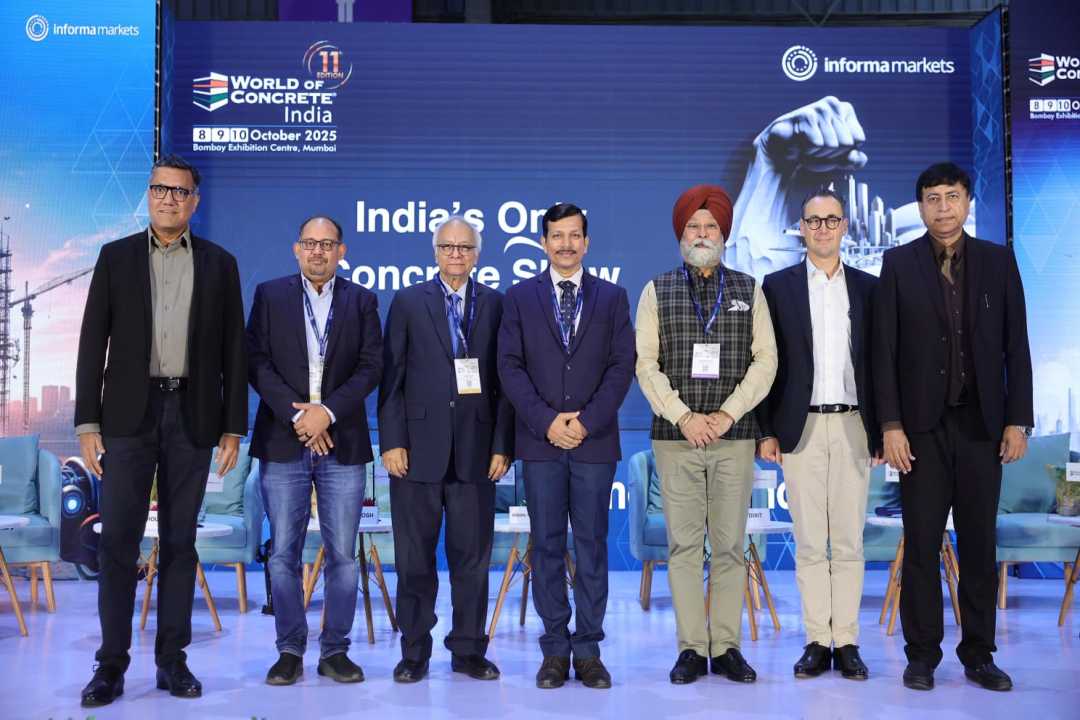
Prominent attendees included Dr Brijesh Dixit, Managing Director of the Maharashtra State Infrastructure Development Corporation; Amar Choudhary, CEO of 1Lattice; Thomas Guillot, CEO of the Global Cement and Concrete Association; and Somenath Ghosh, Vice President of the Consulting Engineers Association of India. Other notable participants included Rajendra Singh Kamboh, National President of the Builders Association of India; Dr Vishal Ramesh Thombare, Deputy Chief Engineer (Roads–Planning) at the Brihanmumbai Municipal Corporation (BMC); and Yogesh Mudras along with Rajneesh Khattar from Informa Markets in India.
During the sessions, speakers addressed the evolving priorities of India’s infrastructure sector and the growing need for collaboration across stakeholders. Dr Brijesh Dixit emphasized that concrete remains the backbone of modern infrastructure yet is often overlooked in discussions on innovation. He noted that greater awareness and dialogue among producers, engineers, and end-users are essential to enhance the material’s performance and ensure long-term sustainability.
Dr Dixit further underscored that as India undertakes rapid urbanization and industrial development, cross-sector cooperation will be key to building an economy that is both resilient and future-ready. He called for collective efforts to improve quality standards and strengthen technical knowledge across the construction ecosystem.
Dr Vishal Ramesh Thombare shed light on Mumbai’s large-scale efforts to upgrade its road infrastructure. He shared that out of the city’s 2,055-kilometre road network, over 1,200 kilometres have already been converted to concrete roads. The municipal body is prioritizing durable, lab-tested materials such as geopolymer concrete and ground granulated blast furnace slag (GGBS) to improve road longevity, particularly under the city’s heavy monsoon and traffic conditions.
From the perspective of engineering design and project execution, Somenath Ghosh of the Consulting Engineers Association of India highlighted the crucial contribution of consulting engineers to national development. He noted that the sector, valued between ₹80,000 and ₹90,000 crore annually, plays a central role in ensuring technical integrity, cost efficiency, and compliance across public and private projects. Continued engagement with government agencies, he said, is vital to sustaining progress and maintaining quality benchmarks.
Representing the construction community, Rajendra Singh Kamboh, President of the Builders Association of India, reaffirmed the importance of structured collaboration between industry and policymakers. With more than 240 branches nationwide, BAI works closely with both central and state governments. Kamboh emphasized that participation in platforms such as World of Concrete India helps align domestic construction methods with global best practices and fosters a culture of continuous learning.
Offering an industry outlook, Amar Choudhary, CEO of 1Lattice, spoke about the ongoing transformation driven by sustainability and technology. He cited innovations such as carbon capture, 3D printing, and artificial intelligence as emerging enablers in concrete production. With ready-mix concrete expected to account for nearly half of India’s total consumption within the next decade, he said, efficiency and low environmental impact will define the next wave of growth.
Yogesh Mudras, Managing Director of Informa Markets in India, observed that the cement and construction sectors are undergoing a structural shift as sustainability becomes central to industry goals. He shared that India’s green cement market, currently valued at around USD 2.3 billion, is projected to surpass USD 3.2 billion by 2029, reflecting strong demand for low-carbon alternatives. Rajneesh Khattar, Senior Group Director for Energy and Construction at Informa Markets, added that India’s infrastructure momentum—driven by projects like Metro Line 3 and Navi Mumbai Airport—is pushing the sector toward more resilient, resource-efficient, and inclusive growth.
According to a recent Moody’s report, cement demand in India is projected to rise from 445 million tonnes per year (MMTPA) in FY24 to 670 MMTPA by 2030, supported by the government’s investments in housing, transport, and industrial development. The exhibition also featured participation from key sector players such as Jindal Panther Cement & TMT Rebars, JSW Cement, UltraTech Cement, Godrej Construction, Sika India, Fosroc, Zydex, Chryso, Normet Chemicals, Q-Green Techcon, Appollo Infratech, and Neptune Industries, showcasing the depth and innovation driving India’s construction materials industry. Supporting associations include NAREDCO Maharashtra, Builders Association of India, RMCMA, Precast Manufacturers Association of India, Drycotec, Indian Concrete Institute (Pune Chapter), Ferrocement Society of India, and Architects, Engineers & Surveyors Association (AESA).