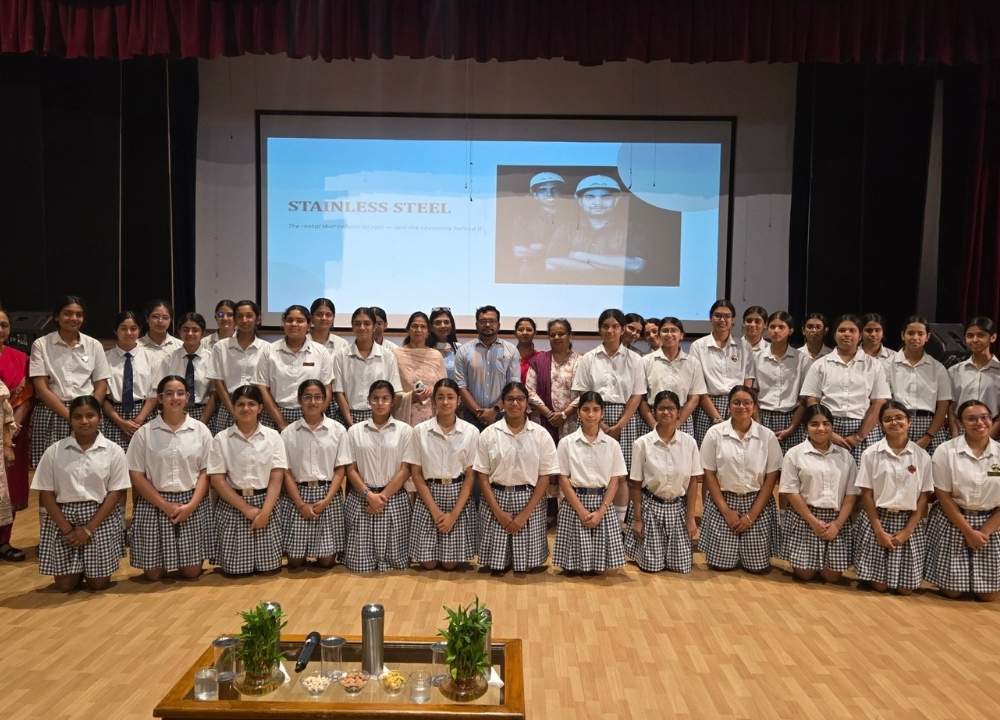
Vidya Devi Jindal School, in association with Jindal Stainless’ Hisar plant, organised an interactive session on stainless steel for students of Classes XI and XII Science. The session, titled ‘Stainless Steel – The Metal That Refuses to Rust and the Chemistry Behind It’, helped students understand how scientific concepts taught in classrooms are used in industrial manufacturing.
The session was led by Dr Arnab Kundu, Associate General Manager – Research & Development at Jindal Stainless. Drawing on his experience in industrial research and stainless steel production, Dr Kundu explained the science behind the material and its importance in everyday life.
Students learned about atomic structure, the periodic table, alloys, oxidation, corrosion and material properties. A key part of the discussion focused on how chromium is added to steel to make stainless steel. The chromium forms a thin protective oxide layer on the surface, helping the material resist corrosion and rust.
The session also introduced students to the four major types of stainless steel: austenitic, ferritic, martensitic and duplex. Dr Kundu explained how different grades are selected for specific applications across industries, including healthcare, railways, automobiles, architecture, food processing and chemicals.
Beyond the technical aspects, the programme gave students an opportunity to learn about careers linked to stainless steel manufacturing. The interaction highlighted how classroom knowledge can be applied in research, engineering, materials science and industrial production. Students actively participated in a question-and-answer session, discussing the manufacturing process, the properties of stainless steel, its applications and the role of research in developing materials for different industrial needs.
Naina Dhillon, Principal of Vidya Devi Jindal School, said the school aims to help students connect classroom learning with practical applications. She noted that direct interaction with industry professionals allows students to understand how scientific concepts are used in manufacturing and research. Such sessions also help them explore different academic and career opportunities.
The programme is part of the school’s efforts to provide practical learning experiences alongside regular classroom education. By bringing industry professionals into direct contact with students, the school aims to encourage curiosity, independent thinking and a better understanding of the industries related to their subjects.
Established in 1984, Vidya Devi Jindal School is an all-girls residential school located on a 47-acre campus in Hisar, Haryana. The school provides academic programmes, career counselling, sports and co-curricular activities, supported by modern infrastructure and technology-enabled learning.
Its student-focused approach combines academic development with character building, experiential learning, mental well-being and social responsibility. The school aims to prepare students with the knowledge and confidence needed for higher education and future careers.