The United Nations University Institute for Water, Environment and Health (UNU-INWEH) and Guglielmo Marconi University (UniMarconi) have signed a Memorandum of Understanding (MoU) to strengthen international cooperation in education, research and capacity development for sustainable food systems. The partnership will contribute to developing professional expertise in food logistics and supply chain management, with a particular focus on addressing challenges across Africa.
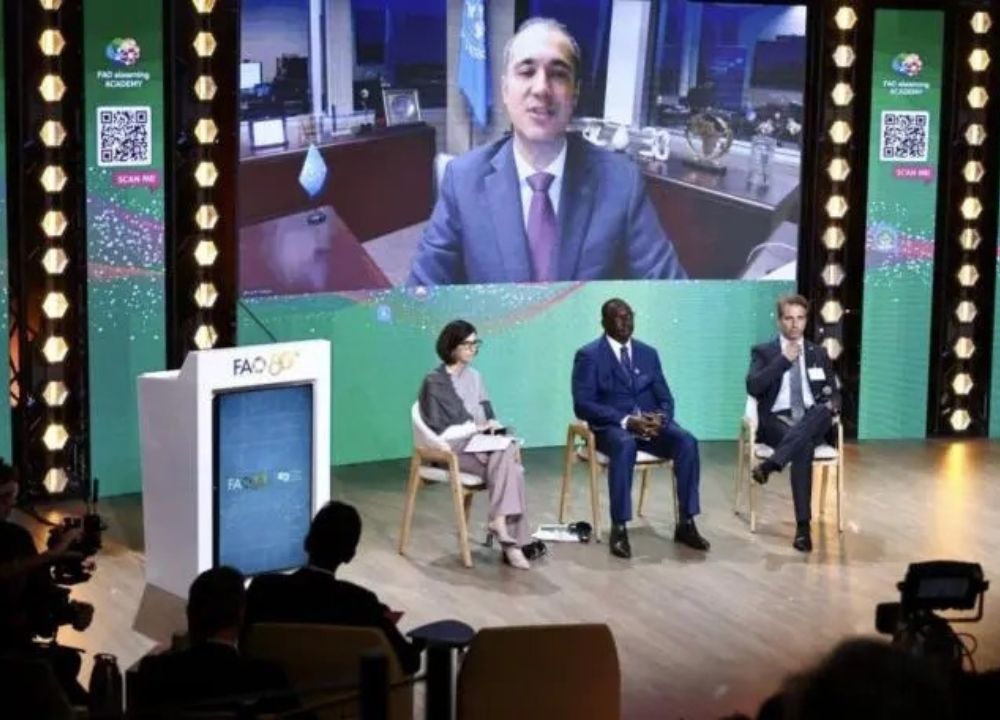
The agreement was signed by Professor Kaveh Madani, Director of UNU-INWEH, and Professor Marco Abate, Rector of UniMarconi. It was announced at a Food and Agriculture Organization of the United Nations (FAO) event in Rome commemorating the second anniversary of the FAO Four Betters Courses Initiative, held as part of the 2026 World Food Forum. The event highlighted the contribution of academic and research institutions to preparing future leaders to transform agrifood systems.
A key outcome of the collaboration will be the partners’ contribution, alongside FAO and the Pan African University, to a joint Master’s degree programme in Sustainable Food Logistics and Supply Chain Management. Building on courses offered through the FAO eLearning Academy, the programme aims to equip professionals with the knowledge and practical skills required to strengthen food supply chains, reduce post-harvest losses and improve food availability and distribution.
Professor Madani said strengthening food security requires scientific knowledge to be translated into practical solutions, alongside investment in the people who will shape future food systems. He highlighted the partnership’s combination of academic expertise, digital learning capabilities and international networks as an opportunity to expand access to quality education and build capacity for more sustainable and resilient agrifood systems, particularly in Africa.
Professor Abate described the agreement as an important step in UniMarconi’s international cooperation. He emphasised the value of universities and international organisations working together to connect research, academic knowledge and digital education with global challenges. The joint master’s programme will provide an initial practical outcome of this collaboration, addressing food security and sustainable food systems through specialised professional education.
Efficient storage, transportation and distribution are essential to reducing food losses and improving the resilience of agrifood systems. These challenges are particularly significant in regions where strengthening logistics infrastructure and supply chain capabilities can help improve access to food. Through joint academic initiatives and accessible digital learning, the partners intend to prepare professionals to address these issues and support sustainable development.
The MoU reflects the shared commitment of UNU-INWEH and UniMarconi to expanding educational opportunities, advancing international research cooperation and translating knowledge into practical solutions. Their collaboration with FAO and the Pan African University is intended to strengthen skills and institutional capacity for more effective, sustainable food supply chains.
The United Nations University Institute for Water, Environment and Health marks its 30th anniversary in 2026. One of the 13 institutions comprising the United Nations University, the institute addresses global water, environmental and health challenges through research, training, capacity development and knowledge dissemination. Headquartered in Richmond Hill, Ontario, it has been hosted and supported by the Government of Canada since 1996 and works with UN entities, governments and international organisations worldwide.
Università degli Studi Guglielmo Marconi is Italy’s first digital university. It combines academic rigour with innovative teaching methods and promotes access to knowledge through research, digital education and international cooperation. Its work focuses on academic quality, inclusion and developing skills to address social, economic and technological change, supported by scientific collaborations and engagement with business and professional communities.