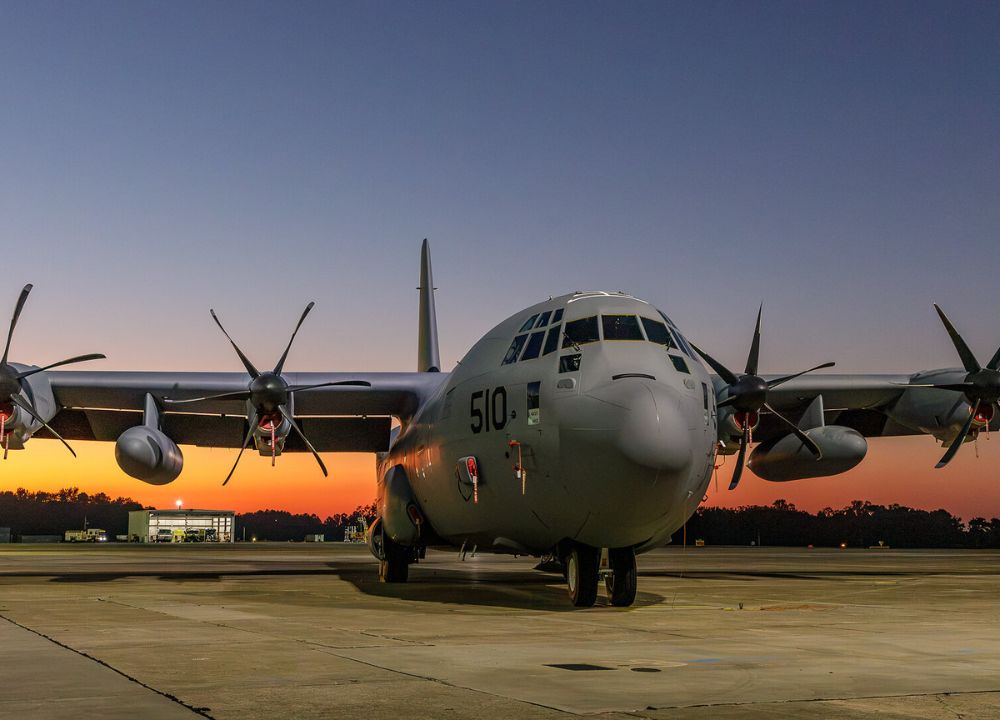
Lockheed Martin has delivered a C-130J-30 Super Hercules aircraft to the US Navy for conversion into the E-130J Phoenix II, the Navy’s next-generation platform for its Take Charge and Move Out (TACAMO) mission. The aircraft was handed over at Lockheed Martin’s facility in Marietta, Georgia.
The delivery marks the start of the aircraft’s transition into a specialised role supporting the US Navy’s airborne nuclear command-and-control communications mission. Following the handover, the aircraft will be transferred to Northrop Grumman, which will lead the integration of the mission systems required for the E-130J Phoenix II.
The C-130J-30 was selected as the platform for the mission because of its range, endurance, payload capacity and established operational record. The four-engine aircraft also features advanced avionics, increased power and improved fuel efficiency, supporting the requirements of long-duration strategic communications operations.
Trish Pagan, Vice President of Lockheed Martin’s Air Mobility & Maritime Missions, said the delivery was an important milestone for the US Navy and the country’s strategic communications network. She said the C-130J platform had continued to adapt to changing customer requirements while retaining the reliability associated with the Hercules aircraft family.
The programme also restores the link between the Navy’s TACAMO mission and the Hercules platform. The EC-130Q variant previously served in this role from 1963 to 1993, supporting airborne strategic communications for three decades. The new E-130J Phoenix II will build on that experience while incorporating updated avionics, communications equipment and survivability enhancements. These systems will be integrated after the aircraft’s transfer to Northrop Grumman, which is responsible for converting the C-130J-30 into the operational mission platform.
US Navy Captain Roger Davis, programme manager for Airborne Strategic Command, Control and Communications (PMA-271), said acceptance of the first C-130J-30 marked a new phase in the programme. He said the aircraft provided the structural and performance foundation needed as the Navy moves into mission-systems integration.
The C-130J Super Hercules is the latest generation of the C-130 Hercules family. It supports more than 20 mission types, including airdrop, search and rescue, firefighting, medical evacuation, intelligence, surveillance and reconnaissance, and special operations. Lockheed Martin said the global C-130J fleet comprises more than 570 aircraft. The platform continues to serve military and other operators in air mobility roles worldwide.
The conversion programme will equip the aircraft for the Navy’s specialised TACAMO requirements, with further work focused on integrating the communications and other mission systems needed before the E-130J Phoenix II enters service. Lockheed Martin is a global defence technology company operating across aerospace, defence and security markets. Its portfolio includes aircraft, missile systems, space systems and integrated mission technologies.