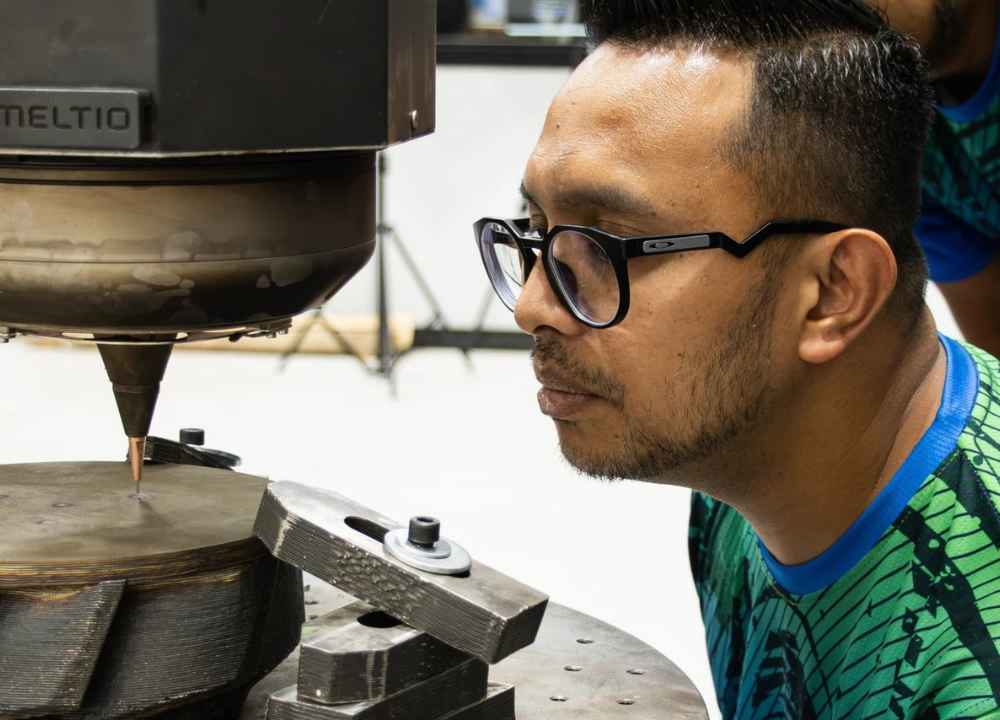
TNB Remaco, a service provider supporting critical equipment in the power generation and Oil & Gas industries, has successfully manufactured an open impeller using metal additive manufacturing technology. The project involved reverse-engineering the component, producing it in stainless steel 316L using Meltio’s wire-laser metal deposition process and completing the final machining through CNC equipment.
The initiative is part of TNB Remaco’s efforts to develop additional manufacturing solutions for low-volume, high-value and time-critical industrial spare parts. The company aims to reduce dependence on conventional manufacturing routes, particularly when replacement components are difficult to source or require long production lead times.
In power generation and Oil & Gas facilities, the failure of critical components such as pump and compressor impellers can lead to equipment downtime and production losses. Conventional replacement methods often involve sourcing parts from original equipment manufacturers or manufacturing new components through casting and CNC machining.
For the impeller selected for this project, TNB Remaco’s conventional manufacturing process required approximately one month for material sourcing and another month for machining, resulting in a total lead time of around two months. To explore an alternative, the company reverse-engineered the open impeller and produced a near-net-shape component using Meltio’s wire-laser metal deposition technology. The component was subsequently finish-machined using CNC equipment to achieve the required dimensions and surface quality. The finished impeller weighs approximately 11 kg.
The process combines additive manufacturing with conventional machining, allowing material to be deposited close to the required final shape before precision finishing. TNB Remaco is also implementing a Meltio Robot Cell to expand its manufacturing capabilities. The robotic system will support different deposition strategies and future applications involving component repair and metal cladding.
The technology uses welding wire instead of metal powder, making it suitable for integration with the company’s existing welding and fabrication operations. The manufactured impeller is currently undergoing further qualification. Penetrant inspection is planned to identify surface-breaking defects, while mechanical property testing will establish the material performance before the component is considered for service.
TNB Remaco intends to extend this capability across the power generation, Oil & Gas, petrochemical, marine and heavy engineering sectors. Its broader approach combines reverse engineering, 3D scanning, additive manufacturing, CNC machining, metallurgy and inspection to identify the most suitable production or repair method for each component. The company aims to build an in-house manufacturing capability that can help industrial operators address spare-part availability challenges and respond more quickly to equipment maintenance requirements.