Pelf Infotech, in partnership with Artec 3D, has launched the Artec Jet reality capture platform in India, marking the debut of an advanced SLAM-based LiDAR solution aimed at accelerating industrial digitisation, smart manufacturing, and digital twin adoption across engineering and infrastructure sectors. The launch comes at a time when industries across manufacturing, utilities, mining, engineering, and infrastructure are increasing investments in automation, predictive maintenance, and intelligent operational systems supported by real-time spatial data.
Artec Jet has been developed as a large-scale reality capture platform capable of rapidly scanning and mapping industrial facilities, engineering assets, utilities infrastructure, mining environments, and complex operational sites. The platform enables organisations to create accurate digital environments supporting inspection, monitoring, maintenance planning, documentation, and operational analytics.
Built on Simultaneous Localization and Mapping (SLAM) technology, the system allows real-time mapping and spatial intelligence generation without depending on GPS signals or fixed reference targets. According to the companies, this enables efficient deployment across indoor, underground, hazardous, and difficult-to-access industrial environments. The platform supports multiple deployment formats including handheld mobile systems, drone-assisted inspections, and autonomous robotic workflows, providing flexibility across varied industrial use cases.
Speaking at the launch event, Ajinkya Huddar, CEO and Managing Director of PELF Group of Companies, said industrial transformation is increasingly dependent on scalable and accurate spatial intelligence systems capable of supporting integrated digital infrastructure and operational decision-making.
He noted that enterprises are moving towards connected digital ecosystems where large-scale reality capture technologies form the foundation for industrial automation, predictive maintenance, and digital twin development.
Andrew Varlamov, Sales Channel Director – EMEA Region at Artec 3D, said industrial sectors globally are shifting toward continuously updated digital environments where real-time spatial intelligence becomes central to operational efficiency and asset management. He stated that India is emerging as one of the fastest-growing markets for industrial digitisation and advanced engineering technologies, making it a strategic market for deployment of next-generation reality capture platforms.
Denis Baev, Customer Experience Manager at Artec 3D, added that industrial organisations are increasingly seeking interoperable digital environments where spatial data becomes an integrated component of ongoing operational intelligence rather than serving only documentation purposes.
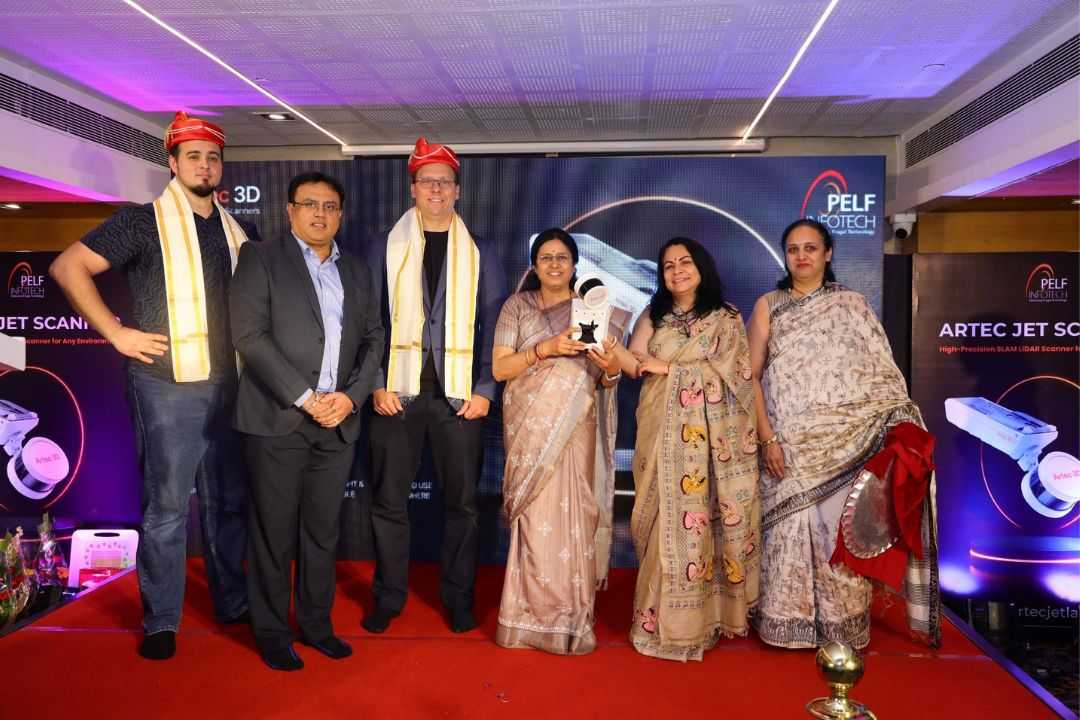
The technology platform was formally unveiled during a technology event held in Pune attended by Medha Kulkarni, cultural researcher and Temple and Murti Shastra expert Shefali Vaidya, along with engineers, geospatial specialists, industrial leaders, and technology professionals.
Pelf Infotech, headquartered in Pune, focuses on advanced 3D scanning, industrial digitisation, and reality capture solutions serving sectors including manufacturing, engineering, industrial inspection, infrastructure, and heritage preservation. Luxembourg-based Artec 3D develops professional 3D scanning hardware and software solutions used globally across industries including aerospace, manufacturing, healthcare, design, engineering, and infrastructure management.
Industry analysts note that adoption of digital twin ecosystems and industrial spatial intelligence platforms is accelerating globally as enterprises seek greater operational visibility, predictive analytics capabilities, and automation-driven efficiency improvements. The introduction of Artec Jet in India is expected to support broader adoption of advanced industrial digitisation technologies across the country’s expanding manufacturing and infrastructure sectors.