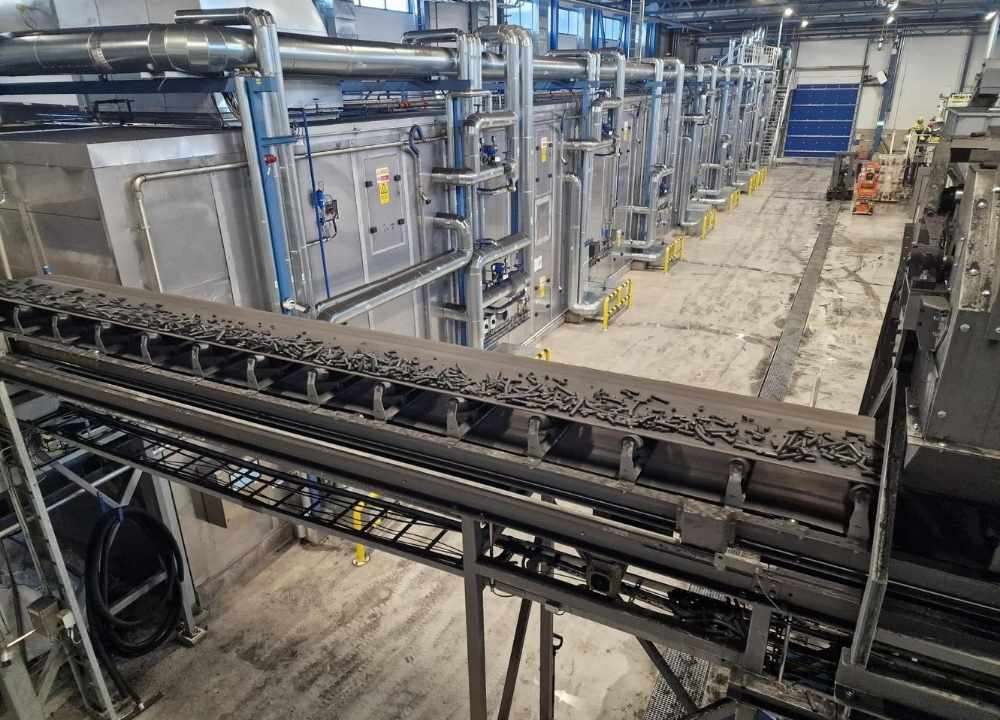
Outokumpu has inaugurated a new agglomeration plant for biocoke at its Tornio production site in Finland, marking a major step in the company’s efforts to reduce carbon emissions from ferrochrome production and advance lower-carbon stainless steel manufacturing. The approximately €30 million investment enables Outokumpu to replace fossil-based coke with biomass-derived biocoke in its ferrochrome production process. The new facility converts biochar into biocoke, which can then be used as a reducing agent in ferrochrome production.
When operating at full capacity, the plant has the potential to reduce Outokumpu’s carbon dioxide emissions by up to 82,000 tonnes annually. The company said this is equivalent to the annual emissions of around 8,000 people in Finland. The investment forms part of Outokumpu’s wider sustainability strategy and supports its target of reducing carbon dioxide emissions across its value chain by 42% by 2030, compared with the 2016 baseline.
Juha Erkkilä, Head of Outokumpu EvoCarbon, said the new facility represents a practical step in reducing the climate impact of the company’s operations. He added that biocoke production has already begun in Tornio, with the material being produced for both Outokumpu’s own operations and external customers.
The biocoke project is expected to play an important role in reducing the direct emissions associated with ferrochrome production. Ferrochrome is a key raw material in stainless steel manufacturing, and reducing emissions from its production can contribute significantly to lowering the overall carbon footprint of stainless steel.
Outokumpu’s Tornio site operates as an integrated stainless steel production complex, covering several stages of the production process. The new agglomeration plant adds another element to the company’s efforts to improve the environmental performance of its operations.
The company said the facility will also strengthen its capabilities in developing and supplying lower-carbon materials for industrial customers. Increasing the use of biomass-based alternatives to fossil fuels is one of the measures being pursued as the steel industry works to reduce its environmental impact. Outokumpu’s ferrochrome already has a carbon footprint that is 67% lower than the industry average, according to the company. The new biocoke facility is expected to further improve the emissions profile of its production operations.
The investment also supports Outokumpu’s broader ambition to maintain its position as a sustainability-focused stainless steel producer. The company is working on measures across its operations and value chain to reduce emissions while maintaining product quality and production efficiency.
With biocoke production now underway in Tornio, Outokumpu expects the new facility to provide a scalable solution for reducing the use of fossil coke in ferrochrome manufacturing. The project demonstrates the company’s approach of combining new technologies, alternative raw materials and existing production infrastructure to reduce emissions from energy-intensive industrial processes. The Tornio plant is expected to remain an important part of Outokumpu’s efforts to develop more sustainable stainless steel and ferrochrome production.