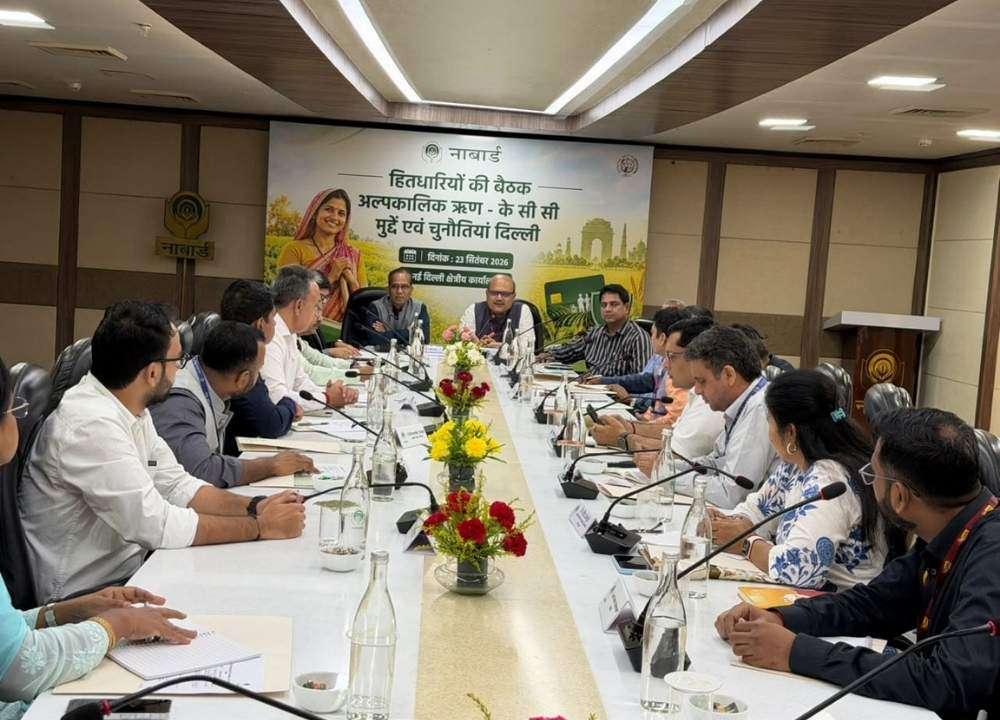
NABARD’s New Delhi Regional Office organised a stakeholder meeting on issues and challenges in the issuance of Kisan Credit Cards (KCC) in Delhi. The meeting was held at NABARD Tower, Rajendra Place, and brought together officials from government departments, banks, RBI, NABARD and other institutions to discuss ways to improve access to agricultural credit.
The meeting was attended by D Sahoo, General Manager and Convener, State Level Bankers’ Committee (SLBC); Dr S Shanmuguvel, Director, Animal Husbandry Department, Government of NCT of Delhi; Dr Ubaid Khan, Deputy Director, Agriculture Department, Government of NCT of Delhi; Tushar Jadhav, Deputy General Manager, Reserve Bank of India; Dr Ritu Singh, Subject Matter Specialist, KVK Ujwa, along with officials from banks, Government of NCT of Delhi, Lead District Managers, RBI’s Lead District Officers and NABARD’s District Development Managers.
Delivering the keynote address, Nabin Kumar Roy, Chief General Manager, NABARD, said improving farmers’ access to KCC remains a priority. He called for closer coordination among government departments, banks, cooperatives and development institutions to address issues faced by farmers at the field level. He stressed the need for practical solutions to ensure eligible farmers receive timely and affordable agricultural credit.
The Director, Animal Husbandry Department, urged banks to extend credit facilities to cattle owners in Delhi and invited banks to visit dairy colonies to understand their credit requirements. The Joint Director, Agriculture Department, informed participants that Delhi has around 20,000 landowners cultivating nearly 28,000 hectares of net sown area, while KCC coverage remains limited.
D Sahoo, General Manager and Convener, SLBC, assured participants that issues related to KCC coverage would be taken up at the forthcoming SLBC meeting for further discussion and follow-up. During the meeting, stakeholders discussed several issues affecting KCC issuance. These included gaps in girdawari records, unclear cultivation rights, fragmented landholdings, incomplete mutation processes, lack of proper land demarcation and oral lease arrangements.
The meeting also discussed alternative credit delivery models for tenant farmers, oral lessees, sharecroppers and farmers organised through Self-Help Groups (SHGs) and Joint Liability Groups (JLGs). Participants examined ways to improve access to institutional credit for farmers who may not have conventional land ownership documents.
KCCfacilities to animal husbandry and fisheries activities by the RBI from July 2026 was also discussed. Stakeholders highlighted the need to create greater awareness about these provisions and ensure smooth implementation through documentation support and credit facilitation camps. The meeting concluded with a focus on coordinated action among banks, government departments and development institutions to address field-level challenges and strengthen the flow of short-term agricultural and allied sector credit in the National Capital Territory of Delhi.