

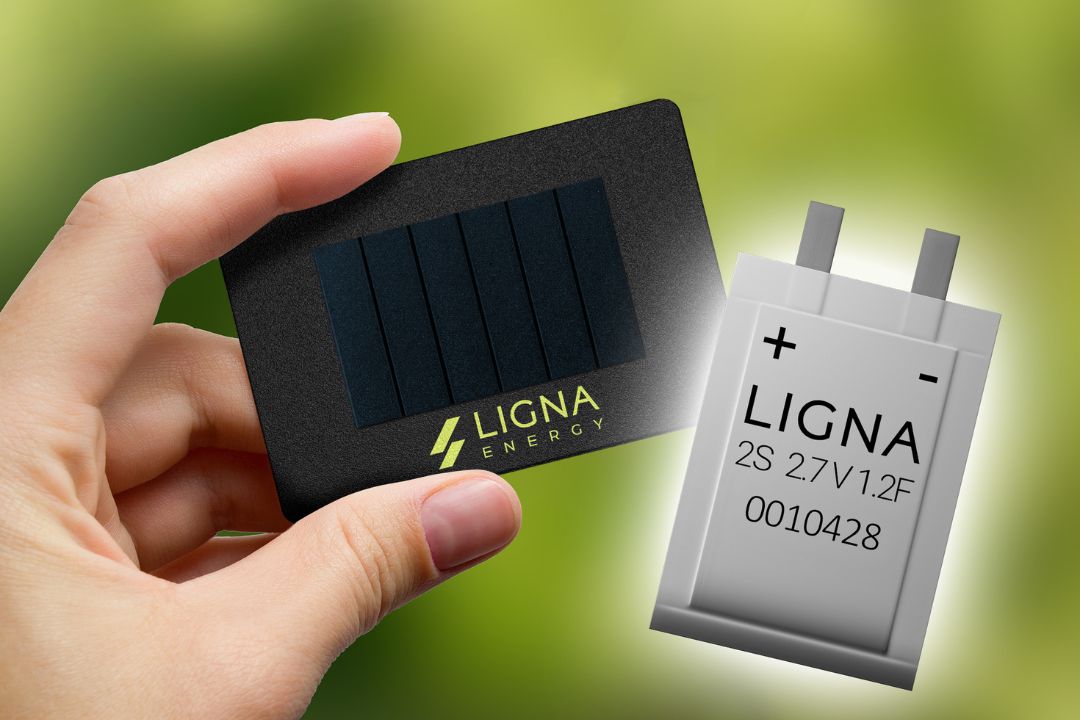
Ligna Energy, a developer of ultra-thin supercapacitors for wireless electronics, will participate in Embedded World 2026 in Nuremberg, Germany, where the company will present energy solutions designed to support smaller, more efficient and sustainable connected devices. At the exhibition, Ligna Energy will demonstrate energy storage technologies aimed at enabling battery-free indoor sensors and compact device designs. Visitors can meet the company and its ecosystem partners at Hall 2, Booth 2-230, where integrated Internet of Things (IoT) system components—including sensing, wireless communication, energy harvesting and power management—will be showcased.
The company’s demonstrations focus on enabling new design approaches for connected devices, particularly in applications ranging from smart cards to smart building infrastructure. Ligna Energy is exploring how the same design principles used in smart cards—thin form factors, minimal materials and efficient energy usage—can be applied to modern indoor sensors.
John Söderström, Marketing Director at Ligna Energy, said one of the most significant challenges in large-scale sensor deployments is the cost and maintenance associated with battery replacement. Routine battery changes increase operational costs, generate electronic waste and require service visits that can disrupt building operations. According to Söderström, the technologies presented at Embedded World aim to support scalable deployments by removing these limitations.
Among the highlights at the exhibition is “Gwen,” a battery-free indoor climate sensor reference design created by Ligna Energy. The concept demonstrates how compact IoT devices can operate without traditional batteries while maintaining reliable performance.
Gwen harvests energy from ambient sources and stores it using Ligna Energy’s S-Power 2S supercapacitor. The sensor measures temperature and humidity and transmits data through Bluetooth Low Energy connectivity. By eliminating conventional batteries, the design supports maintenance-free operation and enables sensors to be placed in locations where larger devices would be impractical.
The reference design also explores how ultra-thin energy storage can enable new device form factors suitable for applications such as indoor monitoring and asset tracking. Rather than offering a standardised sensor product, Ligna Energy intends the design to serve as a platform that original equipment manufacturers and technology providers can adapt to their own products.
Mr Söderström added that battery-free sensors can simplify device lifecycle management. Removing batteries reduces waste and makes end-of-life processing easier by eliminating the need for battery removal and specialised disposal.
Ligna Energy also highlighted its sustainability initiatives. The company has published Environmental Product Declaration (EPD) and Life Cycle Assessment (LCA) data for its S-Power supercapacitors, reporting a cradle-to-gate carbon footprint of 12 grams of CO₂ equivalent per unit. The verified data supports transparent environmental reporting for device manufacturers and system integrators.
Ligna Energy develops sustainable energy storage solutions based on bio-based materials. The company’s supercapacitor technology provides a safe and environmentally responsible alternative to conventional batteries for wireless electronic devices and connected systems.









