

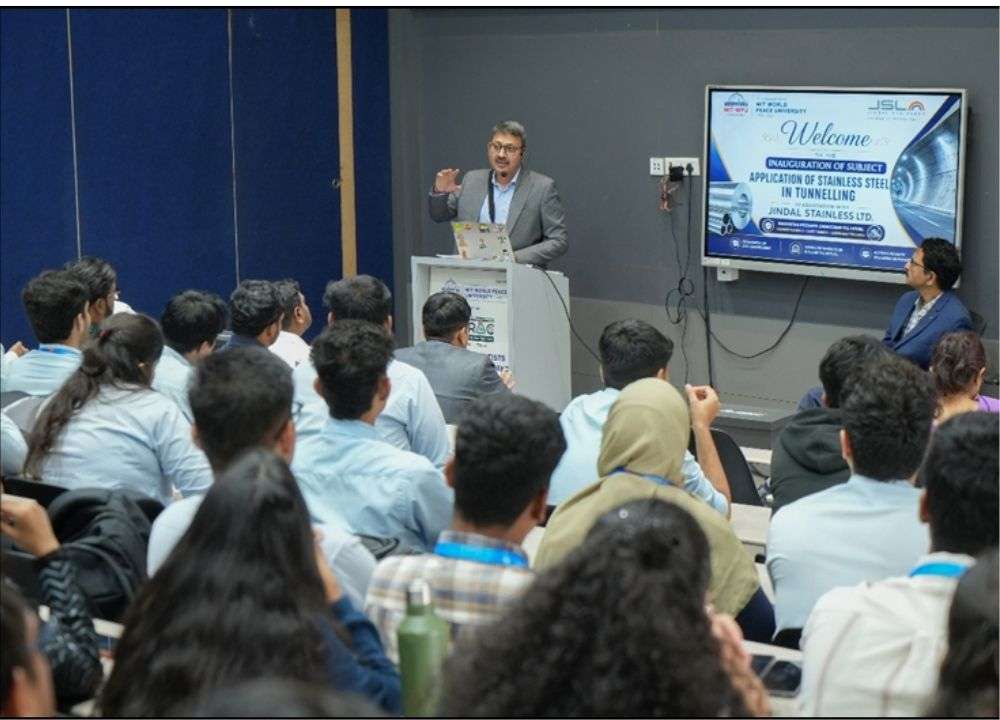
Jindal Stainless has signed a Memorandum of Understanding (MoU) with MIT World Peace University (MIT-WPU), Pune, to launch a specialised course on stainless steel applications in tunnel and underground construction. Titled ‘Stainless Steel: A Sustainable, Green & Innovative Material for Tunnel and Underground Space Construction’, the programme will provide engineering students with practical knowledge of stainless steel, corrosion resistance, material selection and sustainable construction practices.
The initiative comes as India expands investments in metro rail, highways, railways, hydropower and pumped storage projects. With underground infrastructure increasingly exposed to groundwater, humidity and corrosive conditions, the demand for durable materials and engineers with specialised knowledge is expected to grow.
The first batch of the programme has commenced, with 25 students currently enrolled. The three-year agreement between Jindal Stainless and MIT-WPU will cover joint administration, delivery and continuous improvement of the course. Jindal Stainless will support curriculum development and provide technical experts for lectures and practical sessions. Students will also receive opportunities for plant visits, internships, live case studies, research projects and interactions with industry professionals.
The 40-lecture programme will include eight practical sessions and cover metallurgy, corrosion behaviour, stainless steel grade selection, design applications, fabrication, welding, lifecycle costing and sustainability. Six faculty members and industry experts will deliver the programme.
Tarun Khulbe, Chief Executive Officer, Jindal Stainless, said the company believes that India’s infrastructure development must be supported by future-ready engineering talent. He said stronger collaboration between industry and academia can help develop engineers with practical skills needed for the country’s long-term infrastructure requirements.
Deepak Agrawal, Unit Head – Jajpur, Jindal Stainless, said the course would provide students with practical understanding of advanced and sustainable materials and their applications in tunnel engineering. He added that combining academic learning with industry experience would help create skilled professionals for India’s expanding underground infrastructure sector.
Dr Sandeep Potnis, Professor and Tunnel Engineering Program Head, MIT-WPU, said India’s rapidly expanding underground infrastructure requires engineers trained in advanced materials and lifecycle-based design. He added that the partnership would give students greater exposure to real-world tunnel and underground construction requirements.
As part of the initiative, four MIT-WPU faculty members recently visited Jindal Stainless’ Jajpur plant. The visit covered stainless steel manufacturing, metallurgy, alloying, automation, quality control and corrosion-resistant applications. The experience will be used to bring practical industry examples into classroom teaching. With tunnel projects worth more than ₹5 lakh crore expected over the next decade, the collaboration aims to develop technical expertise in materials that can improve the durability and service life of underground infrastructure.
Founded in 1970, Jindal Stainless is one of India’s major stainless steel manufacturers, with an annual melt capacity of 4.2 million tonnes and manufacturing and processing facilities in India and overseas. The company supplies products including slabs, blooms, coils, plates, sheets, precision strips, wire rods, rebars, blade steel and coin blanks.








