

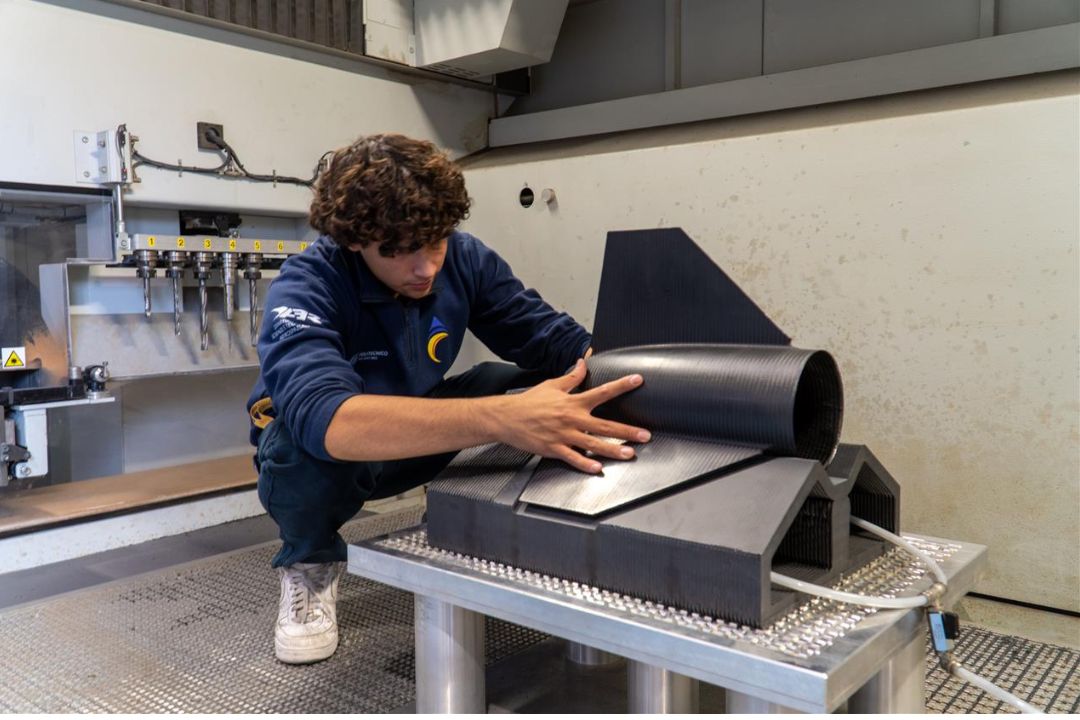
At JEC World 2026, a major global event dedicated to composite materials and advanced manufacturing, Ingersoll Machine Tools will highlight how additive manufacturing is shaping the future of aerospace research. The company will present a collaboration that bridges academic innovation and industrial expertise, featuring the Orion rocket developed by Skyward Experimental Rocketry at Politecnico di Milano and a large-format 3D-printed trim and drill tool produced by the Camozzi Research Center.
The exhibit demonstrates how cutting-edge manufacturing technologies are accelerating experimentation and development in the aerospace sector. By combining advanced engineering with large-scale additive manufacturing, the collaboration reflects a growing trend in which universities and industry partners work together to explore new design possibilities and improve production methods.
A central attraction of the showcase is the Orion rocket, the fifth vehicle developed under Skyward Experimental Rocketry’s Constellation Program. The rocket has been designed as part of the team’s participation in the European Rocketry Challenge (EuRoC) 2025, one of the most competitive student rocket engineering contests in Europe. Orion represents a significant step forward for the student team, integrating new aerodynamic and structural improvements while maintaining a focus on efficient propulsion and performance.
The rocket is powered by a hybrid propulsion system engineered entirely by the Skyward students. Hybrid motors combine the stability of solid fuels with the controllability of liquid oxidizers, making them attractive for experimental rocket development and testing. Through this design, the team aims to achieve optimal thrust while maintaining operational safety and flexibility during flight.
One of Orion’s most notable upgrades is its redesigned tail section. Engineers within the student team refined the geometry of the rocket’s aft structure to reduce drag and enhance aerodynamic stability. This improvement allows the vehicle to reach its target altitude more efficiently and potentially with lower thrust requirements compared with previous iterations. The design changes reflect months of aerodynamic analysis, simulation, and iterative testing conducted by the students.
Another distinctive feature of Orion is its visual design. The new exterior livery, created by members of the Skyward team, deliberately exposes the rocket’s carbon-fiber structure. Rather than concealing the materials used in construction, the design celebrates the advanced manufacturing techniques behind the vehicle’s development. The exposed carbon surfaces highlight the precision and strength of the composite structure while providing a distinctive aesthetic identity for the rocket.
Complementing the Orion rocket display is the trim and drill tool manufactured by the Camozzi Research Center using large-format additive manufacturing. The component demonstrates how 3D printing technologies can be applied to produce industrial tools with complex geometries and optimized material usage. Large-format additive manufacturing allows engineers to fabricate functional components quickly while reducing waste and production time compared with traditional machining processes.
The tool displayed at the booth illustrates how additive manufacturing can support aerospace manufacturing workflows, particularly in the production of tooling and customized equipment. By producing specialized tools through additive methods, manufacturers can rapidly adapt designs, test new configurations, and reduce lead times for complex projects.
Together, the Orion rocket and the additive-manufactured tool present a clear example of how collaboration between research institutions and industrial partners can accelerate technological progress. The partnership between Skyward Experimental Rocketry, Politecnico di Milano, Ingersoll Machine Tools, and the Camozzi Research Center demonstrates how engineering creativity and advanced manufacturing capabilities can intersect to produce innovative solutions.
Visitors to the Ingersoll booth at JEC World 2026 will have the opportunity to explore both projects up close and learn more about the technologies and research behind them. The display reflects the growing role of additive manufacturing in aerospace engineering and highlights how emerging engineers and established industry leaders are working together to expand the boundaries of design and production.








