

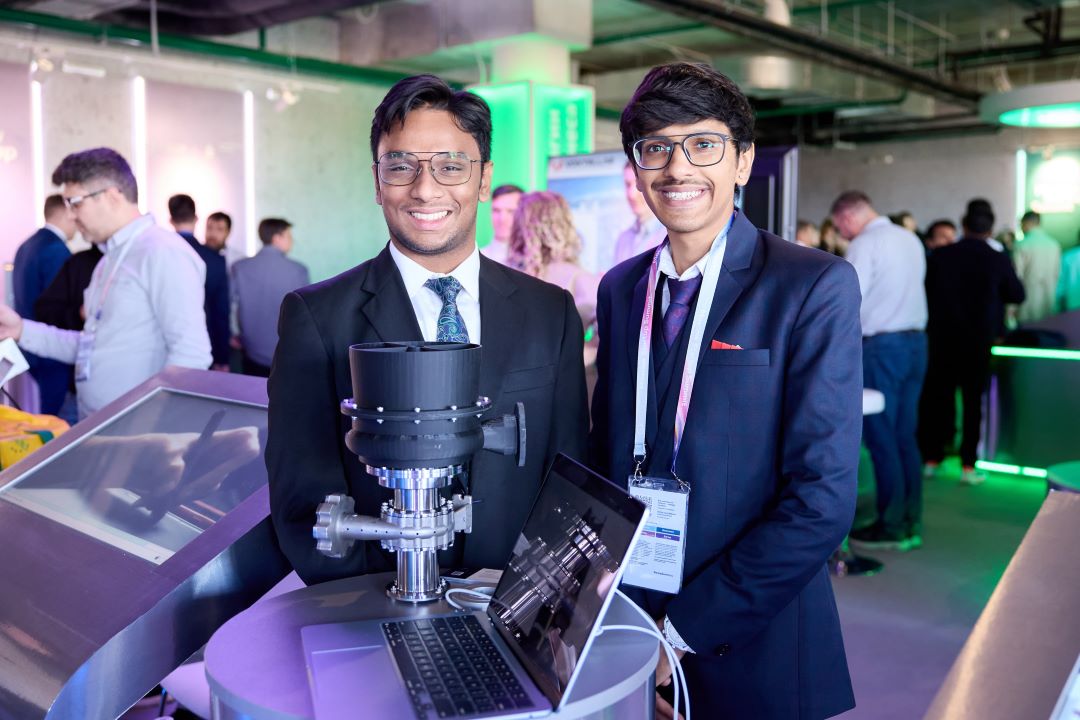
Astrophel Aerospace, a Pune-based deep-tech space startup developing reusable launch vehicles and cryogenic propulsion systems, unveiled its indigenously designed cryogenic pump at the BRICS Startup Summit in Moscow, Russia. The company’s co-founders, Suyash Bafna and Immanuel Louis, engaged with potential investors and international collaborators to explore export opportunities across BRICS markets and beyond.
Currently undergoing validation and certification at ISRO, the cryogenic pump marks a pivotal milestone in strengthening India’s private space manufacturing ecosystem. Once certified, Astrophel will become the first Indian startup to receive ISRO approval for cryogenic hardware usable in both rocket engines and industrial cryogenic systems across the oil & gas, energy, and medical sectors.
“We’re building dual-use cryogenic systems that not only power our reusable rockets but also have global industrial relevance,” said Suyash Bafna, Co-founder and CEO of Astrophel Aerospace. “Our engineering precision and design efficiency enable us to contribute to India’s high-value export ecosystem.”
Astrophel’s 25,000 RPM cryogenic pump is designed to evolve into a turbo pump—critical hardware for cost-efficient, reusable orbital launches. Distinct from many pre-revenue space ventures, Astrophel follows a capital-efficient growth model, initially focusing on component commercialisation to establish a strong, export-oriented supply chain.
“We’re prioritising the market readiness of certified subsystems essential for orbital launches. This approach allows us to scale sustainably while validating our technology through global collaborations,” added Immanuel Louis, Co-founder and COO.
The company has also drawn early interest from ISRO for its indigenous cryogenic valves, which are now under testing for potential procurement. These valves, developed in partnership with a Pune-based listed manufacturer, are key components in Astrophel’s propulsion systems. With precision up to 0.1 mm, the valves enable highly accurate control of cryogenic fluid flow, can handle pressures above 150 bar, and deliver five times the cost efficiency of imported alternatives.
As BRICS nations ramp up investments in indigenous space and cryogenic infrastructure, Astrophel aims to position India as a global supplier of affordable cryogenic systems by 2030.
The global cryogenic valve market, valued at nearly USD 4 billion in 2024, is projected to reach USD 10 billion by 2032, growing at a CAGR of 8–10%. With Asia-Pacific leading this growth driven by space, hydrogen, and LNG applications, Astrophel’s focus on precision-engineered, “Made in India” cryogenic components positions it strongly within this rapidly expanding market.
Astrophel Aerospace is an Indian deep-tech space startup developing affordable launch vehicles for small satellites powered by semi-cryogenic propulsion systems. Its flagship Astra C1 series and Potentia engine have positioned it among the few Indian private firms to have independently developed and test-fired a semi-cryogenic engine on 15 August 2023, without external funding.
By combining automotive manufacturing best practices with 3D printing, Astrophel reduces production costs and lead times by up to 40%, making it one of the most accessible launch providers in its category. The company has developed in-house capabilities spanning throttleable valves, regenerative nozzle design, cryogenic subsystems, and real-time avionics software.
Astrophel plans to conduct full orbital missions using reusable launchers from Indian launchpads, tapping into the nation’s USD 44 billion space economy projected by 2033. Its advisory board includes propulsion experts from ISRO, HAL, and DRDO, providing strategic guidance and technical oversight.








