

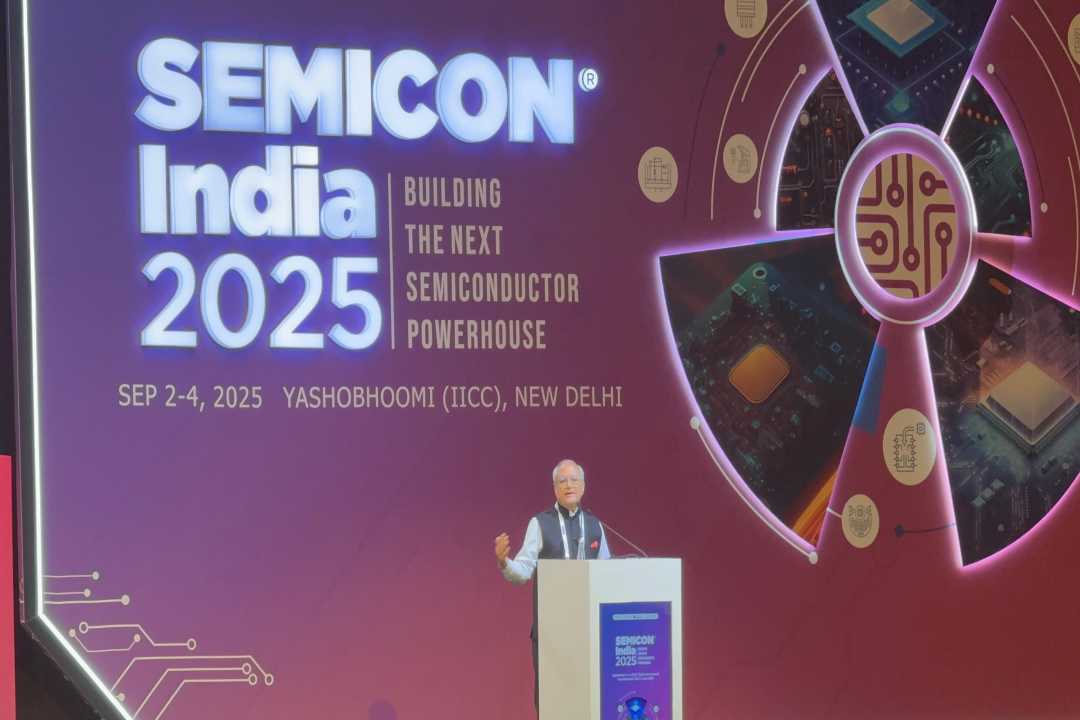
At Semicon India 2025, renowned technologist and EPIC Foundation founder Ajai Chowdhry called for an urgent national push to transition from a service-led economy to one that builds globally competitive technology products. Speaking on the panel “Making India a Product Nation,” Mr Chowdhry stressed the need to harness India’s vast design capabilities and focus on developing a complete ecosystem — from system-level innovation to chip design, manufacturing, and packaging.
Mr Chowdhry argued that while India has excelled in software and design services, it must now focus on creating intellectual property and high-value products to ensure long-term economic and strategic growth. “India holds nearly 20% of the world’s design talent, but we’re mostly designing for others. It’s time we build for ourselves and for the world,” he said.
Adding a significant milestone to the conversation, Sahasra Electronics showcased India’s first indigenously manufactured LED Driver IC and Micro SD memory card, both now in mass production. Developed under the ATMP (Assembly, Testing, Marking, and Packaging) process in India, the products mark a turning point for India’s semiconductor industry. With over 1 million chips shipped, Sahasra becomes the first Indian company to reach this production scale.
These achievements trace back to the vision of the EPIC Foundation, which identified the LED driver project as a priority under its roadmap. The initiative also benefited from the M-SIPS scheme introduced by the Ministry of Electronics and IT (MeitY) in 2012 to boost large-scale electronics manufacturing in the country.
Formed three years ago by two HCL co-founders, the EPIC Foundation was created to champion India’s emergence as a global electronics and semiconductor powerhouse. Under the guidance of Hon Minister Ashwini Vaishnaw and scientific leadership from Prof Ajay Sood, a national task force was created to set bold targets: 30 homegrown systems and 30 chip products to energize the ecosystem.
Mr Chowdhry, a long-standing advocate for building a robust IP and product infrastructure in India, emphasized the need for a full-stack approach — from systems to silicon. “We must not stop at design; we need to build and scale complete systems using Indian chips. That’s how we capture value and ensure digital sovereignty.”
He also pointed to early successes from the DLI (Design Linked Incentive) scheme, with startups like Mindrove Technologies, Incore Semiconductors, Sankhya Labs, Morphing Machines, and Netra Semi all making strides in developing high-performance chips and electronics. Crucially, Mr Chowdhry called for greater government participation to nurture and sustain this momentum.
Drawing parallels to the DARPA model in the US, he urged Indian policymakers to set up challenge-driven procurement programs that fund domestic startups and ensure market access. “When governments become the first customer, it drives innovation and creates a complete cycle of R&D, production, and growth,” he noted.
He also warned about the strategic implications of relying on foreign chips “If a Chinese chip is embedded in an Indian product, all the data can flow back to China. For national security and economic resilience, India must own the silicon inside its systems.”
With strong industry momentum, government backing, and a growing ecosystem of capable startups, Mr Chowdhry concluded with a clear call: “The time for India to become a product nation is now. The foundation is set — now we need scale, ambition, and action.”









