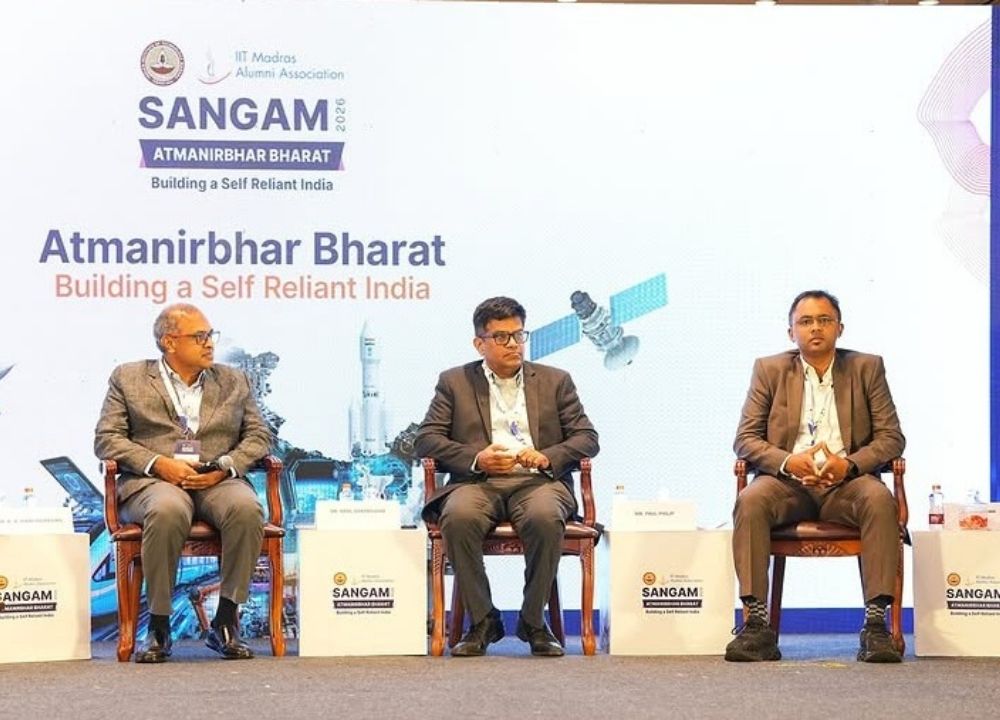
IITMAA Sangam 2026 brought together leaders from government, industry, defence, healthcare, space technology and academia to discuss how collaboration and indigenous innovation can support India’s technology and economic growth. The event highlighted the need to strengthen partnerships between educational institutions, businesses, government agencies and researchers to turn new ideas into practical solutions. Discussions covered renewable energy, defence technology, deep-tech startups, satellite systems, healthcare and financial services.
U-Solar Clean Energy participated in the event, where its Founder and CEO,KR Harinarayan, joined a panel discussion titled “The Solar RE-volution: Powering India’s Sustainable Growth.” The discussion focused on renewable energy, storage solutions and new business models for meeting India’s energy needs.
With nearly 15 years of experience, U-Solar has expanded from rooftop solar installations into ground-mounted and floating solar projects. The company has completed more than 300 MW of projects, with another 200 MW under execution. Its turnover has grown from around ₹425 crore last year to more than ₹1,000 crore this year. The company now combines renewable energy solutions, technology and financial planning to meet customers’ energy requirements.
Defence technology was another key area of discussion. Chief of Defence Staff General NSRaja Subramani stressed the importance of technological self-reliance and closer cooperation between the armed forces, industry and academia. He said control over technology, software and supply chains was essential for national security and modern warfare.
The space technology sector also featured prominently. Pranit Mehta, Co-founder and COO of GalaxEye, discussed the importance of indigenous satellite capabilities. GalaxEye is developing OptoSAR technology, which combines synthetic aperture radar and optical imaging to capture Earth observation data across different weather and lighting conditions. The company has received ₹63.84 crore in government research, development and innovation support for its next-generation satellite.
The event also highlighted the growth of India’s deep-tech startup ecosystem. Amrutash Misra, Co-founder of CoreVoice, said India had more than 4,200 deep-tech startups, including over 550 established in 2025. He emphasised the importance of communicating complex technologies clearly to customers and international markets.
Healthcare discussions focused on applying artificial intelligence to improve patient outcomes. Dr Abhishek Puri, Consultant Radiation Oncologist at Fortis Hospital Mohali and Founder of Agravaani Research, highlighted the role of specialised AI models, clinical data and collaboration between doctors and engineers in developing solutions suited to India’s healthcare needs.
Shivam Sinha, Founder and CEO of Indiassetz and Co-Founder of ARCA Alternatives, also highlighted the role of the IIT Madras alumni network in connecting industry expertise with technology and investment opportunities. The discussions at IITMAA Sangam 2026 reinforced the importance of collaboration in advancing India’s capabilities across critical sectors and bringing research and innovation into practical use.