The 23rd edition of the IGBC Green Building Congress 2025, Asia’s largest gathering focused on sustainable buildings and the built environment, commenced today at the Jio World Convention Centre, Mumbai. The event has been organised by the Confederation of Indian Industry’s Indian Green Building Council (IGBC) in collaboration with the Government of Maharashtra, the Ministry of Housing & Urban Affairs, the Ministry of New and Renewable Energy and the World Green Building Council. The inaugural day drew international sustainability experts, developers, policymakers, architects and technology leaders committed to accelerating India’s shift toward climate-ready infrastructure and resilient urban development.
The inaugural session featured addresses from senior leaders including Jamshyd N Godrej, Past President, CII and Chairman, CII – Green Business Centre; Vir S Advani, Deputy Chairman, CII Western Region Council and Chairman & Managing Director, Blue Star Limited; Jeff Oatman, Chair, Asia Pacific Regional Network, WorldGBC; B Thiagarajan, National Chairman, IGBC; and C Shekar Reddy, National Vice Chairman, IGBC. Speakers emphasised that the transition to sustainable buildings — especially in high-density cities such as Mumbai — is vital to meeting climate goals, reducing resource stress and improving quality of life.
The session was also attended by Dr Mala Singh, Chairperson, IGBC Mumbai Chapter; Chitranjan Kaushik, Co-Chair, IGBC Mumbai Chapter; KS Venkatagiri, Director, CII GBC; M Anand, Deputy Executive Director, CII GBC and S Karthikeyan, Deputy Executive Director, CII GBC.
Addressing the gathering, Mr Godrej noted that India’s green building movement has now crossed 18,000 registered projects covering 14.8 billion sq ft. He stressed that the shift from “green” to “net-zero” must demonstrate stronger business value through reduced operating costs, lower emissions and healthier indoor spaces. He added that industry collaboration, combined with IGBC’s efforts, positions India to take global leadership in sustainable building development.
In his theme address, Mr Thiagarajan reiterated that the green building ecosystem in India is evolving rapidly through initiatives in low-carbon cooling, green finance and inclusive sustainability programmes. He stated that India has the capability to become the global benchmark for resource-efficient, climate-resilient buildings. Delivering the vote of thanks, Mr Reddy said that the insights from industry experts and global partners reaffirm the need for decisive action today to build a green and people-centric tomorrow.
A major highlight was the launch of the IGBC Green Hotels Rating System – Pilot Version, a framework designed to help India’s fast-growing hospitality segment transition toward carbon-neutral and resource-efficient operations. The rating system focuses on sustainable site planning, optimised water and energy consumption, responsible material sourcing, healthy indoor environments and green operations, enabling hotels across metros and Tier II–III cities to upgrade infrastructure in line with modern sustainability expectations.
Another key milestone was the unveiling of the IGBC Green New Buildings Rating System – Version 4, chaired by Ramesh Nair, CEO, Mindspace Business Parks REIT. The advanced version incorporates forward-looking focus areas that include embodied carbon measurement, zero-discharge water strategies, enhanced circularity of materials, demand-controlled ventilation, decarbonisation pathways with carbon-reduction incentives and deeper ESG integration. Version 4 will guide thousands of new projects in aligning with both Indian and international sustainability benchmarks.
Strengthening its digital governance roadmap, IGBC also introduced the Automation Tool for IGBC Green Homes and Green Interiors, a platform created to streamline submissions, assessments and certification processes through interactive dashboards, automated validation and standardised formats. AI-enabled preliminary assessments are planned in phases to accelerate review cycles and improve accuracy. The platform is expected to simplify certification for developers, consultants and project teams across India.
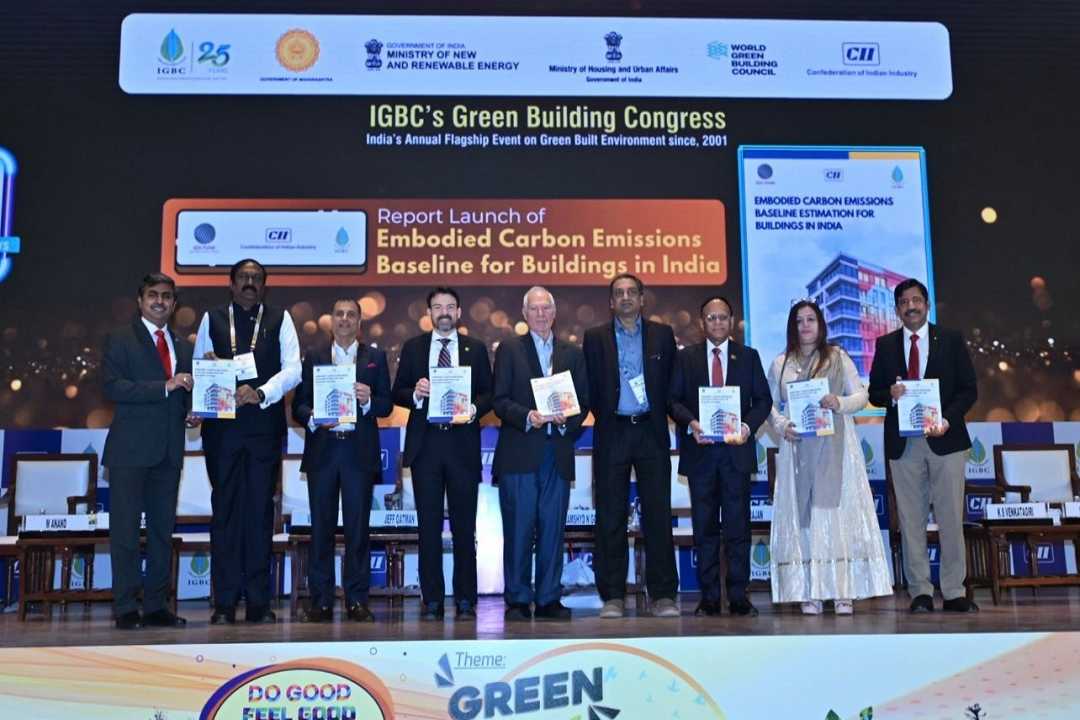
The day further marked the release of India’s first national embodied carbon baseline report, titled “Embodied Carbon Emissions Baseline Estimation for Buildings in India”, developed with support from the SED Fund. The report presents Life Cycle Assessment-based findings from 20 case studies and maps embodied carbon intensities across five major building typologies and multiple climatic and seismic zones. The study underscores the need to address embodied carbon alongside operational emissions as India expands sustainable construction at scale.
Along with the main plenary, the event hosted the International Conference on Green Buildings & Built Environment, where global and national experts discussed climate-responsive urban development, net-zero pathways, green financing mechanisms and the future of construction technologies. The conference placed additional focus on Mumbai’s expanding infrastructure landscape and the necessity of resilience, efficiency and inclusivity in urban planning. An expansive expo showcasing the latest in sustainable materials, high-performance building technologies, HVAC innovations, water-efficiency solutions, renewable energy systems and circular construction tools created a platform for industry-wide collaboration and business partnerships.
The opening day of IGBC Green Building Congress 2025 set a dynamic foundation for the three-day conference with its mix of visionary leadership, innovative frameworks, technology-driven initiatives and data-backed research. The following sessions over the next two days will feature conferences dedicated to net-zero homes, green energy in buildings, reimagined workplaces, green factories, logistics parks, green financing and leadership panels, along with structured B2B networking to catalyse industry partnerships.
The Indian Green Building Council (IGBC) was founded by the Confederation of Indian Industry (CII) in 2001 to advance the green building movement across the country. With 32 chapters nationwide, IGBC engages stakeholders from industry, government, architecture, product manufacturing and academia. India today has 14.80 billion sq ft of registered green building footprint across more than 18,125 projects spanning 32 IGBC rating systems. With nearly 90 percent of India’s green building projects adopting IGBC Green and Net Zero Rating Systems, the Council continues to lead the nation’s transition toward a future-ready, resource-efficient and climate-resilient built environment.