

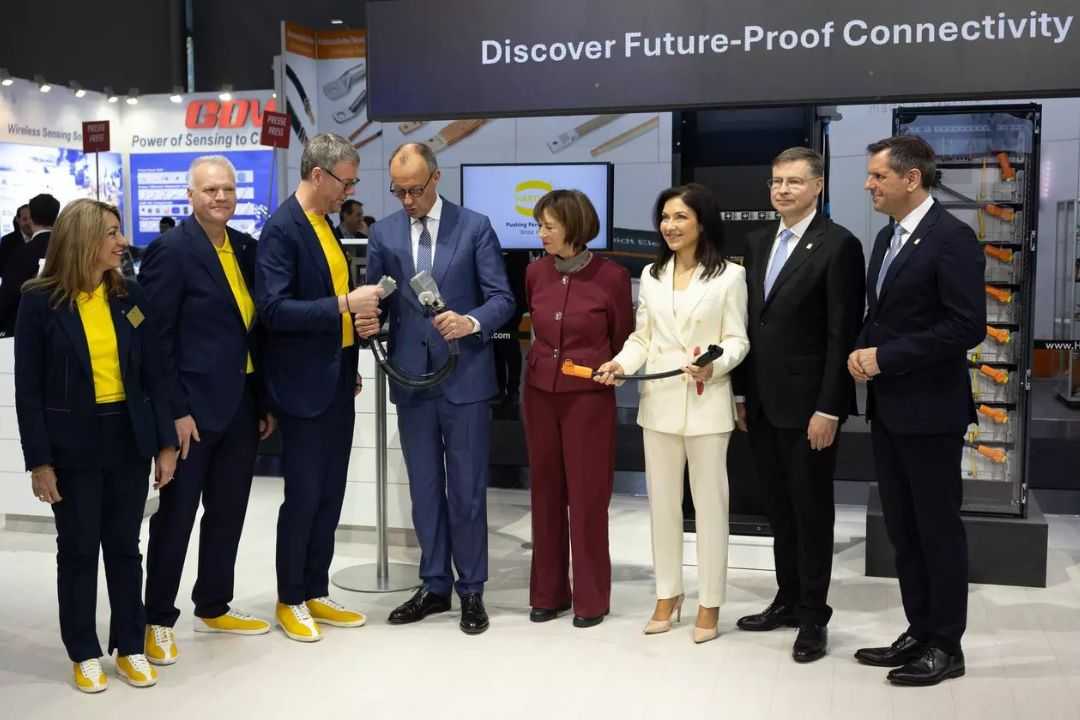
Chancellor Friedrich Merz visited the exhibition stand of HARTING Technology Group at Hannover Messe 2026, where he was briefed on the company’s latest innovations in energy systems, digitalisation and industrial automation. The visit was part of a high-level delegation that included Katherina Reiche, Olaf Lies and Valdis Dombrovskis.
During the visit, HARTING showcased advanced connectivity solutions designed to support resilient and sustainable energy infrastructure. Among the highlights was a fuel cell pilot project under development at the company’s Espelkamp facility in collaboration with start-up Reverion. The system will initially convert locally generated biogas into electricity, enhancing on-site energy efficiency and reducing emissions. In the future, it will also enable storage of renewable energy as green hydrogen, which can be converted back into power when required.
The pilot plant is designed to achieve electrical efficiency of up to 80 percent and incorporates HARTING’s own connectivity components. The initiative forms part of the company’s broader efforts to strengthen energy independence and reduce the risk of supply disruptions.
Company leadership noted that industrial and economic conditions are undergoing rapid transformation due to geopolitical developments, trade challenges and shifting supply chains. In this context, HARTING emphasised the importance of early adaptation and long-term strategic planning supported by reliable infrastructure technologies.
The company also shared a positive business outlook, projecting revenue growth of more than 10 percent for the 2025–2026 financial year, building on the previous year’s performance of approximately €1.1 billion. Growth is being supported by a globally distributed yet locally focused operating model.
At Hannover Messe 2026, HARTING is presenting solutions that integrate energy systems, data networks and automation processes into scalable industrial applications. These include technologies for stabilising energy supply, enabling modular manufacturing systems and supporting high-speed data transmission in demanding environments.
The company is also introducing digital tools designed to simplify engineering workflows, improve system configuration and enhance lifecycle transparency. These tools are expected to reduce development timelines and improve operational efficiency.








