

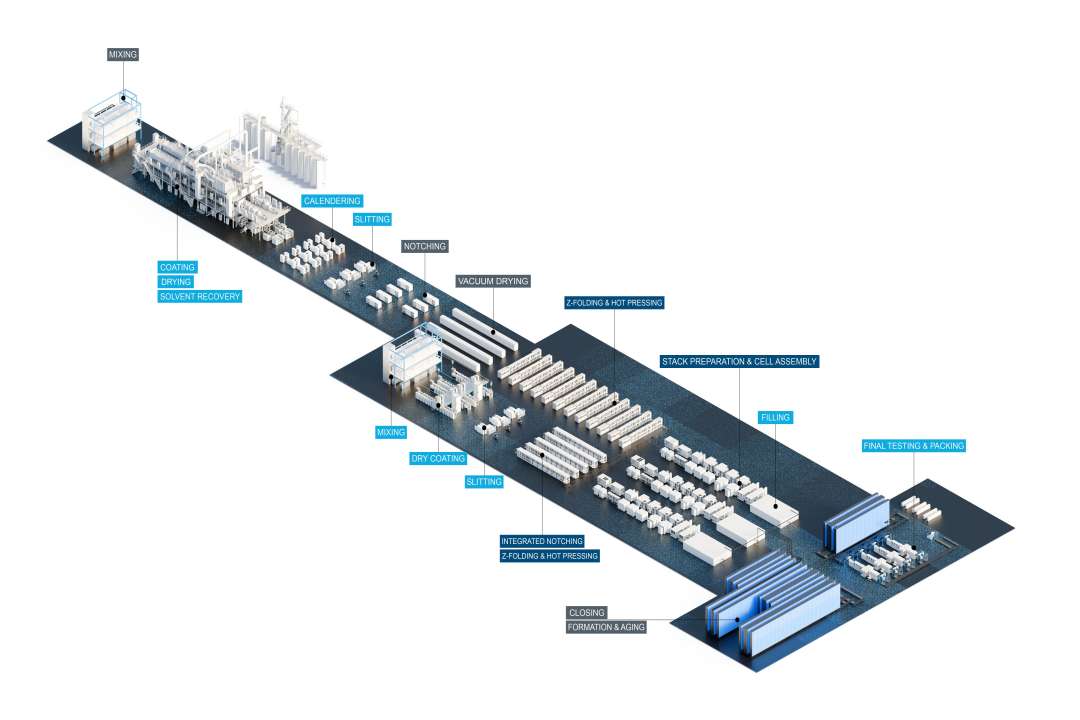
Engineering specialists Dürr and GROB have introduced a groundbreaking concept factory for lithium-ion battery cell production, setting new benchmarks in energy efficiency, space utilization, and product quality. The two companies are presenting their joint innovations at The Battery Show India 2025 in Greater Noida, showcasing how advanced manufacturing technologies can redefine sustainable battery production.
The concept factory combines dry electrode coating—which eliminates the need for traditional drying—with next-generation Z-folder assembly technology that includes integrated notching. Together, these innovations enable a production setup that requires 50% less space and 70% less energy, while ensuring superior cell performance and consistency.
Since 2022, Dürr and GROB have been collaborating in lithium-ion battery production technologies with the goal of becoming full-system suppliers for manufacturers across Europe, North America, and India. The partnership emphasizes local manufacturing and technology localization, supporting India’s Atmanirbhar Bharat initiative and the nation’s shift toward clean mobility.
“We are driving India’s clean mobility transition through advanced lithium-ion battery manufacturing systems that merge global engineering expertise with localized production and service,” said Aji Philip, Head of LiB at Dürr India. German Wankmiller, CEO of the GROB Group, added: “Our joint portfolio now spans nearly the entire battery cell production value chain, offering comprehensive, high-performance technologies for the global market.”
At the heart of the new factory concept is Dürr’s X.Cellify DC system, which implements the Activated Dry Electrode® process developed with LiCAP Technologies. Unlike conventional slurry-based coating, this process uses a dry-mixed active material that is calendered into a free-standing film and then laminated onto the collector foil.
The dry coating method removes the need for drying, solvent recovery, and treatment—cutting costs, reducing energy use, and minimizing environmental impact. Material efficiency is also enhanced, as excess film can be recycled back into the process.
Following a successful proof of concept, Dürr has demonstrated consistent high-quality output from its dry coating equipment and is now seeking pilot partners to scale the technology in industrial applications. GROB’s latest Z-folder systems integrate the notching step directly into the folding process, resulting in faster throughput and more compact production layouts. The machine maintains stable web tension with minimal deflection rollers, ensuring reliability and precision. With a robust magazine buffer system for electrode handling, the solution achieves up to 95% system availability.
Dürr has developed an innovative high-pressure electrolyte filling process that allows cells to be filled in a single step without residual gas. Operating at pressures up to 30 bar—two to three times higher than conventional methods—the process enables more accurate dosing, significantly reduces filling time, and accelerates electrolyte penetration into the cell’s active materials.
The new concept factory is fully digitally integrated from design to production. A digital twin allows complete factory simulation during the planning stage, optimizing commissioning and reducing time-to-production.
All process data is managed through Dürr subsidiary iTAC’s MES/MOM software, which provides real-time monitoring, traceability, and quality analytics. This ensures maximum equipment effectiveness and defect-free manufacturing across every stage of production.
With this new concept, Dürr and GROB demonstrate how sustainability, efficiency, and precision engineering can come together to power the next generation of electric mobility. Their approach sets a clear direction for the future of large-scale battery production—smarter, cleaner, and more resource-efficient.








