

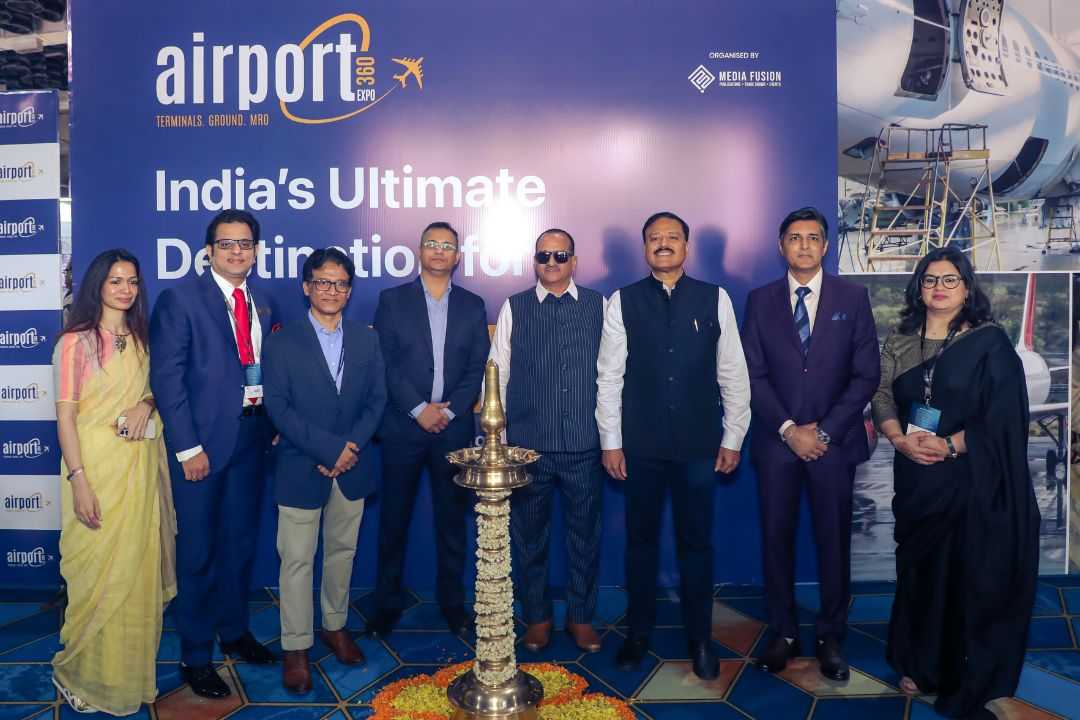
India’s aviation sector is entering a decisive phase of growth, with airport development shifting from capacity creation to performance-driven, efficient, and passenger-centric ecosystems. Reflecting this transition, Airport360 Expo 2026 successfully concluded today at the Bombay Exhibition Centre, Mumbai, bringing together key stakeholders from across the global aviation landscape.
Airport360 Expo 2026 was formally opened by prominent leaders from across the aviation ecosystem, including Sharad Kumar, Chief Advisor at Airports Authority of India; B V J K Sharma, CEO of Navi Mumbai International Airport; Shankar Dey of dormakaba India; Susanta Sharma of Aurionpro; and Taher Patrawala of Media Fusion. Their presence reflected a collective commitment to strengthening airport infrastructure and improving operational preparedness across India.
Speaking on the sector’s transformation, Sharad Kumar noted that India’s aviation industry is at a critical juncture where sustained growth will depend on clear strategic direction. He highlighted global trends such as digital adoption, sustainability, and stronger linkages between aviation, logistics, tourism, and trade. He also pointed out that geopolitical uncertainties continue to influence routes, costs, and efficiency.
Offering insights on growth and infrastructure, B V J K Sharma underlined that India is already among the top global domestic aviation markets, with passenger traffic showing strong upward momentum. He emphasised that continued expansion of airports, backed by national initiatives and increasing aircraft orders, will support future demand.
Mr Sharma further noted that aviation remains a major economic contributor, generating employment and supporting allied industries, with MRO emerging as a key growth area. At Navi Mumbai International Airport, phased development is underway to build significant passenger capacity, supported by advanced connectivity and integrated planning to meet long-term demand.
Organised by Media Fusion, the second edition of Airport360 Expo brought together more than 2,500 industry professionals, over 70 exhibitors, and participants from multiple countries, reflecting its growing international relevance. Commenting on the broader outlook, Taher Patrawala noted that India’s aviation market is projected to expand significantly in the coming decades, with airport infrastructure playing a central role. He added that with relatively low air travel penetration, the focus is now on building high-performance airports at scale. He also highlighted the rapid growth of the MRO segment, supported by favourable policy measures, and described Airport360 Expo 2026 as a platform that aligns industry stakeholders around design, operations, and technology for the sector’s next phase of expansion.
India is already among the world’s largest domestic aviation markets, with passenger traffic projected to approach 500 million by 2030 and potentially reach 1 billion by 2047. This growth is supported by ongoing airport expansion, fleet additions, and national initiatives aimed at improving regional connectivity. The sector continues to play a vital economic role, contributing significantly to GDP and employment, while emerging segments such as maintenance, repair, and overhaul (MRO) gain momentum.
A key theme at the event was the need to strengthen India’s position as a global aviation hub by reducing reliance on foreign transit points. Experts emphasised the importance of policy alignment, digital transformation, and integrated infrastructure to capture greater value across airline operations, cargo, and airport-led services.
Speakers also stressed that future airport development must prioritise efficiency and adaptability over conventional design approaches. With terminals expected to reach saturation in the coming years, flexible and modular infrastructure—supported by digital planning tools and data-driven decision-making—will be essential. Optimising existing assets through improved passenger flow, process innovation, and technology integration can significantly enhance capacity without proportional expansion.
Passenger experience emerged as a critical driver of airport performance. Seamless journeys, reduced wait times, and well-designed commercial spaces are increasingly influencing traveller behaviour and revenue generation. Industry leaders pointed to global best practices where airport functions extend beyond terminals, integrating retail, lifestyle, and urban infrastructure to create holistic travel environments.
Airport360 Expo 2026 featured participation from over 2,500 professionals, 70+ exhibitors, and representatives from more than 10 countries. The event showcased innovations in terminal design, digital systems, safety, and airside operations, underlining the growing role of technology in shaping next-generation airports.
Running alongside the exhibition, the conference hosted multiple sessions focused on operational excellence, infrastructure planning, and future-ready airport ecosystems. As India’s aviation market continues its upward trajectory, the expo reinforced the sector’s commitment to building scalable, resilient, and globally competitive airport infrastructure.









