Aerospace industry veteran Srinivasan Dwarakanath may speak softly, but when the topic turns to precision manufacturing for global aviation from India, his enthusiasm is unmistakable. With more than 20 years of experience in aircraft manufacturing, technology development, and supplier creation, Dwaraka — as he is widely known — has witnessed the sector’s evolution firsthand.
“We are at a defining moment,” says Mt Dwarakanath, Director General of the Aerospace India Association. “Interest from global OEMs and mid-sized companies in establishing manufacturing capabilities in India is stronger than ever.” He believes India’s aerospace manufacturing and services exports could expand tenfold over the next decade, reaching $20 billion annually.
India’s strong engineering talent and technology base have long made it a hub for software and design services. Now, with airline demand accelerating — the country is expected to double its passenger aircraft fleet by 2030 — the business case for domestic manufacturing and maintenance operations is compelling.
Recognizing this potential early, GE Aerospace established its Pune facility in 2015. Since then, the site has grown into a high-performance manufacturing center. Over the past two years, the company has invested $44 million in India to introduce advanced production technologies, enhance automation, and expand capacity for critical engine components.
This expansion is supported by a vibrant supplier ecosystem. More than 300 companies now support the Pune facility, forming part of a wider network of over 2,200 suppliers across India. Procurement of castings, manifolds, and subassemblies from Pune has increased significantly, reinforcing its role within GE Aerospace’s global network of more than 80 factories.
When the company began identifying suppliers for its Pune operations in 2014–15, Hyderabad-based Raghu Vamsi Machine Tools emerged as a strong candidate. Led by Vamsi Vikas Ganesula, the company brought prior experience in oil, gas, and aerospace applications.
GE Aerospace required end fittings — precision connectors used in high-pressure fuel and gas transfer systems. Raghu Vamsi now supplies connectors ranging from 0.25 to 7.5 inches in diameter, manufactured to exacting tolerances. “Our journey with GE Aerospace has been about capability enhancement as much as growth,” says Director Preeti Vamsi.
A similar transformation can be seen at Saakshi Medtech and Panels, which has partnered with GE Aerospace’s Pune facility for a decade. Initially supplying vibration-monitoring panels, the company later expanded into industrial X-ray services and drives and controls systems. Managing Director Aniket Vijay Latkar notes that consistent technical guidance from GE Aerospace played a key role in this progression.
At JK Maini Global Aerospace in Bengaluru, nearly 60 engineers now focus on new product development. The company introduced 150 new products last year and aims to launch 365 this year. Managing Director Gautam Maini highlights advances such as dry film lubricant development and a move up the value chain into machined castings and forgings for global customers.
Another key partner, Godrej Aerospace — part of Godrej Enterprises Group — has established a dedicated design team for line replaceable units (LRUs). Executive Vice President Manek Behramkamdin says the focus is on developing proprietary solutions while strengthening expertise in complex fabrication, precision components, and flight-critical systems.
In aviation, there is no room for compromise. Safety and quality standards must be met without exception. At GE Aerospace, this philosophy is embedded in its SQDIP framework: safety, quality, delivery, inventory, and productivity.
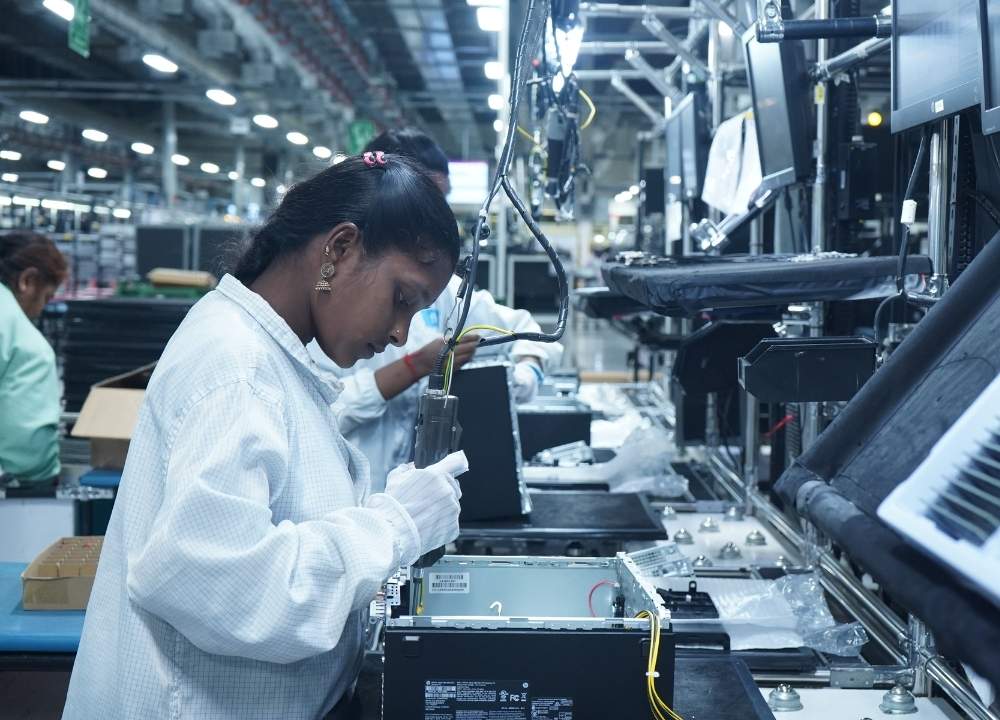
Preeti Vamsi notes that while technical skills can be taught, cultivating a culture of quality requires sustained effort. Many shop-floor employees are recruited from technical institutes and trained extensively to meet aerospace standards. Once embedded, this mindset drives efficiency, reduces waste, and enhances overall performance.
India’s aerospace manufacturing landscape is entering a new phase of growth. Through sustained investment and supplier development, GE Aerospace has played a pivotal role in preparing local companies to serve not only its own programs but the broader global aerospace market.
The next stage for these suppliers involves producing increasingly complex components and assemblies, enabling deeper integration into the global value chain. With rising domestic aviation demand and a skilled workforce aligned with international safety and quality benchmarks, India’s aerospace industry is positioned for significant expansion in the decade ahead.