The Osaka–Kansai Expo 2025, which opened on April 13, features an innovative display by Murata Manufacturing, a Gold Partner Sponsor, inside the Better Co-Being Signature Pavilion produced by Hiroaki Miyata. Murata has contributed advanced devices that merge its expertise in electronic components with immersive sensory technology, offering visitors a completely new form of experience.
Among these attractions, the “echorb Wonder Stone” stands out. Using specialized vibrations, it creates the illusion of being pulled, surprising visitors with a sensation that feels vividly real. We spoke with the developers behind this remarkable technology to understand the science of 3D Haptics, the foundation of the device.
At Murata’s pavilion, the echorb Wonder Stones have captured the imagination of visitors. When held, the stone’s gentle shape and intricate vibrations make users feel as though their arms are moving forward, backward, or side to side. Positioned near digital art pieces, the device vibrates in sync with the exhibits, generating a shared resonance experience that feels alive.
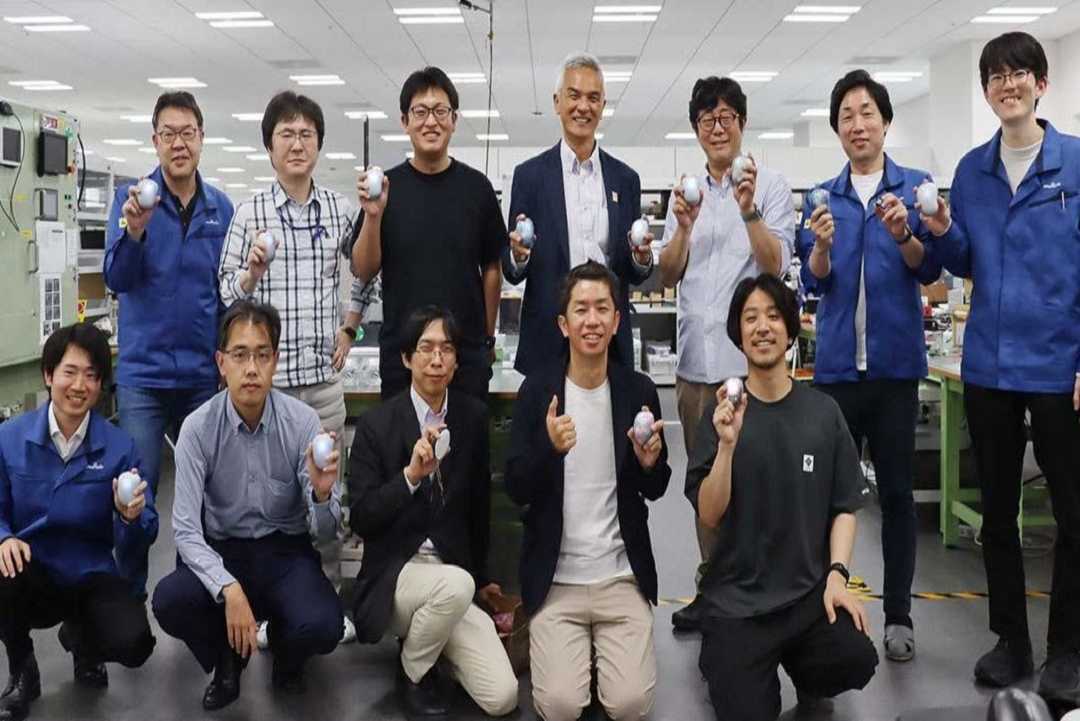
Natsuo Koda, co-founder of MIRAISENS, describes 3D Haptics as a technology that expands human sensory perception. Founded in 2014 as the first start-up from the National Institute of Advanced Industrial Science and Technology (AIST), MIRAISENS emerged when Koda, formerly of the Sony Kihara Research Center, collaborated with Dr Norio Nakamura, a pioneer of tactile illusion research at AIST.
Their breakthrough lies in reproducing sensations of force, texture, and touch—making users feel something that doesn’t physically exist. As Mr Koda explains, “Just as optical illusions trick the eyes, our technology uses vibrations to create illusions in the brain. It removes physical constraints and unlocks entirely new experiences.”
Unlike standard vibration feedback in gaming controllers, which only simulate surface textures or impacts, MIRAISENS’ 3D Haptics recreates more complex sensations—such as being pulled, pushed, or meeting resistance—bringing digital experiences closer to physical reality. In 2019, Murata integrated MIRAISENS into its corporate group. Mr Koda recalls that joining forces with Murata provided the key to progress: “We needed precise actuators to fully express our algorithms. Murata’s expertise in electronic components allowed us to develop the actuator we had envisioned for years.”
Importantly, Murata preserved MIRAISENS’ start-up agility. “They didn’t absorb us into their structure; instead, they empowered us to move fast,” Mr Koda says. That speed and collaboration became vital in creating the echorb Wonder Stone for the Expo. In April 2023, Murata selected MIRAISENS to develop a portable version of their 3D Haptics system for the pavilion—a device that could operate independently, not tethered to a computer.
Kenji Kagayama, who led actuator development, recalls, “We accomplished in six months what would normally take two or three years.” Murata’s deep knowledge of actuator design allowed the team to build a model capable of dual-axis vibration, enabling sensations in multiple directions with high precision and responsiveness.
But achieving this effect for large crowds required more than hardware. The software team, led by Keito Kito, refined vibration patterns through repeated testing with new participants, ensuring that the “pulling” sensation was clearly felt. Meanwhile, Hiroyuki Harada, responsible for product design, worked to reduce the stone’s weight “gram by gram” to ensure optimal tactile transmission.
How did the team overcome so many technical challenges? Mr Koda credits creativity: “Everyone imagined the joy on visitors’ faces. Even without detailed specifications, we shared a vision of the smiles we wanted to create.” He adds, “When thinking about the future, there are no fixed guidelines. We must imagine what society could be and design experiences for that world.”
At the Expo, visitors’ amazed reactions reaffirmed the power of 3D Haptics. The team reflected, saying, “It reminded us how extraordinary this technology is—and how accessible it can be.” Potential uses for 3D Haptics extend far beyond entertainment. It could make gaming more lifelike, enhance assistive devices like canes for the visually impaired, and transform digital communication by introducing a sense of touch.
Mr Koda concludes, “Our experience at the Osaka–Kansai Expo sparked countless new ideas. Humans constantly rely on touch, even when we’re unaware of it. We want to keep expanding this frontier—bringing tactile experiences into areas no one has explored before.”