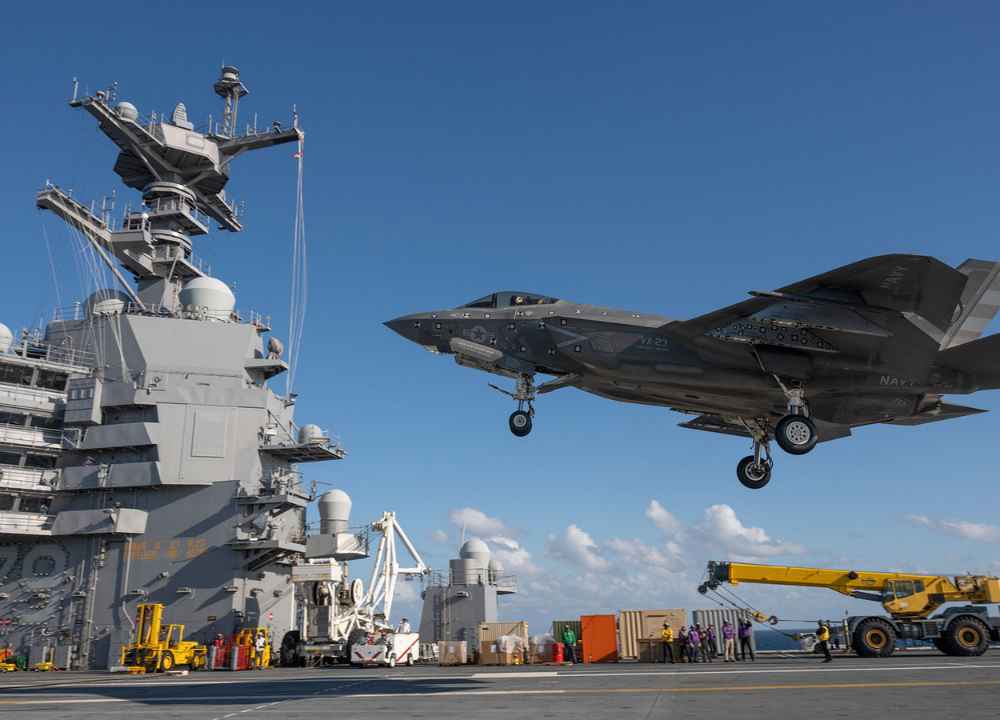
Lockheed Martin’s F-35C Lightning II has completed its first launch and recovery operations aboard the Gerald R Ford-class aircraft carrier PCU John F. Kennedy (CVN 79), marking a milestone in the integration of the fighter into the US Navy’s next-generation carrier fleet. The testing was conducted at sea over 11 days and involved two F-35C aircraft from Naval Air Station Patuxent River, Maryland. The aircraft completed 34 flights, 122 catapult launches and 122 arrested landings using the carrier’s Electromagnetic Aircraft Launch System (EMALS) and Advanced Arresting Gear (AAG).
The trials marked the first shipboard compatibility testing of the F-35C aboard a Ford-class carrier. The programme assessed the aircraft’s ability to operate from the new flight deck and generated data required for future carrier operations. Ford-class carriers feature EMALS for aircraft launches, AAG for recovery operations and a redesigned flight deck and island that change airflow, exhaust conditions and deck operations. The systems are intended to support a wider range of aircraft and improve control during launch and recovery.
The testing followed shore-based trials conducted between January 2024 and May 2025. The at-sea programme evaluated the EMALS and AAG software and installations, validated aircraft structural and load models during launch and recovery, and supported the development of operational launch and recovery bulletins for Ford-class carriers. The team also assessed mission-system software stability, including the initial use of Block 4 software in the carrier environment, and reviewed aircraft support requirements under the operating conditions of the new carrier.
Sean Jackson, Vice President of Lockheed Martin’s F-35 Development Program, said the testing marked an important step for the F-35C, the John F. Kennedy and the US Navy. He said the aircraft had demonstrated launch and recovery capability from a Ford-class flight deck and that the Navy had cleared the F-35C for operations across its aircraft carrier fleet. The milestone advances the integration of the F-35C with the Navy’s newer carriers. The fighter combines stealth, advanced sensors and data-sharing capabilities for maritime and joint-force operations.
Renowned for its commitment to research and development, Lockheed Martin invests significantly in emerging technologies, including artificial intelligence and hypersonics, to enhance national security and address complex global challenges. With a workforce of approximately 114,000 employees, the company emphasizes diversity, sustainability, and corporate responsibility while maintaining strong partnerships with government agencies and international allies to ensure peace and stability worldwide.