Standing in Leh recently and looking across the high desert of Ladakh, one understands very quickly why this is among the toughest military terrains on earth. The air carries roughly half the oxygen of the plains, temperatures stay well below freezing for months, and every bag of cement, every steel sheet and every pair of working hands has to come up long, fragile roads that close with the snow. For a soldier posted here, a bunker is the difference between exposure and protection. Yet building one the conventional way takes weeks of labour that these mountains rarely allow.
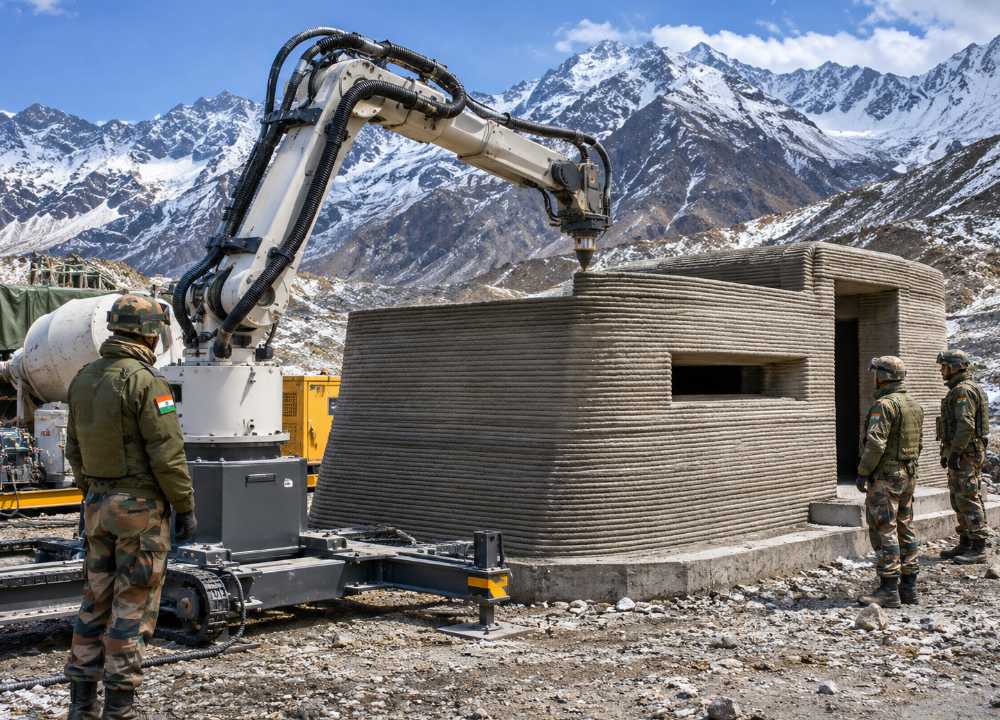
That is why the work happening between the Indian Army and the Indian Institute of Technology (IIT) Hyderabad caught my attention after I returned. Under a programme called Project PRABAL, the Army is now printing its bunkers on site, layer by layer, with a robotic arm and concrete made largely from local sand and aggregates. What began as one officer’s idea has moved, in a short span, from a trial at 11,000 feet in Leh to operational use in the forward areas of Sikkim. For those of us who follow Indian manufacturing, it is one of the clearest examples of additive manufacturing, robotics and materials science moving out of the factory and into the field.
An officer’s question
The idea came from Lt Col Arun Krishnan, an officer with about sixteen years in uniform across the northeast, the western borders and the northern sector. While pursuing his MTech at IIT Hyderabad, he concluded that the real problem in high-altitude construction was not the materials but the method. Building at altitude is slowed by thin air, extreme cold, limited manpower and the constant risk of being watched by the adversary. His question was simple: could shelters and defences be built faster, with fewer people, right where they are needed?
He took that question to the Department of Civil Engineering at IIT Hyderabad, where Prof K V L Subramaniam guided the project, and to Simpliforge Creations, a deep-tech construction printing startup founded in 2022. Simpliforge had already printed India’s first 3D printed bridge and an on-site printed medical facility for the Army, which gave the team valuable field experience. Lt Col Krishnan, now a PhD scholar at IIT Hyderabad, has said publicly that several teams and companies had earlier tried to bring 3D printed construction to Leh, and that Ladakh’s conditions had defeated them.
Those conditions are severe. Oxygen levels in the region are roughly 40 to 50 percent of sea level norms, which cuts the output of both people and machines, including generators and engines. Low humidity affects how concrete cures, and intense ultraviolet radiation adds further stress on materials and equipment. According to the project team, cement that stays workable for more than an hour on the plains gives only about 30 minutes at altitude, leaving very little margin for a process that depends on a steady and uniform flow of material.
Fourteen hours in Leh
The solution rested on four elements: a portable robotic arm, a terrain-specific concrete mix using local materials, printing strategies tuned to the site, and structural forms optimised for protection. Before deployment, the IIT Hyderabad team studied local materials and simulated the environmental stresses of Ladakh in the laboratory. The resulting mix was engineered to handle sub-zero temperatures, low humidity and high UV exposure while still delivering the strength and durability that a military structure demands.
In Leh, at about 11,000 feet, the printer was set up in under 24 hours. The bunker was completed in five days with about 14 hours of actual printing time, a job that conventional methods would normally stretch over weeks. The structure follows a form-optimised design with a geometric patterned facade meant to reduce ricochet, offering high protection with relatively low material use. The partners announced the result in April 2025 and described it as the world’s highest on-site 3D printed military structure built under high-altitude, low-oxygen conditions.
The significance goes beyond the record. Earlier 3D printed military buildings in India, such as the two houses the Military Engineer Services (MES) built in Gandhinagar in 2022 with Chennai-based Tvasta Manufacturing Solutions, were printed in accessible locations. PRABAL was conceived differently, as a robotic arm palletised for airlift and assembled at the site, printing where the soldier actually stands. The team has also developed a printing geometry that lets the robot work inside an excavation and be withdrawn before the space is sealed, opening the door to printed underground structures.
From trial to the forward areas
The true test of any technology is whether it moves from demonstration to deployment. In December 2025, the Army announced that the Trishakti Corps had operationalised on-site 3D concrete printing in the forward areas of Sikkim and adjoining locations for bunkers, sentry posts and other protective structures. The Defence statement noted that the capability had already been proven in other operational areas. The system is an indigenous robotic printer made up of a robotic arm, a circular mixer, a piston pump and a generator, and it is fully portable by vehicle across mountainous terrain.
Live ballistic trials were carried out on the printed structures, and the Army said these validated their strength and protective performance. Earlier testing included live fire with standard infantry weapons and penetration studies on site and in simulation labs at IIT Hyderabad, which the team reports showed better ballistic and blast resistance than traditional field fortifications. The Army has listed customised and terrain-specific designs, higher compressive strength, better quality control, efficient use of local materials and advanced camouflage among the advantages. For a commander, the most important gain is that construction can be finished within tactically acceptable timelines.
PRABAL is not an isolated effort. Through the Army Design Bureau, the Army has also worked with MiCoB Pvt Ltd, an Ahmedabad-based startup incubated at IIT Gandhinagar, which reported building 30 bunkers and three other structures across defence locations, along with India’s first 3D printed two-storey dwelling unit for soldiers at the Ahmedabad Cantonment. Army officials have said units are using 3D printing for precast permanent defences and overhead protection, with these structures validated over a year across terrains including Ladakh. The direction is clear: printing is becoming part of how the Army plans its field infrastructure.
Beyond bunkers, a wider manufacturing shift
Additive manufacturing in the Army is moving well beyond concrete. At the National Additive Manufacturing Symposium 2026 in New Delhi in March, organised by the National Centre for Additive Manufacturing under the Ministry of Electronics and Information Technology, the Army delegation was led by Lt Gen Rajiv Kumar Sahni, Director General of the Corps of Electronics and Mechanical Engineers. He described additive manufacturing as having grown from a prototyping tool into a mature manufacturing capability that can transform logistics, sustainment and equipment modernisation. The discussions covered combat force regeneration at the battlefield edge, rapid prototyping and sustainment of drones, and decentralised manufacturing in forward areas.
The Army has said it is integrating polymer and metal additive manufacturing and building digital design ecosystems with national institutions and industry. The challenges were stated just as plainly at the symposium. Material qualification, certification, interoperability and cyber-physical security all need joint work between the military, academia and industry. These are, in many ways, the same questions Indian manufacturers face when they bring additive processes onto their own shop floors.
What it means for Indian manufacturing
For the manufacturing community, PRABAL carries a lesson that goes beyond defence. It combined an officer’s field problem, academic research in materials and structures, and a young startup’s engineering, with each partner bringing what the others could not. The robotic arms, pumps, mixers, sensors and control systems that make such printers work are products Indian engineering companies can design and build, and demand from defence, disaster relief and remote infrastructure is growing. The project’s reported next steps include bunkers, barracks and medical facilities in Ladakh, Sikkim and Arunachal Pradesh, along with civilian uses in remote construction and disaster response.
It also shows how military capability is now measured. In the mountains, an army’s strength depends not only on its weapons and soldiers but on how quickly it can protect, house and sustain them where the roads end. A machine that travels by vehicle or air, works with local sand and turns out a bullet-resistant shelter within hours changes that equation. It reduces the number of people exposed during construction, the material hauled up long supply lines and the time a position stays vulnerable.
Standing in Leh, it is hard not to feel the weight of history in those mountains and the sacrifices made to hold them. It is equally encouraging to know that the protection our soldiers receive there is increasingly being engineered, designed and printed in India. Project PRABAL is still young and its numbers will grow, but it already shows what happens when the battlefield and the laboratory work together. For Indian manufacturing, that is a conversation worth joining.