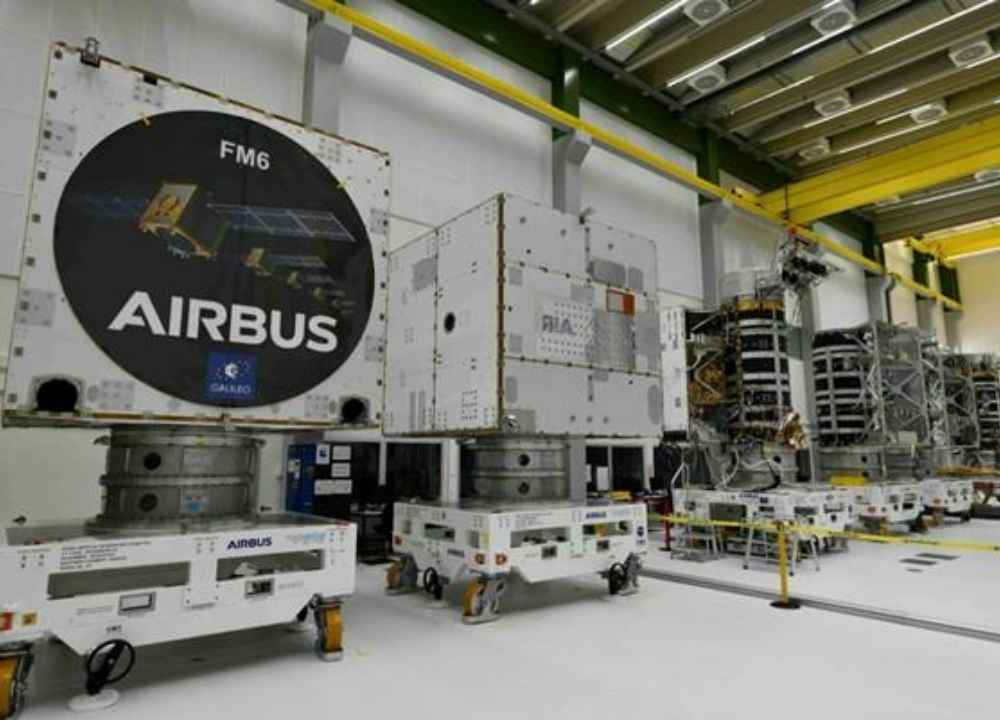
Airbus has secured a contract to build two additional second-generation Galileo satellites, following an award from the European Space Agency (ESA), acting on behalf of the European Union Agency for the Space Programme (EUSPA) under delegation from the European Commission. The new contract builds on an existing order for six second-generation Galileo satellites. The additional spacecraft will benefit from established manufacturing capabilities and production arrangements, extending the partnership supporting Europe’s flagship satellite navigation programme.
“With these contracts, ESA and European industry are safeguarding the continuity of Europe’s satellite navigation services, responding to the evolving needs of users, and strengthening Europe’s strategic autonomy. These contracts represent an investment in Europe’s ability to navigate its own future, independently and with confidence,” said Laurent Jaffart, ESA Director of Resilience, Navigation and Connectivity.
Alain Fauré, Head of Space Systems at Airbus, said the award highlighted the company’s satellite manufacturing expertise and its commitment to delivering next-generation spacecraft designed to enhance navigation capabilities for European security, defence and wider civilian applications.
The second-generation satellites will feature enhanced navigation antennas designed to improve the accuracy and performance of Galileo signals. Their fully digital payloads will be reconfigurable in orbit, allowing the system to adapt to changing user requirements through new signals and services.
Each satellite will also incorporate an enhanced atomic clock configuration and inter-satellite links, enabling spacecraft to communicate and cross-check data. Advanced anti-jamming and anti-spoofing capabilities will help protect navigation signals against interference and manipulation.
Weighing more than two tonnes each, the satellites are designed to operate in orbit for 15 years. Airbus will use its coordinated production programme, drawing on spacecraft manufacturing, integration and testing expertise across facilities in Backnang near Stuttgart, Friedrichshafen, Getafe near Madrid, Ottobrunn and Toulouse.
Galileo is a flagship programme of the European Union, funded by the EU and managed by the European Commission. ESA leads the design, development and qualification of the space and ground systems and is responsible for procuring launches. The agency also conducts research and development for the programme’s future through Horizon Europe. EUSPA oversees service operations and deployment, including launch services, and works to ensure that Galileo meets market and user requirements.
The additional satellite order supports the continued development of Europe’s independent satellite navigation infrastructure. By incorporating more capable navigation payloads, improved timing systems and enhanced signal protection, the second-generation spacecraft are intended to address evolving requirements across transport, public services, commercial applications and security-related operations. The contract also reinforces the role of European industrial expertise in delivering and maintaining the infrastructure required for reliable satellite navigation services across Europe and beyond.