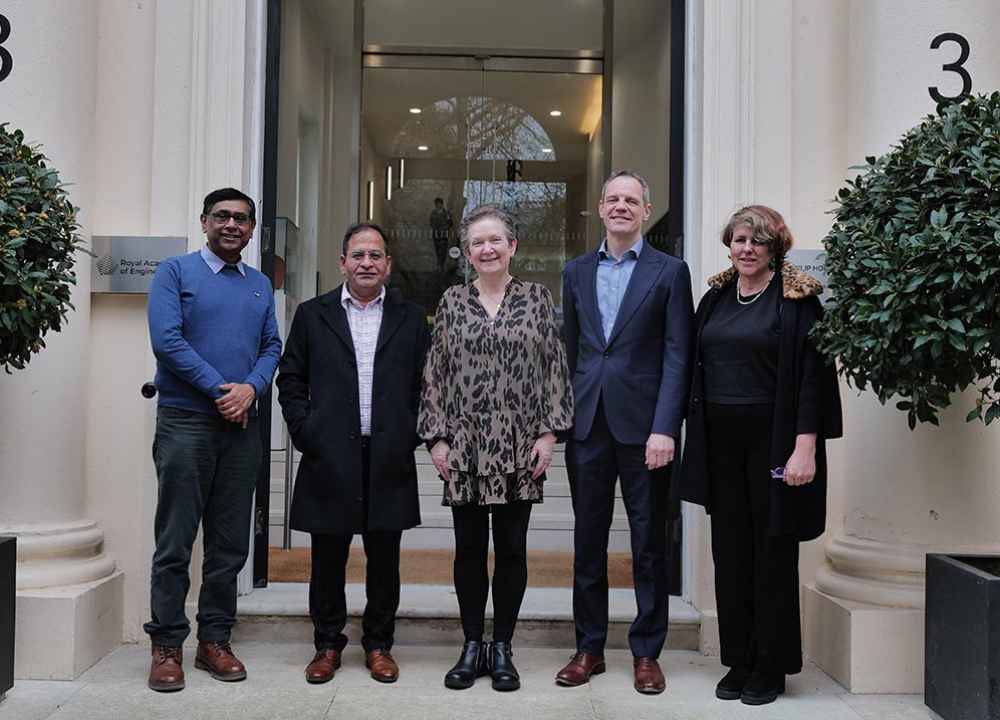
The Royal Academy of Engineering and Tata Steel have announced a three-year research and innovation partnership to advance the use of sustainable and recycled materials and strengthen cooperation between industry and universities in the United Kingdom and India. The partnership will focus on developing practical solutions for circular materials, resource efficiency and resilient supply chains for critical materials and minerals. It will also support policy missions between the two countries to exchange knowledge and generate market intelligence on circularity and supply-chain resilience.
The programme builds on earlier collaboration involving India’s Department of Science and Technology and the Indian National Academy of Engineering. It is intended to bring together research expertise and industrial experience to help move promising technologies towards practical application.
The initiative is supported by nearly £1.9 million from the UK Government, matched by £1 million from Tata Steel. Successful projects will also receive funding equivalent to at least half the value of their grant, allowing research teams to attract additional support and develop their technologies further.
Subodh Pandey, Vice President – Technology, R&D, NMB and Graphene at Tata Steel, said innovation in circular and sustainable materials would play an important role in the company’s future. He said the partnership would help advance research towards industrial use while building long-term relationships to support lower-carbon approaches to construction and manufacturing.
Professor Ravi Silva CBE FREng, Director of the Advanced Technology Institute at the University of Surrey and Chair of the Academy’s Transforming Systems through Partnership programme, said the collaboration would combine expertise from India and the UK to develop solutions that could be applied in real-world settings.
The partnership is expected to support up to 15 research and innovation grants, each worth between £100,000 and £150,000. Projects will run for up to three years, beginning in April 2027. Each project will be co-led by an academic or research partner from the UK and India and will need to demonstrate a route towards industrial application, entrepreneurship or wider practical impact.
Alongside funding, Tata Steel will provide selected teams with industry mentoring, access to laboratories and facilities, and technical expertise from senior personnel. Projects with commercialisation or spin-out potential may also receive mentoring and incubation support, depending on their requirements.
The partnership will be delivered through the Royal Academy of Engineering’s Transforming Systems through Partnership (TSP) programme. Over more than a decade, TSP has supported more than 300 collaborative projects connecting universities and industry across nine partner countries and built a network of over 800 awardees.
The programme comes as both countries seek to reduce carbon emissions and environmental impacts while meeting rising demand for infrastructure and manufactured products. Developing recyclable materials and more resource-efficient industrial processes could help improve material use and strengthen supply chains. The International Science Partnerships Fund, the UK Government’s flagship international research and innovation fund, supports collaboration on shared scientific and technological priorities. The new partnership aims to build.
Tata Steel Group is among the world’s leading steel companies, with an annual crude steel capacity of 36 million tonnes and operations and commercial presence across the globe. The Group recorded a consolidated turnover of around US$26 billion in the financial year ended March 31, 2026, and has a workforce of more than 77,000 across five continents through Tata Steel Limited and its subsidiaries, associates and joint ventures. The company has set major sustainability goals, including achieving net-zero emissions by 2045, and is pursuing a multi-year, digitally enabled business transformation to become a leader in digital steelmaking. Its Jamshedpur, Kalinganagar and IJmuiden plants have received the World Economic Forum’s Global Lighthouse recognition, with 78% of its steel production coming from these facilities. Tata Steel was also recognised with the Economic Times CIO’s Digital Enterprise of India – Steel Award in 2024.
The company received the World Economic Forum’s Global Diversity, Equity and Inclusion Lighthouse recognition in 2023 and is the world’s largest SA8000-certified organisation in terms of workforce coverage. It has been part of the Dow Jones Sustainability Index Emerging Markets Index since 2012 and has consistently ranked among the top 10 steel companies in the DJSI Corporate Sustainability Assessment since 2016.
Tata Steel’s Jamshedpur plant was the first site in India to receive ResponsibleSteel certification, followed by its Kalinganagar and Meramandali plants. More than 90% of its steel production in India comes from ResponsibleSteel-certified sites. The company has received several industry honours, including the Prime Minister’s Trophy for the best-performing integrated steel plant for 2016–17, worldsteel’s Steel Sustainability Champion recognition for nine consecutive years, CDP’s 2024 Supplier Engagement Assessment Leader recognition, and Brand Finance’s 2024 recognition as India’s most valuable mining and metals brand.