

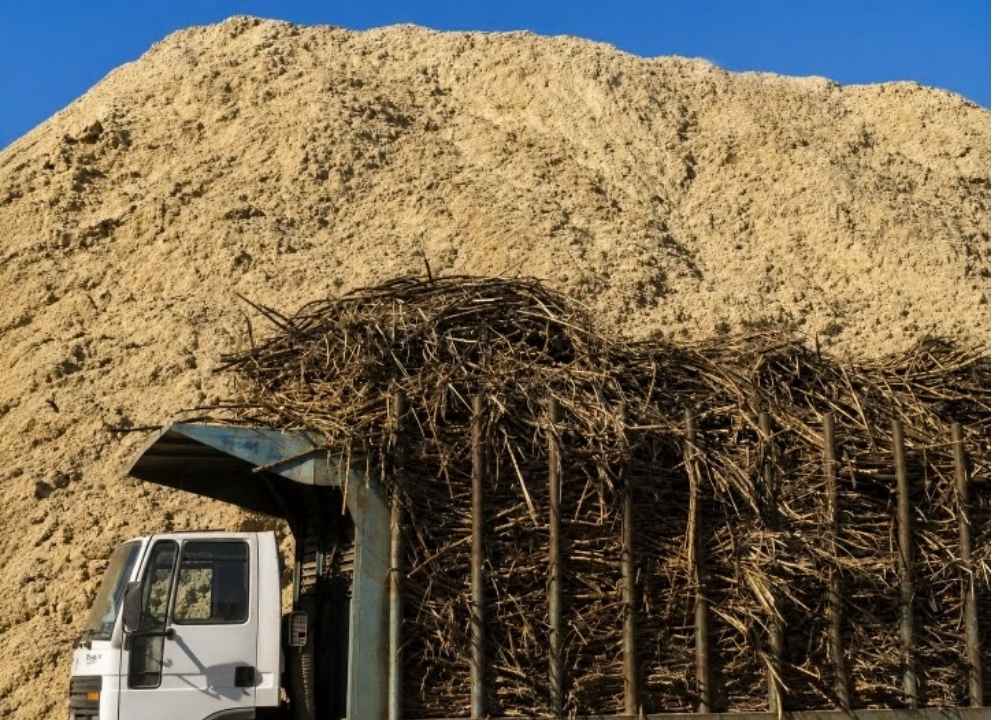
A tipper backs up to the reserve stack at a sugar mill’s bagasse yard and drops another load on a pile already two storeys high. Nobody on the ground can see inside it. Bagasse heats from the core outward, and the surface is usually the last place to show it. By the time a warm patch can be seen or felt by hand, the core has typically been heating for days, sometimes longer.
That is the problem a reserve yard has to manage: a fuel that starts fires from the inside, stored in stacks too large to inspect by hand and held for months to keep a cogeneration boiler fed through the off-season. Many mills still walk the yard once a shift and feel for warm spots. That catches a hotspot late, after it has climbed most of the way up the heating curve. A thermal camera running continuously is the only instrument that keeps pace with a fire that develops this way. It also has a blind spot of its own, and any mill specifying one needs to know where it is.
Why a walk-through and a fixed sensor both miss
A manual inspection samples one point at one moment. A fixed spot sensor or a thermocouple string improves on that only slightly, since it reports temperature where it is mounted and nowhere else. Neither matches how a fire actually develops in a bagasse stack. Hotspots do not form at a predictable location. They form wherever moisture, compaction and residence time happen to coincide on a given day, which can be anywhere along a long stack face or inside a conveyor gallery. Any detection scheme built around fixed points will, sooner or later, be looking at the wrong point.
What full-frame coverage does
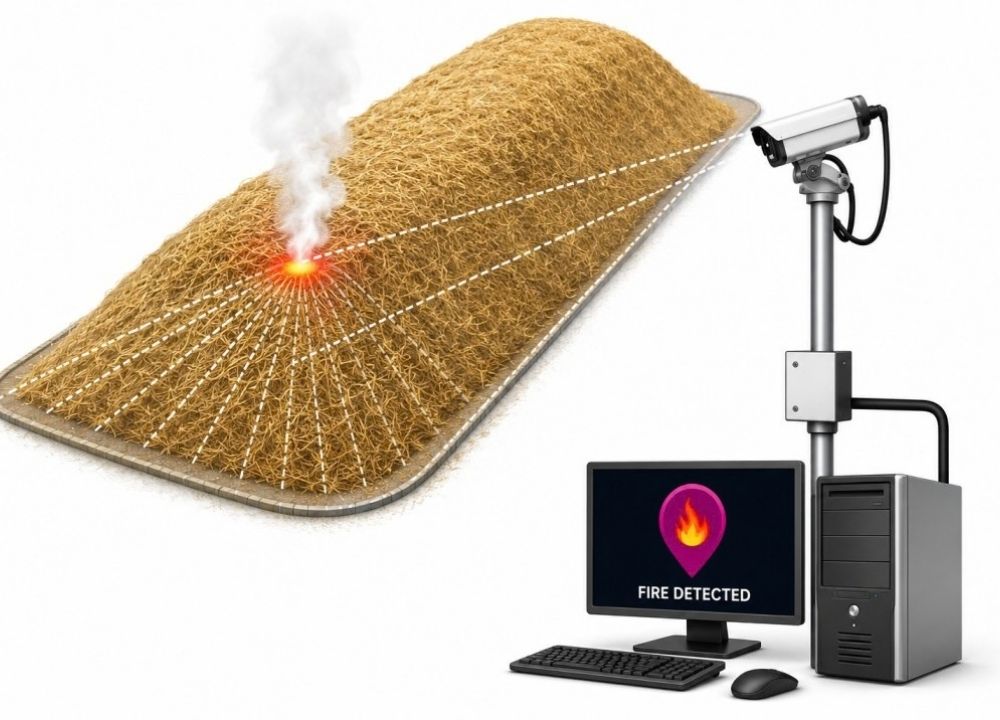
A thermal imaging camera reads its entire field of view continuously. A typical industrial unit carries a detector array of several tens of thousands of pixels, and each pixel is a live temperature reading. Pointed across a stack face or down a gallery, the camera turns the whole visible surface into a monitored zone instead of a handful of checked points. That is what makes it possible to catch a hotspot while it is still small enough to remove by reclaiming a section rather than fighting a fire.
The single reading matters less than the trend. A patch a few degrees warmer than its surroundings is unremarkable on its own. The same patch climbing steadily hour after hour is a different matter, and the monitoring software has to be set up to surface that rate of rise rather than a fixed threshold alone. Early self-heating in bagasse is microbial and slow; the curve generally steepens only once the core reaches the range where chemical oxidation takes over. Alarm logic carried across from a coal stockyard will not read a bagasse pile correctly. Set too tight, it floods the operator with false alarms every afternoon when the sun warms the stack face. Set too loose, it misses the early rise. Thresholds and rate-of-rise settings have to be tuned on the yard’s own data over the first few weeks of operation, and revisited when the season changes.
The blind spot even good cameras have
One limitation needs stating plainly. Bagasse heats from the inside first, and a large, well-insulated reserve stack can run hot at the core long before that heat reaches a surface any camera can see. Surface thermal imaging on its own can miss a fire that is already well advanced deep inside a tall stack. The stronger arrangement pairs surface coverage with embedded temperature probes or periodic core sampling in the deepest static zones of the yard, so detection never rests on the surface reading alone.
This adds cost and maintenance. Probes in a pile that is later reclaimed get damaged or lost. Core sampling takes a crew off other work. The mills I have seen weigh that against the cost of losing a reserve stack and the boiler downtime that follows, and accept it.
Coverage geometry: where the cameras need to sit
A single camera at the yard gate is not coverage. Reserve yards are irregular by nature, with stack faces, access roads and covered storage bays that block line of sight from any one position. Effective coverage means placing units so their fields of view overlap across every static storage zone, with particular attention to corners and bay interiors that a camera at the entrance never sees. During gallery and yard inspections ahead of a thermal imaging rollout at a sugar mill’s cogeneration yard, Rollcon’s field team found that two of the five planned camera positions would have left an entire bay corner unmonitored. Repositioning them before installation closed the gap before the system went live.
Layout errors of this kind are cheap to fix on the drawing and expensive to fix after the brackets are welded. Lens fouling has to be planned for at the same stage. Bagasse dust and steam from the mill settle on any optical surface, so purged housings or a fixed cleaning schedule belong in the specification from the start.
From detection to response
Detection pays for itself only if it triggers something. A confirmed alert should send a crew to a specific stack section within minutes, with a location the camera map can point to, rather than a hundred-metre face to search by hand. The response has to start before the trend line the camera flagged turns into visible smoke, and the choice of response is not obvious. Reclaiming a hot section exposes it to air and can flare it. Water applied to the surface of a deep-seated hotspot may not reach it, and the moisture left behind restarts biological heating in whatever bagasse remains. Isolating the section and reclaiming it under supervision, straight to the boiler where the boiler can take it, is usually the safer sequence. These decisions belong in a written response procedure agreed before the first alarm, with one named person authorised to call the action. An alert that sits in a dashboard for an hour while someone looks for a supervisor has done nothing useful.
Someone has to be watching
A reserve bagasse yard can hold fuel worth a full off-season’s generation, and it sits static for months at a time. No inspection routine built on people walking past it once a shift can watch it the way it needs watching. Full-frame thermal coverage, calibrated to bagasse and backed by core probes where the surface cannot see, can. The stack does not keep shift hours. Whatever is watching it cannot either.







