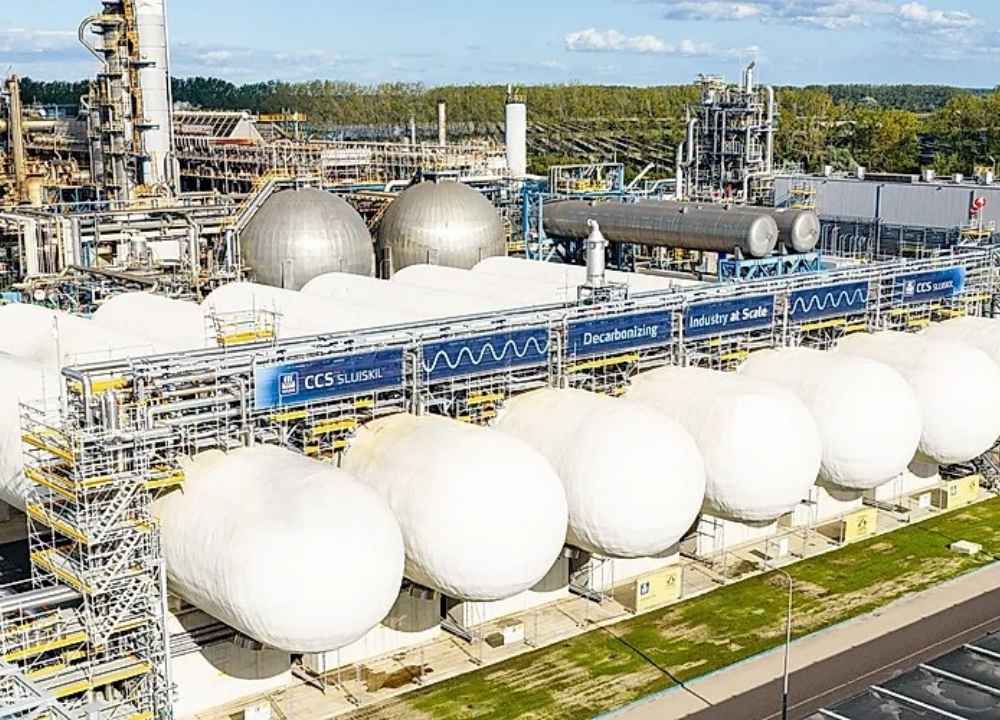
Yara has inaugurated what it describes as Europe’s largest industrial carbon capture facility at its Sluiskil plant in the Netherlands, marking the establishment of a cross-border carbon dioxide capture, transport and permanent storage chain. The project represents a significant step in the decarbonisation of industrial operations and demonstrates the potential for carbon capture and storage (CCS) to reduce emissions from hard-to-abate industrial processes.
The newly commissioned facility is capable of capturing and liquefying up to 800,000 tonnes of carbon dioxide annually from ammonia production at the Sluiskil site. Following capture and liquefaction, the CO₂ will be temporarily stored at the Yara facility before being transported by Northern Lights vessels to Øygarden in Norway.
At Øygarden, the captured carbon dioxide will be permanently stored approximately 2,600 metres below the seabed. Subject to appropriate regulatory and policy framework conditions, the project is expected to capture and permanently store approximately 12 million tonnes of CO₂ over a 15-year period.
The project builds on a cooperation agreement signed between Yara and Northern Lights in 2023. It establishes an integrated cross-border value chain covering the capture and liquefaction of CO₂ at Yara’s production site, temporary storage, maritime transportation and permanent geological storage in Norway.
Svein Tore Holsether, President and CEO of Yara International, said the inauguration represents an important milestone for both the company and European industry. He highlighted the facility as evidence that large-scale industrial decarbonisation can be implemented today, while emphasising the need for Europe to reduce emissions without undermining industrial competitiveness, employment and critical supply chains.
Tim Heijn, Managing Director of Northern Lights, said the start of operations marks the realisation of the agreement signed with Yara in 2023. He noted that the project demonstrates the viability of cross-border CO₂ transportation and storage while contributing to the development of Europe’s emerging carbon management market.
The establishment of the capture and storage chain also creates opportunities to reduce the carbon intensity of products and energy solutions associated with Yara’s operations. The company said CCS can support the production of lower-carbon fertilisers, ammonia for industrial applications and clean energy solutions, as well as fuels for the maritime sector.
The project highlights the role of collaboration between industry and governments in developing the infrastructure required for industrial decarbonisation. By connecting industrial CO₂ capture in the Netherlands with permanent offshore storage in Norway, the initiative establishes a model for cross-border carbon management and supports Europe’s broader transition towards lower-emission industrial production.