Swiss-type, or sliding head, lathes are the machines most shops walk past at exhibitions and admire from a distance. Small footprint, multiple spindles, tooling arrangements that take a moment to make sense of, and parts coming off them that look like they could not have been made in a single setup.
Swiss-type machines complete complex, high-precision components in one pass, without the part being touched between operations. The sliding headstock feeds bar stock through a guide bushing, keeping the material supported at the cutting zone and delivering exceptional dimensional accuracy on long, slender parts that would deflect on a conventional lathe.
The machines were originally developed in Switzerland for the watchmaking industry, where tolerances measured in microns and part dimensions in single-digit millimetres were the baseline. That heritage is reflected in the name, but the application of these machines has long since outgrown the watch trade.
Where Swiss-Type Machines Now Work
Medical devices account for a large share of global Swiss-type machine usage. Bone screws, surgical instruments, implant components, dental tooling, all parts where tolerances are tight, materials are demanding, and a dimensional error means rejection. The single-setup nature of Swiss-type machining matters enormously here because every additional handling step introduces the possibility of error.
Aerospace and defence follow a similar pattern, with small, complex turned and milled components for guidance systems, actuation mechanisms, and fuel systems. High-volume automotive work rounds out the picture, where Swiss-type machines run the same part at very high speed for very long cycles, and cycle time reductions of even a few seconds translate into significant output gains over a year.
Manufacturers chose Swiss-type machines to complete complex work in a single setup, reduce cycle times, and hold tight tolerances consistently across large batches. The investment is in process capability.
Why the Installed Base Is Growing
Global Swiss-type machine installations have been rising for years, driven by growth in medical and aerospace and by the broader manufacturing shift toward complexity and consolidation: fewer setups, more operations per fixturing, tighter tolerances driven by miniaturisation.
India is part of this trend. Medical device manufacturing in India is expanding, defence production is being pushed onshore, and automotive suppliers are under constant pressure to cut cost and lead time simultaneously. Swiss-type machines address all of these pressures in one platform, which is why more of them are arriving now on Indian shop floors.
The Programming Problem Nobody Talks About Enough
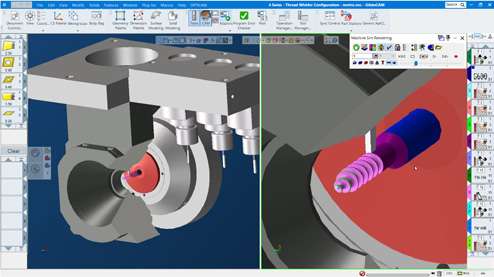
Swiss-type machines are genuinely complex to programme, and that complexity has practical consequences for anyone who underestimates it. A typical Swiss-type machine has multiple spindles, multiple turrets, a sliding headstock, a guide bushing, bar feeders, part catchers, and tool systems that can include driven tooling, Y-axis milling, thread whirling, and sub-spindle operations running simultaneously. A modern Swiss-type machine can have fifteen or more axes, with three or four simultaneous cutting flows running at once.
Historically, this complexity was managed by manual programming. The machine builder supplied a proven programme for a specific part, that part ran for years with minimal change, and the machine’s capabilities were accessed only to the extent a small group of specialists understood them.
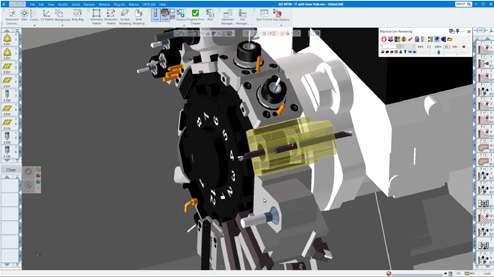
Manufacturers today run multiple parts on the same machine, make frequent changeovers, and need access to every axis and flow they paid for. That requires a CAM system built around how Swiss-type machines actually work, rather than one adapted from a general turning platform.
A generic CAM system with Swiss-type support handles straightforward operations adequately. It struggles with synchronisation across multiple flows, full machine simulation, and post-processed output that covers machine-specific utility operations like bar feed, part transfer, and re-chucking. Programmers end up compensating manually.
What GibbsCAM GO Swiss Actually Does
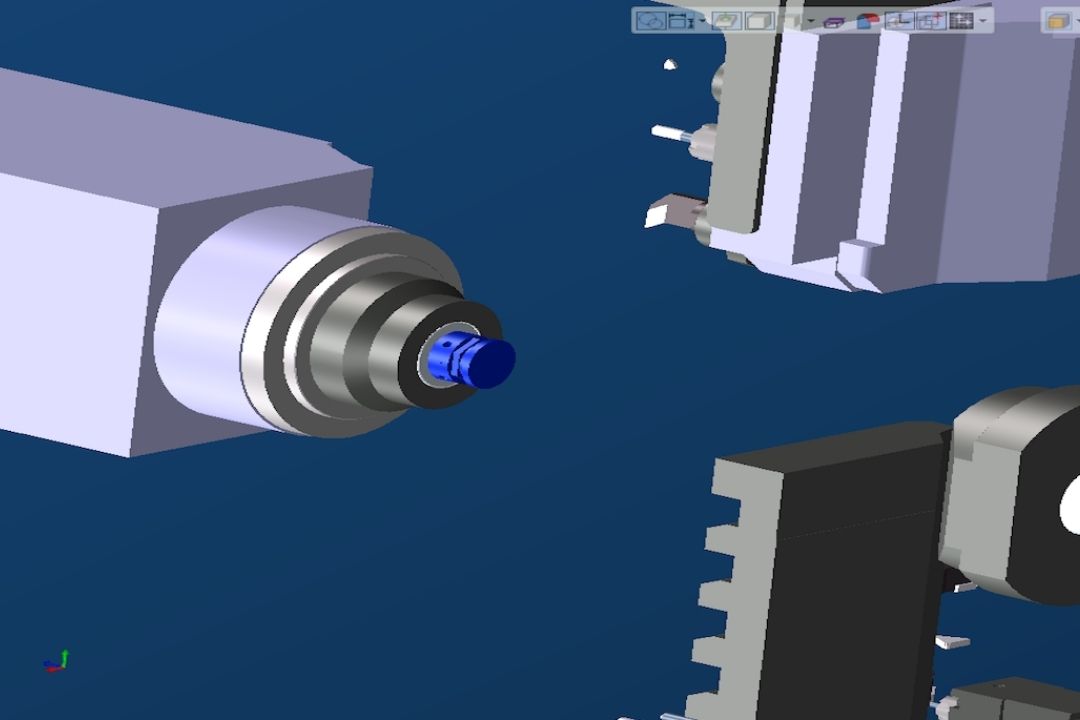
GibbsCAM’s Universal Kinematic Machine technology, known as UKM, allows users to programme, simulate, and post-process for machines with any number of axes, turrets, spindles, and simultaneous flows. The machine configuration is captured from the start, so the programmer works in an environment that accurately reflects the actual machine.
Synchronising operations across multiple parallel flows is one of the genuinely hard problems in Swiss-type programming. GibbsCAM’s Sync Manager handles it through a graphical interface that calculates operation times, controls non-cutting moves, and automatically checks for invalid synchronisation, so the programmer can focus on the part.
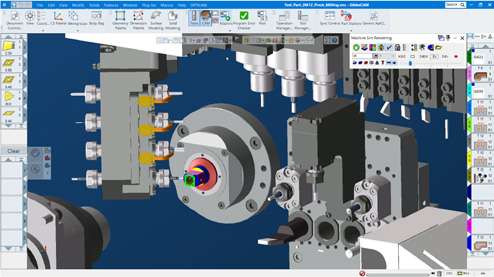
Simulation runs at the full machine level, with multiple tools cutting simultaneously and gouge checking across all active operations. Because the simulation accurately represents every machine component and movement, programmes verified on screen run as expected on the shop floor.
GibbsCAM develops post-processors in-house and supplies them factory-ready for specific machine tools. Swiss-type machines rely on utility operations like re-chucking bar stock, sub-spindle part transfer, and bar feeders that generic post-processors often handle poorly. GibbsCAM’s post-processors produce multi-flow NC code with these operations and sync codes included as standard, reducing run times from the first cycle.
Building the Knowledge Base
Swiss-type programming expertise has historically been concentrated among a small group of experienced resellers in Europe and the US. As demand grows globally, including in India and the Middle East, GibbsCAM is expanding that capability.
GibbsCAM has launched a structured training programme for sliding head and Swiss-type machine programming. The first session was held at the SECO facility in Alcester, UK, where engineers from different regions worked through real applications together and visited Citizen Machinery UK to see the machines running live.
Seeing the bar feed, the part transfer, and simultaneous cutting flows running on a real machine gives the programmer a physical reference that changes how they approach the software. The programme that comes from someone who has watched a Swiss-type lathe run reflects that experience.
Further training sessions are planned, and the programme will eventually extend to resellers in regions where Swiss-type demand is growing fastest, including India and MEA. The goal is to build local programming capability that can support customers where the machines are, so expertise does not need to be flown in from Europe or the US every time a complex application arises.
The Investment Argument
A well-equipped sliding head lathe costs more than most machining centres, and the tooling and workholding add further. The business case rests on the machine’s ability to run complex parts quickly, consistently, and with minimal operator intervention.
A CAM system that cannot programme the machine to its full capability undermines that case directly. If the programmer has to leave half the turrets unused because the software cannot synchronise them, or if proving a new part takes three days of shop floor time because the simulation was not accurate enough to trust, the machine’s economics stop working. The CAM software is part of what makes the machine viable.
This is the argument GibbsCAM makes. The shops getting the most from their Swiss-type machines programme them with software designed for the task. The shops that struggle do so because they are trying to make general-purpose CAM do something it was never designed for.