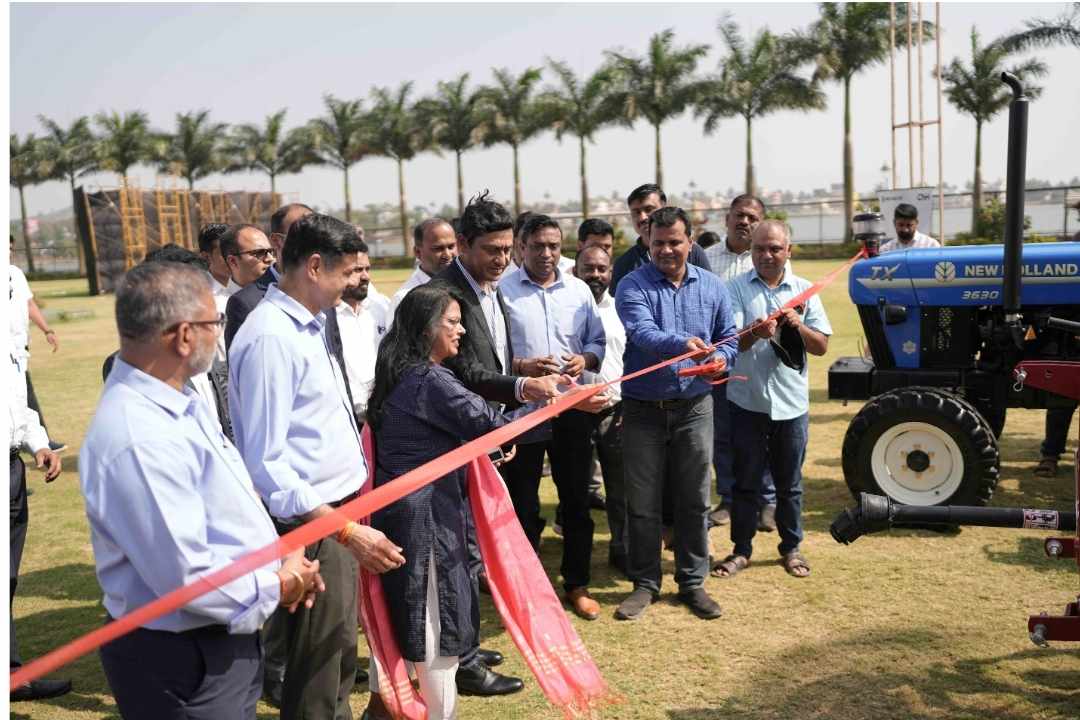
CNH, a global leader in agriculture and construction equipment, has expanded its Sustainable Environment Solution (SES) programme to key agricultural regions in South India, strengthening its efforts to curb stubble burning and promote sustainable crop residue management through mechanised farming practices. The initiative has been introduced in Sindhanoor and Hubli in Karnataka, Gudur Manal in Nellore district of Andhra Pradesh, and Lalgudi in Tiruchirappalli district of Tamil Nadu. The expansion builds on the programme’s successful implementation across several northern and central Indian states, including Punjab, Haryana, Uttar Pradesh, Madhya Pradesh, Bihar, Chhattisgarh, Maharashtra and Uttarakhand.
The SES programme focuses on agricultural extension services, farmer awareness and capacity building to address the growing challenge of crop residue management. By encouraging mechanised baling instead of open-field burning, the initiative aims to improve environmental sustainability while creating additional income opportunities for farmers.
Commenting on the expansion, Narinder Mittal, President and Managing Director, CNH India, said efficient crop residue management is essential for improving environmental outcomes and supporting sustainable agriculture. He noted that the initiative promotes practical alternatives to stubble burning that reduce air pollution, improve resource utilisation and create long-term value for farming communities through collaborative efforts.
Since its inception, the programme has enabled the baling of more than 60,000 tonnes of paddy straw, preventing an estimated 97,000 tonnes of carbon dioxide emissions. Instead of being burnt in fields, the collected crop residue is supplied to industries and power plants, where it is utilised for electricity generation and the production of methane-based fuel for automobiles. This approach not only reduces environmental pollution but also converts agricultural waste into a valuable economic resource.
One of the programme’s most notable successes was achieved in Kallar Majri village in Punjab, which emerged as a model for eliminating stubble burning. The village’s achievement received national recognition when it was highlighted by the Prime Minister of India during an episode of Mann Ki Baat in 2018.
The expanded programme will follow a structured implementation model that combines technology deployment with farmer education. CNH will support participating regions by facilitating access to mechanised baling equipment, including tractors, balers, rakes and slashers, enabling complete crop residue collection, storage and transportation.
In addition, the company will conduct awareness campaigns, field demonstrations and training programmes to familiarise farmers with the environmental and economic benefits of sustainable residue management. These activities are designed to encourage wider adoption of mechanised solutions while promoting the productive use of crop residue for composting, livestock feed, biofuel production and other industrial applications. The initiative also seeks to improve the economic viability of sustainable farming by creating opportunities linked to carbon credits and the commercial utilisation of agricultural by-products.
With the expansion of the Sustainable Environment Solution programme into South India, CNH continues to strengthen its commitment to environmentally responsible agriculture. By combining advanced farm mechanisation, farmer engagement and circular resource utilisation, the company aims to support cleaner farming practices, reduce greenhouse gas emissions and contribute to a more sustainable agricultural ecosystem across the country.
CNH India operates in the country through its Case IH, New Holland, and CASE Construction Equipment businesses and has maintained manufacturing operations in India for more than 25 years. The company also operates through its financial services arm, CNH Capital India, which provides financing solutions across its agriculture and construction equipment portfolio.
Globally, CNH Industrial develops agricultural machinery, construction equipment, digital farming technologies, precision agriculture systems, and advanced industrial solutions designed to improve productivity, sustainability, and operational efficiency across multiple industries.