

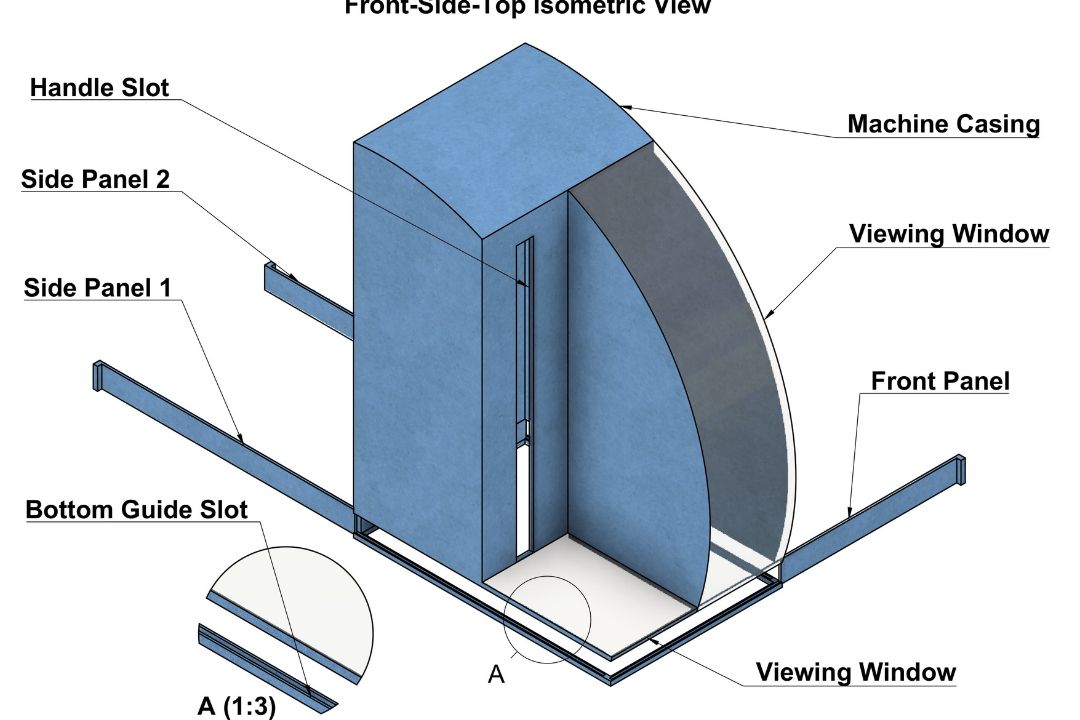
Researchers from MIT World Peace University (MIT-WPU) have developed an innovative engineering solution designed to significantly reduce noise generated during abrasive cutting operations while improving overall workplace safety. The technology, created by Dr Rohit Raghunath Ghadge, Dr Mahesh Vasantrao Kulkarni, and PhD scholar Yash Utsahi Chavande from the Department of Mechanical Engineering, aims to address one of the most persistent occupational hazards across manufacturing, fabrication, construction, and engineering industries.
The newly developed system consists of a compact protective enclosure that can be integrated with both existing and new abrasive saw machines. Unlike conventional machine guards that offer only limited protection, the enclosure surrounds the cutting zone and incorporates transparent viewing panels and adjustable access sections that allow operators to monitor cutting activities without compromising safety or productivity. A distinguishing feature of the design is its specialized geometry, combining a rectangular rear section with a curved front profile.
This configuration helps contain and redirect sound waves produced during cutting operations while simultaneously preventing the escape of sparks, metallic debris, and dust particles generated during the process. Industrial abrasive saws commonly produce noise levels ranging from 95 to 110 dB(A), making them among the loudest machines found in workshops and production facilities. Extended exposure to such environments can affect worker comfort, communication, concentration, and overall occupational safety.
The MIT-WPU innovation seeks to address these concerns directly at the source. To enhance acoustic performance, the research team evaluated advanced composite materials incorporating E-glass fibre, basalt fibre, and perforated aluminium layers. Laboratory testing conducted according to recognized industry standards demonstrated high sound absorption capabilities and significant sound transmission reduction across frequency ranges typically associated with industrial machinery.
Based on material performance and enclosure design, the researchers expect the system to achieve practical noise reductions of approximately 10–20 dB(A) under real operating conditions. Such reductions can substantially improve workplace environments and reduce worker exposure to harmful noise levels.
Beyond acoustic control, the solution supports broader occupational health objectives by minimizing the spread of sparks, airborne particles, and dust. Its retrofit-friendly design allows industries to upgrade existing equipment without extensive infrastructure modifications or major capital expenditure.
The patent application for the technology has already been filed and published. The project is currently progressing through prototype development and field validation. Researchers believe the innovation holds strong commercialization potential for sectors including manufacturing, automotive, metal fabrication, railway maintenance, shipbuilding, construction, and heavy engineering, supporting safer and more sustainable industrial operations.









