

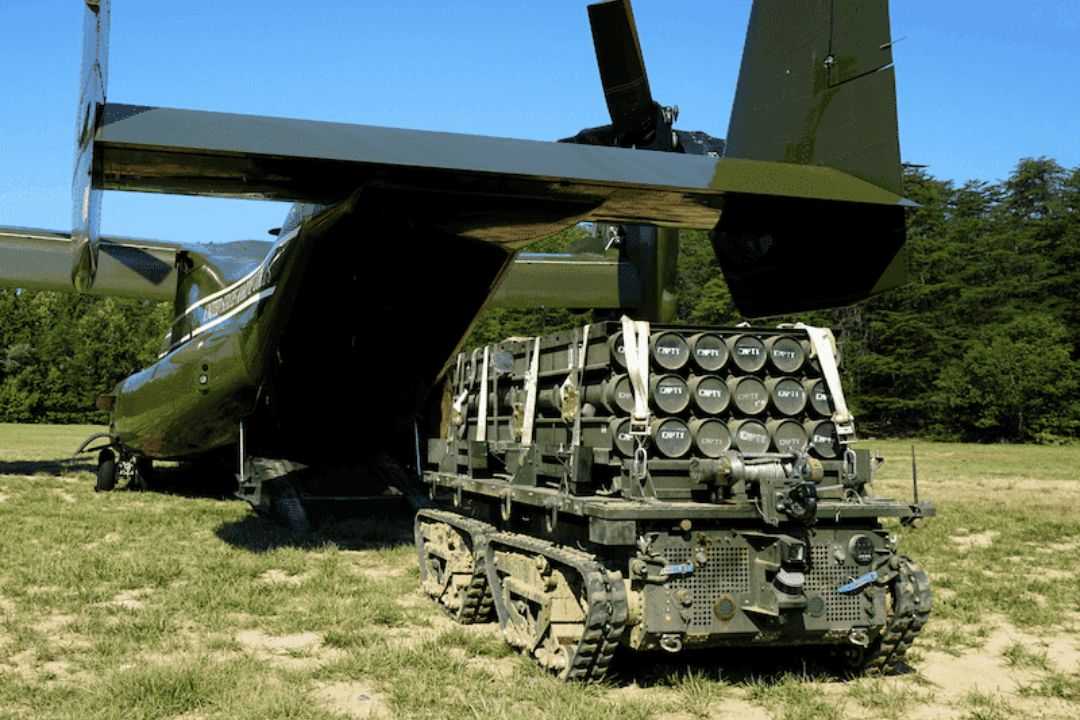
Stratom has successfully demonstrated its eXpeditionary Cargo Loader (XCL), a lightweight robotic cargo-handling system designed to support tactical airlift operations for the US Air Force in austere and contested environments. The demonstration was conducted in partnership with the Air Force Research Laboratory Center for Rapid Innovation and validated the system’s ability to improve cargo handling efficiency for C-130 aircraft operating from remote and undeveloped airfields.
Following the proof-of-concept trials, three additional operational units have expressed interest in acquiring the system to support operational deployment and pre-production experimentation initiatives. Stratom stated that it is pursuing follow-on funding opportunities to further advance the technology and support broader acquisition programs.
The XCL system has been developed to support Agile Combat Employment and contested logistics missions by enabling rapid cargo movement in challenging operational conditions while minimizing aircraft space requirements and improving mission flexibility. Unlike conventional cargo-handling equipment, which can occupy up to three pallet positions inside a C-130 aircraft, the XCL system requires only a single 463L pallet position while still supporting cargo loads of up to 10,000 pounds.
This reduced footprint allows aircraft operators to free up additional space for mission-critical equipment, personnel, and cargo, potentially enabling transport aircraft to carry two to five additional pallet positions during operational missions. The company said the solution directly addresses operational challenges associated with tactical airlift logistics and expeditionary deployment scenarios.
Mark Gordon, President and CEO of Stratom, stated that the XCL system was specifically engineered to improve aircraft utilization and enhance mission effectiveness in contested operational environments. The cargo loader operates on a tracked mobility platform capable of navigating sand, dirt, rough surfaces, and uneven terrain commonly encountered in forward-operating locations and remote deployment zones.
Stratom noted that the system’s low-signature architecture minimizes emissions from onboard radios and sensors, reducing detectability and supporting military operational security requirements. The platform also aligns with Department of the Air Force operational energy objectives by lowering fuel demand and reducing the number of sorties required to complete logistical missions.
According to the company, one of the key design priorities was enabling rapid deployment immediately after aircraft arrival. The XCL can reportedly begin operations within ten minutes of unloading from air transport while offering simplified controls that reduce training complexity for operators.
Stefan Elsener, Director of Engineering Operations and Program Management at Stratom, stated that the system was developed specifically for the realities of tactical logistics missions in austere conditions. He noted that the focus was on delivering a low-complexity, highly mobile system capable of immediate operational readiness while reducing risks for military personnel.
Technical specifications for the XCL include a total system weight below 5,000 pounds, compatibility with 463L pallets and ISU containers, tethered remote-control operation, and all-terrain tracked mobility. The company plans to showcase the XCL platform at the Support Equipment and Vehicle Modernization Summit taking place from May 11 to May 15, where the system’s applications for expeditionary logistics and Agile Combat Employment operations will be highlighted.
Stratom specializes in autonomous ground vehicles, robotic logistics systems, hazardous material handling solutions, and autonomous mobile robotics for defense and commercial applications. The company’s technologies are currently used to support cargo movement, robotic refueling, hazardous liquid transfer, and advanced logistics operations in complex and demanding environments worldwide.








