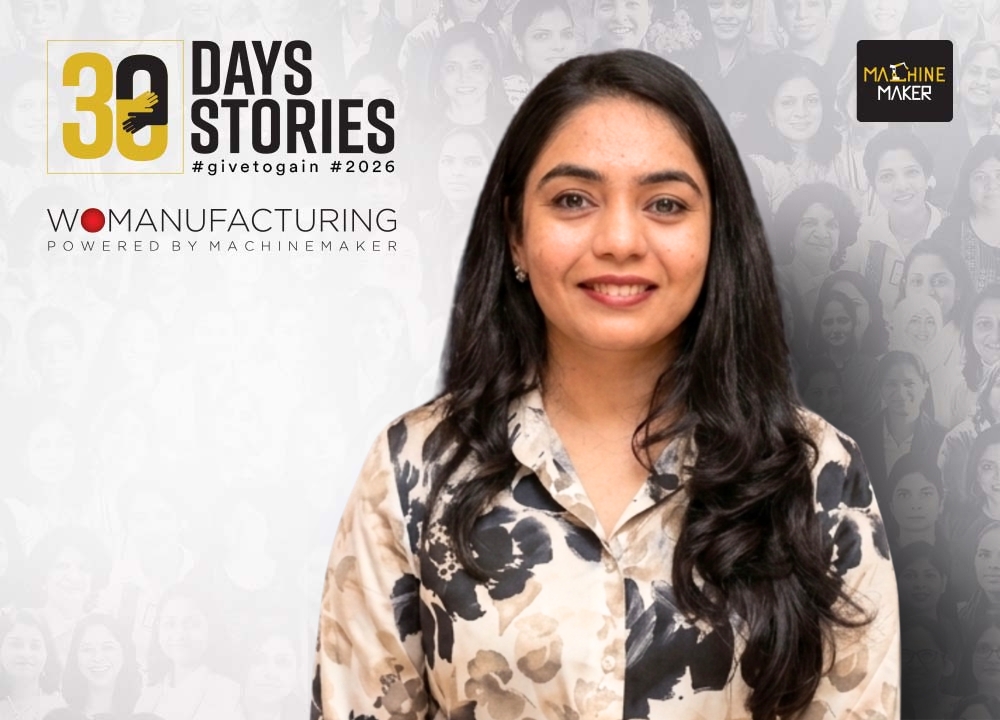
Shruti studied accounting and finance. She expected a career in numbers, cost structures, and ledgers. What she did not expect was to spend three months on a construction site learning how seismic-resistant support systems are installed inside data centres, reading engineering drawings from scratch, and figuring out the commercial documentation for one of the most technically demanding industries in the country. That willingness to start from zero is what defines Shruti Dedhia. She is the Whole-Time Director and Finance head at JIKA EPC Services Limited, a Navi Mumbai-based company that designs, manufactures, and installs precision engineering systems for data centres, semiconductor facilities, and other critical infrastructure. She oversees finance, customer billing, regulatory compliance, HR, administration, and IT for an organisation of over 600+ workforce. A decade in, she has not stopped learning.
JIKA EPC Services is part of the Riddhim Siddhim Group, a second-generation family business with over 35 years of experience in roll forming and precision engineering. JIKA was carved out as a separate entity to focus specifically on the data centre infrastructure market, offering turnkey smart solutions including structural false ceilings, seismic-resistant modular MEP support systems, hot aisle containments, and caging partitions. The company has executed 520-plus megawatts of IT deployment, achieved 72% repeat business, maintains a zero-accident record, and holds eight global certifications. Chairman Vilas Dedhia and Managing Director Rushabh Dedhia lead the company, with Shruti Dedhia as Whole-Time Director alongside independent directors on the board.
Eight Years of Building the Foundation
Shruti joined the parent company, Riddhim Siddhim, in 2014, straight out of college. She came in with a degree in accounting and finance and was looking for a role where she could put that knowledge to work. What she found was something broader: a manufacturing business where understanding numbers meant understanding the entire operation, from procurement to final delivery.
Over eight years, she moved across functions. Accounts first, then HR, then compliance, then site billing and commercial documentation. Each move was a layer added to her understanding of how a manufacturing business actually runs. By the time JIKA was established as a separate company to serve the data centre industry, she had seen the operation from almost every angle. Moving to JIKA was not part of a plan she had drawn up. It happened because the business needed it and she was ready for it.
Every step was a good learning phase. That is how she describes it. Not a series of calculated career moves. A decade of accumulation, each role building on the last, until the picture was complete enough to lead.
Three Months on Site with No Engineering Background
When Shruti moved into JIKA’s world, the technical gap was real. Data centre infrastructure involves precise engineering, complex drawings, exacting installation standards, and commercial documentation that only makes sense if you understand what the drawings describe. She had none of that background.
Her response was straightforward. She spent three months on site. Not in an office reviewing reports. On the actual construction floor, watching how systems were installed, learning how to read drawings, doing product training, familiarising herself with the software the engineering teams used. She was not going to lead a business she did not understand.
Her husband Rushabh, who is also Managing Director and an engineer, was a patient teacher throughout this process. He walked her through drawings, helped her understand technical documentation, and supported her at every stage. The learning was challenging. It was also, she says, genuinely exciting.
Getting live knowledge from the industry, knowledge that is useful in the long run. That is how she describes what those early months gave her. Not a shortcut. A proper foundation.
When the Room Expected to Deal with Someone Else
Data centre infrastructure is a sector where almost everyone at the table is a man. When Shruti first began dealing with clients and suppliers in this space, some of them assumed they would be more comfortable doing business with her husband or another male counterpart.
She did not argue with that preference or try to explain herself around it. She simply made clear that she was the person they would be working with: “You have to deal with me, whether you are comfortable with it or not.”
She said it plainly. Not aggressively. Not as a statement of defiance. As a fact. And they accepted it. She did not feel the need to prove herself through performance or persuasion. Her faith in her own capability, built over a decade of learning the business from every angle, was enough. The room eventually caught up.
The Man Who Came from Interior Design and Built a Manufacturing Company
When Shruti talks about who inspires her most, her answer is her father-in-law, Vilas Dedhia. Vilas Dedhia started his career in interior design. He did not come from a manufacturing background. He built one. Over 35 years, through ups and downs, through the slow grinding work of establishing credibility in an industry that rewards technical expertise above almost everything else, he built a business that is now publicly listed and globally active.
What she takes from his story is not the scale of what he built, but the principle underneath it: if you bring genuine knowledge from wherever you started and you have the drive to learn what you do not yet know, you can build something real in any industry. Your degree does not define your ceiling.
His three principles for running a business have stayed with her. Focus on the work. Focus on the processes. Maintain the cash flow. And running underneath all three: look after the people, because the people look after the company.
What She Would Tell Women Hesitating at the Door
JIKA currently has around 20 to 25% women in its staff roles. On-site roles remain predominantly male, though the company is actively looking to change that. Shruti is clear that the barriers for women in manufacturing and infrastructure are less about the workplace itself than about the hesitation that keeps them from walking in.
In the workspace, she says, people are increasingly supportive. The challenges are more often personal ones: family expectations, self-doubt, the assumption that technical industries are not for people without technical degrees. None of those assumptions, she knows from experience, hold up against the reality of actually doing the work.
Her message is simple: “Follow your passion. Choose the work you genuinely want to do, not what you think is realistic for someone like you. When you love what you do, the hard days are manageable and the long days feel worth it.” The concept of work-life balance, she says, dissolves when the work is something you care about.
She is a commerce graduate running the financial and operational spine of a company that builds the physical infrastructure holding India’s data economy together. She got here by learning, by staying curious, and by refusing to let the room’s assumptions about who belonged in it become her assumptions too.
Her dreams keep her going. That is the honest answer she gives when asked what sustains her through the difficult stretches. Not a framework or a philosophy. Just the knowledge that she is still moving towards something, and that the distance left is worth the effort.