Rebecca studied filmmaking, trained in theatre. She had plans to open a production house and make feature films. Then in 2023, her father’s health took a turn, and everything she thought she had mapped out shifted. She walked into a welding and cutting equipment company instead, and she has not looked back.
Rebecca Golla is the Director of Marketing at Warpp Engineers, a Mumbai-based manufacturer of welding and cutting machines that her father, Prabhudas Golla, co-founded in 1994. She brought a camera lens, a theatre sensibility, and a complete willingness to be a beginner. It turned out manufacturing needed exactly that.
Warpp Engineers Pvt Ltd has been in the welding and cutting industry for over thirty years. Founded in 1994 by Prabhudas Golla and his partner Ramakant Bhagwat, the company manufactures more than 100 machine models, operates a network of 50-plus dealers, and has an international presence across the UAE, Saudi Arabia, Oman, Indonesia, Egypt, and the United States. The company’s journey from a 500-square-foot office where the canteen doubled as the workspace, to a manufacturing operation with 250 employees, is the kind of story that plays out slowly, over decades, built on relationships that last. Warpp has employees who have been with the company for 27 years. That does not happen by accident.
Rebecca Golla: The Girl Who Wanted to Make Films
Rebecca grew up with a creative mind and a clear plan. She did her graduation in filmmaking, trained in theatre alongside her online classes during the COVID years, and saw her future in production. Opening her own production house, making a feature film. These were not idle dreams. They were scheduled.
Her father had never pushed her toward the business. That is the part she says with real warmth. “In Indian families, if you have a set business, they usually ask you to study in those areas. My father was never like that. He told me, go pursue whatever you want.”
She had always planned to join him eventually, five or ten years down the line. She had time. Then 2023 arrived and her father went through a serious health crisis. The timeline collapsed. She decided this was the right moment, not because she was obliged to, but because she chose to. “I was never told that, you know, now you have an empire to take over. It was always my decision. And yeah, here I am.”
Two Daughters, One Company, One Year
When Rebecca joined Warpp in 2024, something else happened at the same time. Rachna Bhagwat, the daughter of co-founder Ramakant Bhagwat, joined in the same year. Both in the same age group. Both stepping into a company built by their fathers. Rachna from an engineering background, Rebecca from the arts. “The best part about this is that we bring in a blend. And that blend is something that comes to us like a blessing.”
Engineering and creativity, technical precision and brand storytelling, sitting in the same room, working on the same company. The fathers built Warpp together. The daughters are building its next chapter together. There is something beautiful about that.
Why a Filmmaker Belongs in a Welding Company
The honest version of entering an unfamiliar industry: everything is alien at first. Rebecca says this directly. She had grown up hearing her father’s conversations about the business, absorbing the language without understanding the depth of it. When she actually arrived, she had to learn from the ground up.
What she brought, though, was a question that manufacturing marketing had long needed someone to ask: why is this industry so bad at showing people how interesting it is? “B2B marketing was always seen as: you don’t need to be seen by people, you don’t need social media, you just need to be in contact with big names in the industry. That was always the norm. For me, it was always a challenge to bring in my take, to keep my word that we can do so many things with marketing.”
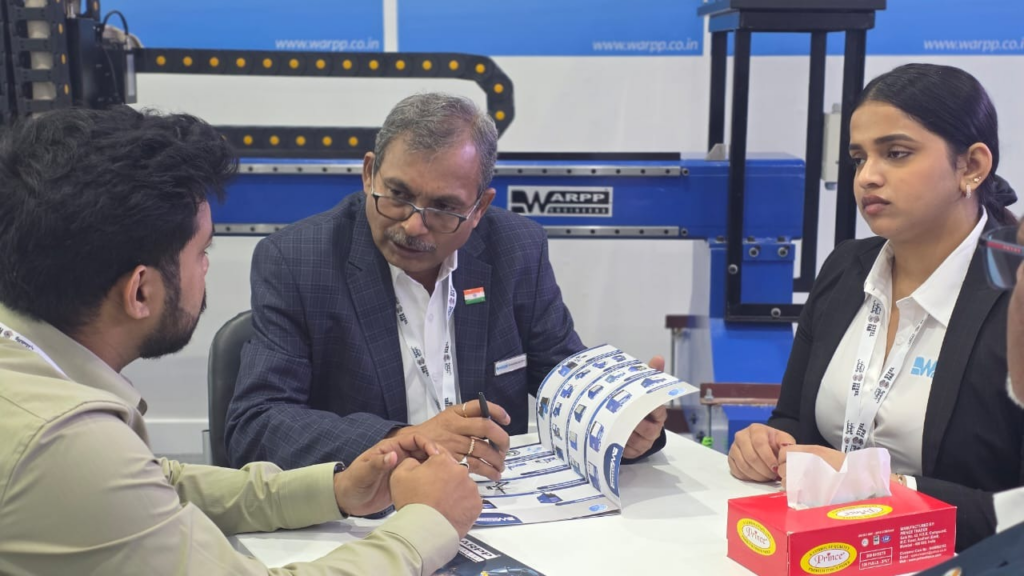
She started figuring out what works on each platform. LinkedIn, she found, is where people look for professional depth, CSR stories, and industry updates. YouTube is where they want long-form storytelling: customer spotlights, employee journeys, the real narrative behind a company. Instagram needed something different entirely. ASMR-style videos of machines in operation. The sound of welding. The rhythm of manufacturing, filmed like a short film. She keeps coming back to a line her father lives by: “You have to be relevant with the time.”
They Thought We Were Volunteers
Rebecca and Rachna were at a major industry event, attending on behalf of their fathers who were both travelling. The event had big names, senior figures, industry stalwarts. It was the kind of room where decades of manufacturing experience walked in and took their seats.
They were the only two women in the room. Someone walked up and asked them which way the food area was. “For a second I was like, even I don’t know, because we just entered. And then we realised, oh, they thought we were volunteers. Because there were no women out there. It was just us two.”
Rebecca recalls this incident as an observation about what the manufacturing world was used to seeing and what it is not. She had come from a creative world where women directing films was not remarkable. Walking into a manufacturing event and being mistaken for the catering staff was a different kind of education. “You should always stand tall and the world will see it. You don’t have to do much.”
The Babysitter Who Made It Possible
During a Women’s Day celebration at the Warpp office, Rebecca asked the team a simple question: who are the two most important women in your life? The answers came back: mothers, sisters, the expected ones. Then the woman at the front desk said: her babysitter.
Rebecca found it so interesting that she still talks about it. The woman had travelled far from home to work in the city and had no relatives nearby. The babysitter was not just childcare. She was the entire support system that made going to work possible.
“Your cook, your maid, your house help, your babysitter. They play such a vital role. Imagine people who have travelled all the way just to come here to work and don’t really have any relatives. These women are their support systems. And I think that is very important to also realise.”
It is the kind of observation that comes from someone who pays attention at every level of an organisation, not just the top.
Her Father’s Legacy, Her Own Note on the Desk
When asked about her idol, the answer comes without hesitation: her father. Not because he built a company, but because of how he built it. He is someone, she says, who has always made time for the people around him. All 250 of them.
“Anyone in the company, no matter the problem, knows they can walk up to Prabhudas sir. He has always been that person for everyone here.”
Her mother Bhagya, a homemaker, gave her something different: the seed of independence. “Please don’t pay heed to societal pressures. Keep working till you achieve what you want. Do not listen to anyone. Go out, live your life, experience everything on your own.”
Her sister Rachel is an entrepreneur, runs her own business, has an eight-year-old daughter, and balances it all with what Rebecca calls the grace of a pro. Three women, three different ways of showing what is possible. Rebecca is paying attention to all of them.
On her desk, there is a handwritten note that she keeps close: “If you wish to get to the front of the queue, then you must take your moment when it is least expected. You must not wait to be allowed, or you will never catch your opposition.” She reads it when the weight of leadership gets heavy. She wants every woman reading this to take it too.