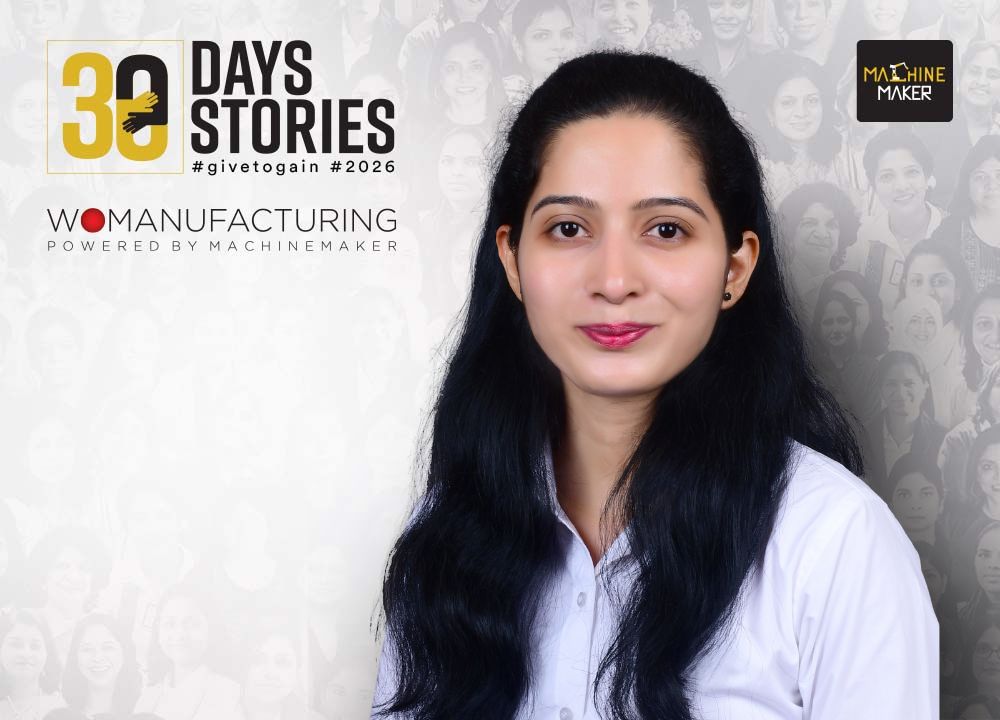
Pratiksha grew up in a farming family in rural Maharashtra, watching her father tend to his land. Agricultural machines moved through those fields every season: sowing, harvesting, turning the soil. Pratiksha Chavan watched them closely, the way curious children do, and started asking questions nobody around her thought to ask. How does this work? What is inside it? Why does it do what it does? That curiosity took her from a farm in a small town to a mechanical engineering degree, through three companies across three entirely different industrial domains, and eventually to one of the most technically demanding projects she has worked on: designing the air pollution control system for a carbon black manufacturing facility. And she is only getting started.
Ecomak Systems Private Limited is a global leader in industrial air pollution control and gas cleaning solutions. The company designs and engineers systems that capture dust, fumes, and harmful gases across industries including steel, ferro alloys, carbon black manufacturing, and power generation. Its solutions cover particulate and gaseous air pollution control, turnkey packages for steel melting shops, boiler exhaust systems, and carbon black bag collector packages. Ecomak’s work sits at the intersection of engineering precision and environmental responsibility, helping industries meet the toughest emission compliance standards while keeping workers and communities safer. Pratiksha Chavan works here as a Mechanical Design Engineer, creating the drawings and technical documentation that make these systems real.
From a Farmer’s Field to the Drawing Board
Pratiksha’s father, Tanaji Rao Chavan, is a farmer. He is also the person she credits most for who she has become. Growing up watching him work, she absorbed something that no classroom teaches formally: the values of hard work, discipline, and consistency. She also absorbed a fascination with the machines on the farm. The way they moved, the way they were built, the way they solved a physical problem with mechanical logic. That curiosity became an ambition.
When she told her family she wanted to study mechanical engineering, the reaction was one of surprise. It was far removed from anything her background suggested. But her father supported her. Unconditionally.
In small towns across Maharashtra, girls who choose mechanical engineering are the exception. The field is unfamiliar territory, dominated by men at every level. Pratiksha did not have a template to follow or a woman in the room ahead of her. She had a father who said yes, and a mind that kept asking how things worked.
Six Girls in a Class of Eighty
When Pratiksha joined her mechanical engineering programme, there were eighty students in the department. Six of them were women. She does not describe it as a hostile environment. She describes it as a challenge she accepted. The ratio told her where she stood. What she decided to do about it told her who she was.
She was drawn specifically to design. While others found the drawing and design coursework routine, she found it compelling. The idea that you could think a system into existence on paper, that you could create something complex from scratch through careful technical thinking, was what made engineering exciting for her. She built her entire career around that interest.
After graduating, she joined Sunbeam Appliances in Kolhapur, where she worked on 3D CAD design and 2D drawings for new products and product modifications, including high ambient panel air conditioners, crane air conditioners, and water chillers. Then she moved to Aqua Chill System India in Pune, designing turnkey EPC projects in HVAC and process cooling, creating equipment drawings, P&ID diagrams, and airflow schematics. Each company was a different domain. Each one required her to learn a new technical language from scratch.
The Site Visit Nobody Thought She Would Take
Design engineering is predominantly office work. Drawings, software, documentation, technical reviews. But there are moments when a designer has to go to the site, walk the factory floor, look at a problem with her own eyes, and resolve it on the spot. Early in her career, the assumption in some environments was that site visits were not for women. The conditions were not suitable, the reasoning went. It was a quiet limitation that nobody stated as a rule but everyone enforced through habit.
Pratiksha pushed back. Not loudly. Not confrontationally. She told her team directly: she could go to the factory, she could communicate with the people there, and she could handle the situation independently. Then she did it. She went to the Coca-Cola facility during her time at a previous company and proved the point not through argument but through action.
“I appreciated myself and said I can do it. I motivated myself that I can do it and I did it. Because of this, people saw that I was confident and capable. The projects started coming, one after another. My career started moving forward.” It is a straightforward principle that sounds simple but takes real courage to execute: the only way to remove a limitation is to make it irrelevant.
The Carbon Black Project
At Ecomak, Pratiksha is currently handling one of the most technically demanding projects of her career. Carbon black manufacturing is an industrial process that produces significant particulate emissions and requires highly precise, robust air pollution control systems to manage them. The engineering involved is exacting: hoppers, casings, structural frameworks, railing systems, all designed to capture and contain emissions without compromising performance, within tight spatial constraints, against strict environmental standards.
She was given this project by the company’s leadership because they believed she could handle it. She is handling it. The work involves designing manufacturing drawings, fabrication drawings, installation and assembly drawings, and detail drawings using AutoCAD and Solid Edge. She works closely with manufacturers to ensure design specifications are met during production, travels to customer premises when drawing issues need to be resolved on site, and provides support to the proposal team for customer-facing technical documentation.
What drives her is not the scale of the project alone. It is the knowledge that the system she is designing will reduce the harmful particulate matter released into the air around an industrial site, that somewhere a worker will breathe cleaner air because the drawing she produced was precise. That is the part she finds genuinely meaningful.
What She Would Tell the Next Girl from a Small Town
Pratiksha is clear about one thing: the challenges she faced were not about gender. They were about skill, confidence, and the willingness to prove yourself through work rather than through argument.“Challenges are not about gender. They are about skill and confidence. Women are not sensitive. They have a different mindset. They can be just as strong in manufacturing. The field is open. You just have to walk in.”
She has worked in three companies, navigated three different industrial domains, and taken on a project that most engineers would consider complex regardless of gender. She came from a small town and a farming family with no engineering precedent behind her. And her message to every girl in a small town who has ever wondered whether mechanical engineering is for someone like her is simple: “Believe in yourself. Mechanical engineering is not just machines and factories. It is problem solving, creativity, and impact. It is thrilling. Come into this field. It needs you.”She started with a farmer’s curiosity and the support of a father who never said no. She is building the rest herself.