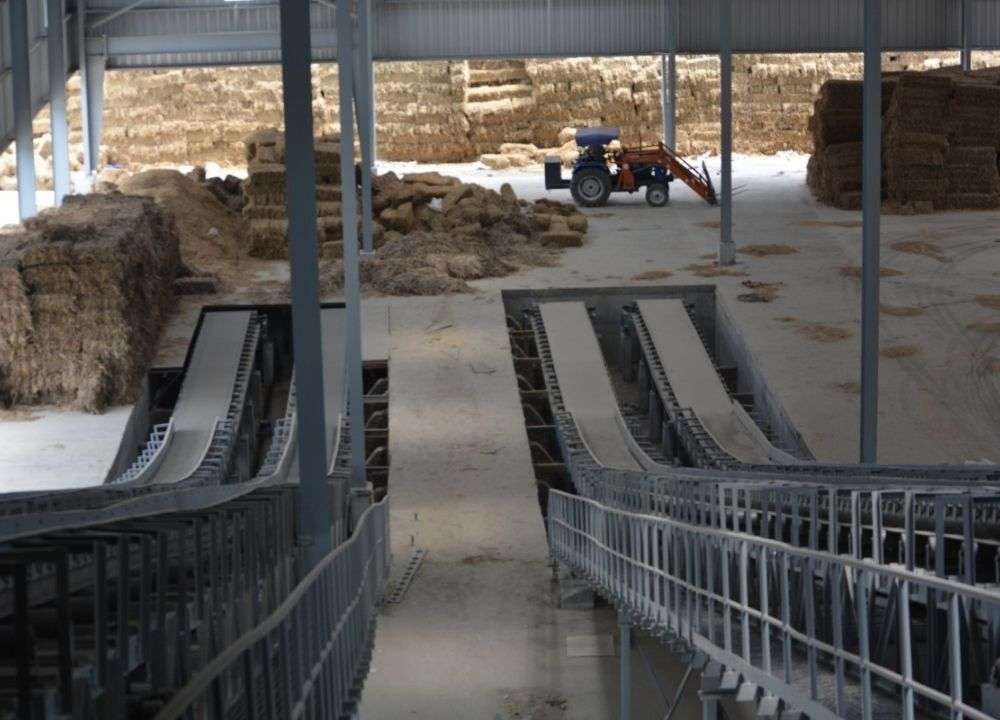
At a straw-fired boiler running close to full load, the fuel conveyor has stopped for the third time this week. A forklift has dropped bales near the feed point and two workers are lifting them onto the belt one at a time, the way it is done at most straw yards in India. Nothing in that step is wrong. A bale is not a uniform object, and getting it onto a moving belt starts with a pair of hands. The maintenance log will record this stoppage as a mistracking issue. What actually happened is that a bale landed a little off-centre, the frame and skirting were never built to absorb that much variation, and the belt drifted under the offset load until fibre wedged between skirt and belt. Two men will now spend the better part of an hour clearing the feed point and walking the belt back into line. None of that hour appears as downtime. It appears as a shift that delivered less fuel than the one before.
The complaint that reaches the plant owner is almost always about speed. The conveyor is too slow, the belt should run faster, the boiler wants more than the line can give. Across the straw bale lines I have walked in Punjab and Haryana, speed was rarely the constraint. The constraint was how many times in a shift a person had to correct for something the conveyor should have absorbed on its own. Straw bale handling is a different engineering problem from coal or loose biomass, and specifying it as a speed problem rather than a feed control problem is why so many lines run below rated capacity within the first year.
Throughput Means Something Different for a Bale
Coal is not a uniform material either. Anyone who has run a reclaimer through a monsoon knows what wet fines do to a chute. But coal handling has decades of standard practice behind it: chute angles, idler troughing, belt speeds and skirt lengths are all sized for a material that breaks down, spreads across the belt and moves as a stream. A straw bale does not behave as a stream. It is a discrete object, typically 150 to 250 kg depending on the baler and the crop, and it arrives one at a time. Bales interlock with their neighbours. They bridge over feed openings. They compress unevenly under their own weight, and their density and surface friction shift with moisture depending on when the straw was baled and how long it sat in open storage. Carry a coal-handling design across to this material and the plant inherits jamming and feed interruptions that were never in the original model.
This changes what throughput measures. In a coal system it is a function of belt speed and load density. In a bale system it is a function of how much variability the design tolerates before someone has to step in. Two lines can carry the same nameplate rating and behave completely differently once commissioned, and the difference is not on the equipment datasheet. It sits in the feed geometry, in how the frame takes point load, and in how much of the ordinary scatter of a hand-fed bale the line accepts without contact, spillage or drift. Most conveyor manufacturers in India, conditioned by coal and loose biomass work, put the least design attention exactly there.
Where the Loading Station Goes Wrong
The failure usually begins at the moment the bale lands, though not because of how it got there. Hand transfer from forklift to belt is standard at straw yards and there is no practical alternative at most plant sizes. A hand-fed bale will land off-centre by some margin every time. A design that assumes it will land dead-centre, which is what a carried-over coal frame effectively assumes, turns that ordinary margin into edge contact with the skirting. Edge contact tears fibre loose. On a straw line that is a fire matter before it is a housekeeping matter, because loose combustible fibre lying beside a running conveyor will meet a hot bearing or a spark eventually. It is also the first visible sign that the feed geometry was never engineered for this load.
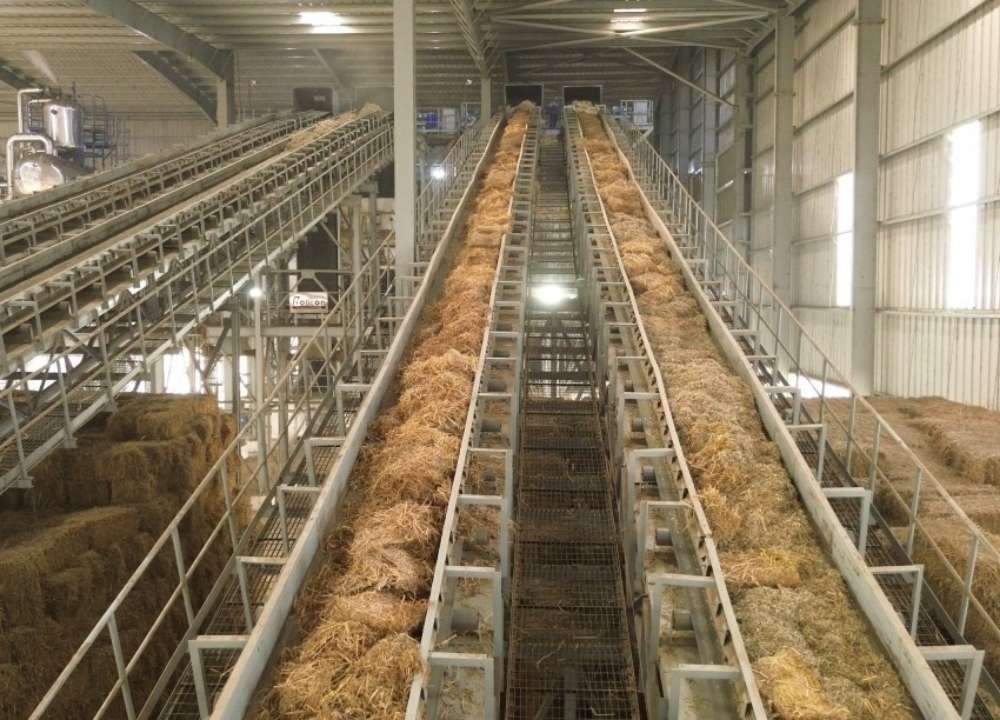
Point load is the second problem. A bale lands as a concentrated load on a small footprint, well above the distributed load that coal or loose biomass places on the same section of frame. Where the stringers and idler brackets were not sized for it, they deflect a little more with each drop. Deflection puts the idlers out of alignment, the belt starts to track off, spillage appears on both edges, and the structure fatigues ahead of its design life. None of that is a maintenance failure. It is a decision taken at the specification stage, before the plant saw its first bale.
What Each Stage Has to Absorb
On a line built for bales, the journey from open yard to boiler grate is short; on one installation we timed it at under three minutes. That figure only repeats across shifts if every stage after the hand-feeding step is designed to accept variation instead of fighting it.
At the loading station, a mechanical alignment guide should bring the bale to the belt centreline as it comes off the worker’s hands, so an off-centre placement never reaches the skirt. Along the conveying run, the skirting has to run full length on both sides, because a bale is irregular in shape and can open up in transit; skirting only at the feed and discharge points, which is normal coal practice, leaves the middle of the run unprotected. Impact idler stations at every loading zone, spaced closer than a coal design would call for, take the point load so the frame does not. In the gallery, where two parallel lines typically run to give the boiler a standby, line speed should be matched to boiler consumption so one conveyor can idle while the other feeds without an operator rebalancing by hand. At the boiler interface, an interlocked transfer with dust containment takes the last and most safety-critical handoff away from a supervisor’s eye.
Each of these choices costs something. Full-length skirting adds belt drag and a rubber wear item along the whole run. Tighter idler pitch adds idlers and bearings to maintain. An alignment guide is one more mechanism at the feed point. Those are real costs and a buyer should see them on the quote. What they replace is corrective labour: clearing a jam, walking a belt back into line, sweeping fibre off the floor. That labour never appears on a proposal, which is why the cheaper line usually wins the tender and loses the first operating season.
Reading the Warning Signs
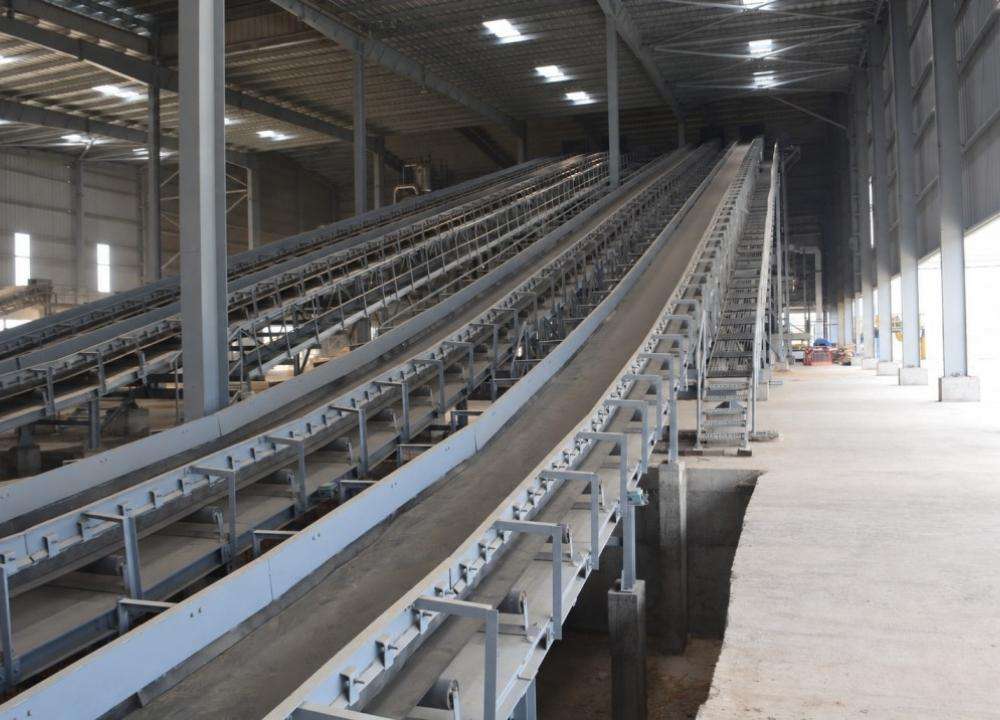
Hand transfer at the feed point is not a warning sign. What should concern a plant owner is what happens after that point. An operator routinely pushing bales back into position once they are already on the belt, breaking blockages further down the line, or nudging the flow all shift is showing where the loading step and the belt behind it do not match. A line built for bales runs consistently despite ordinary feed scatter. A line that runs smoothly only because one experienced operator is correcting for it will fail the day that operator is on leave, and that dependence never appears in a vendor’s proposal. Most plant owners discover it after commissioning, once continuous operator attention and uneven flow make it clear the system was specified for capacity and not for handling behaviour.
What the First Year Shows
The test of a bale line is its first twelve months of daily commercial running, through at least one monsoon and one fresh baling season. Two straw bale handling systems Rollcon supplied to operating boiler plants have now completed that period with no conveying-related boiler stoppage in the plant log. Forklifts still bring the bales in and hands still lift them onto the belt. Everything downstream of that point was sized for what a hand-fed bale actually does: its point load, its irregular shape, the way it changes with moisture. Full-length sealed skirting, impact idler stations at every loading zone and a bale alignment guide are there for one reason, which is to take the corrective labour off the shift. That shows up in one place. On the shift log, the tonnage column stops depending on who was on duty.