


In precision manufacturing, miniature end mills commonly defined as tools with diameters below 1/8 inch (3.175 mm) plays a critical role in producing high-complexity components. These tools are indispensable in aerospace, medical devices, electronics, mould & die, and micro-mechanical applications, where tight tolerances, fine surface finishes, and intricate geometries are non-negotiable.
However, machining at this scale operates under a fundamentally different set of physics compared to conventional milling. Success depends not only on machine capability, but also on a deep understanding of tool behaviour, material response, and process optimisation.
Understanding the Fundamental Challenges
Tool Fragility and Strength Scaling
Tool stiffness decreases rapidly with diameter. Bending stiffness is proportional to the fourth power of tool diameter, meaning that reducing diameter by 50% results in a stiffness reduction of approximately 94%. As a result, miniature end mills are highly sensitive to deflection, vibration, and overload, even under seemingly conservative cutting conditions.
Runout: A Critical Failure Driver
In conventional milling, radial runout values of 5–10 μm may be tolerable. Inmicromachining, the same runout can be catastrophic.
- Example: A 0.5 mm end mill with 10 μm runout experiences 2% eccentricity, causing one flute to carry most of the cutting load.
- Best practice: Keep total indicated runout (TIR) below 1–2% of tool diameter, preferably under 5 μm for tools below 1 mm.
Excessive runout leads to:
- Uneven flute wear
- Premature chipping
- Poor surface finish
- Sudden tool breakage
Chip Thickness vs. Cutting Edge Radius
At miniature scales, the minimum chip thickness becomes a dominant factor. When chip thickness approaches or falls below the cutting edge radius:
- The tool transitions from shearing to ploughing
- Cutting forces increase sharply
- Heat generation rises
- Burr formation and work hardening intensify
For many micro-tools, the minimum effective chip thickness is approximately 20–40% of edge radius, which must be accounted for when setting feed per tooth.
Optimisation Strategies for Miniature End Mills
Tool Selection and Setup
- Choose the largest possible diameter that meets geometric constraints to maximise rigidity.
- Prefer short flute lengths and reduced neck tools where possible.
- Advanced coatings (AlTiN, TiSiN, nano-composite coatings) can extend tool life by 30–200%, particularly in hardened steels and stainless alloys.
Coatings also enable cutting speed increases of 20–50%, provided heat evacuation is managed effectively.
Tool Holding Best Practices
- Shrink-fit and high-precision hydraulic holders typically achieve <3 μm runout, outperforming standard collet systems.
- Minimise tool overhang; even a 1 mm reduction in stick-out can significantly reduce deflection.
- Ensure maximum shank engagement in the holder to improve damping and stability.
Toolpath Considerations
Toolpath strategy significantly influences miniature end mill performance. When entering workpieces axially, circular ramping distributes cutting forces evenly across multiple axes, reducing shock loading. For radial approaches, arcing entries gradually introduce cutting forces rather than instantaneously loading the tool.
When machining slots, conventional wisdom regarding flute count must be reconsidered. For miniature applications, higher flute counts increase core diameter and rigidity, reducing deflection risk. However, this necessitates shallower depth of cuts, typically 5-15% of tool diameter rather than the 50-100% common with larger tools. Increase feed rates proportionally to maintain productivity.
Feed rate modulation around corners is essential, as these geometric transitions significantly increase tool engagement and cutting forces. Deceleration when approaching corners prevents force spikes that could compromise tool integrity.
Operational Parameters
The climb versus conventional milling debate requires nuanced consideration in micromachining. Climb milling generally yields superior surface finishes but may induce chatter in insufficiently rigid setups. Conventional milling proves advantageous for delicate operations and thin-walled features due to its tendency to pull the tool into the material.
Flood coolant application reduces cutting forces while enhancing surface finish. Testing workpiece hardness prior to machining confirms material properties and enables appropriate parameter selection. For materials prone to burring, consider applying support materials to reinforce workpiece edges.
Advanced Techniques
Variable Geometry Tools
Variable pitch and variable helix designs disrupt harmonic frequencies at high spindle speeds (often 40,000–100,000 RPM), reducing chatter and improving stability.
Thin-Walled Component Strategies – Case Insight
In medical implant machining, thin titanium walls (<0.3 mm) often lack sufficient rigidity for separate roughing and finishing passes. Successful strategies include:
- Single-pass semi-finishing with reduced step-over
- Controlled radial engagement below 10% D
- Optimised toolpaths to maintain constant engagement
Such approaches have demonstrated tool life improvements of 40–60% while maintaining dimensional accuracy within ±5 μm.
CTC Praezision Tools: Precision Engineering for Micromachining
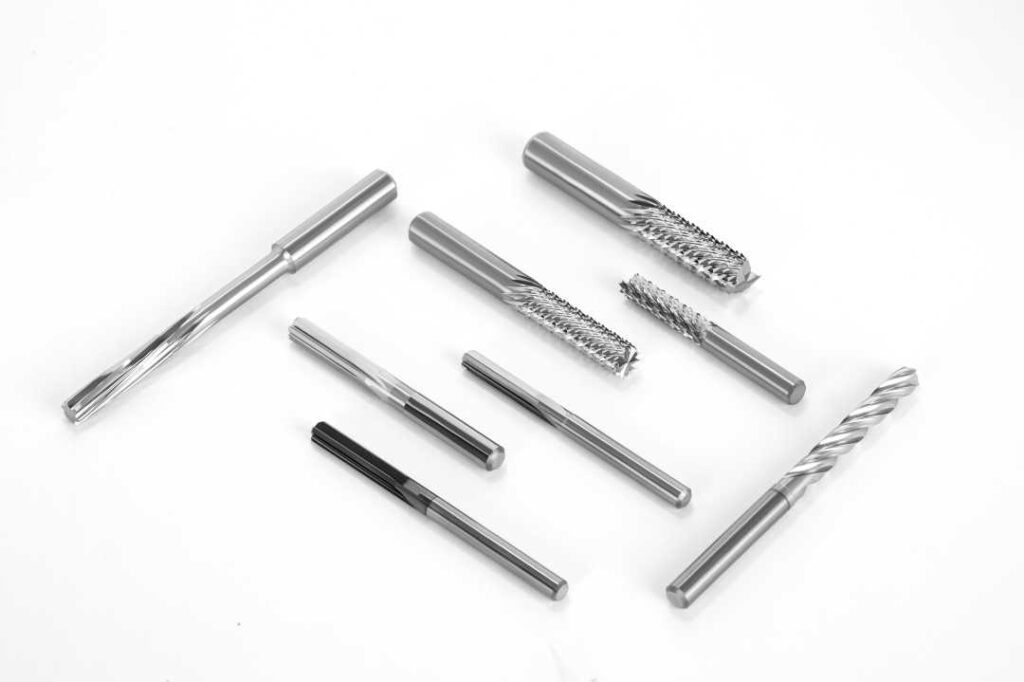
CTC Praezision, a division of the CTC Group, offers specialised cutting tools designed explicitly for micromachining applications. Their product lineup features miniature end mills manufactured with sub-micron grain carbide substrates, providing exceptional edge strength and wear resistance critical for micromachining success.
The company’s coating technologies address the unique thermal and mechanical demands of miniature tooling. Their ultra-precision grinding processes achieve exceptional concentricity tolerances, minimising the runout issues that plague micromachining operations.

CTC Praezision’s end mills are available in diameters as small as 0.1mm with various geometries optimised for specific material applications. Their application engineering team provides technical support for parameter optimisation, ensuring customers achieve maximum tool life and part quality in demanding micromachining applications.
Conclusion
Miniature end milling is a discipline where microns matter and assumptions fail quickly. Tool failure is rarely caused by a single parameter; it is the cumulative result of runout, chip thickness, engagement, and thermal effects acting together. Manufacturers who treat micromachining as a distinct process supported by precision tooling, disciplined setup, intelligent toolpaths, and data-driven parameter selection consistently achieve higher productivity, longer tool life, and superior surface quality.
At the micro scale, precision is not a goal, it is the operating condition. When paired with premium offerings like those from CTC Praezision, these techniques enable the reliable production of intricate components with exceptional precision and surface quality.







