


As India accelerates into a new phase of advanced manufacturing driven by aerospace, defence, composites, renewables, and next-generation infrastructure, the role of Additive Manufacturing is rapidly shifting from experimentation to actual industrial production. With hybrid processes, AI-driven predictability, and high-performance composite materials now entering mainstream usage, the global technology race in Large-Scale Additive Manufacturing (LSAM) has intensified.

The Indo-Italian Chamber of Commerce and Industry (IICCI), with the support of the Embassy of Italy in New Delhi, and in collaboration with UCIMU – SISTEMI PER PRODURRE Group and AMAPLAST, is hosting a technical webinar titled “Additive Manufacturing Unlocked: Innovations, Trends & Sectoral Growth Opportunities” on 9th December 2025 from 3:30 PM to 4:30 PM IST. Ahead of his technical session at the Indo-Italian Additive Manufacturing webinar being held tomorrow, Andrea Sanzani, Sales Area Manager at Breton SpA, spoke exclusively to Machine Maker, offering deep insights into Breton’s flagship Genesi Large-Scale Hybrid Additive Manufacturing platform, its future impact, and the growing strategic relevance of India in Breton’s global roadmap.
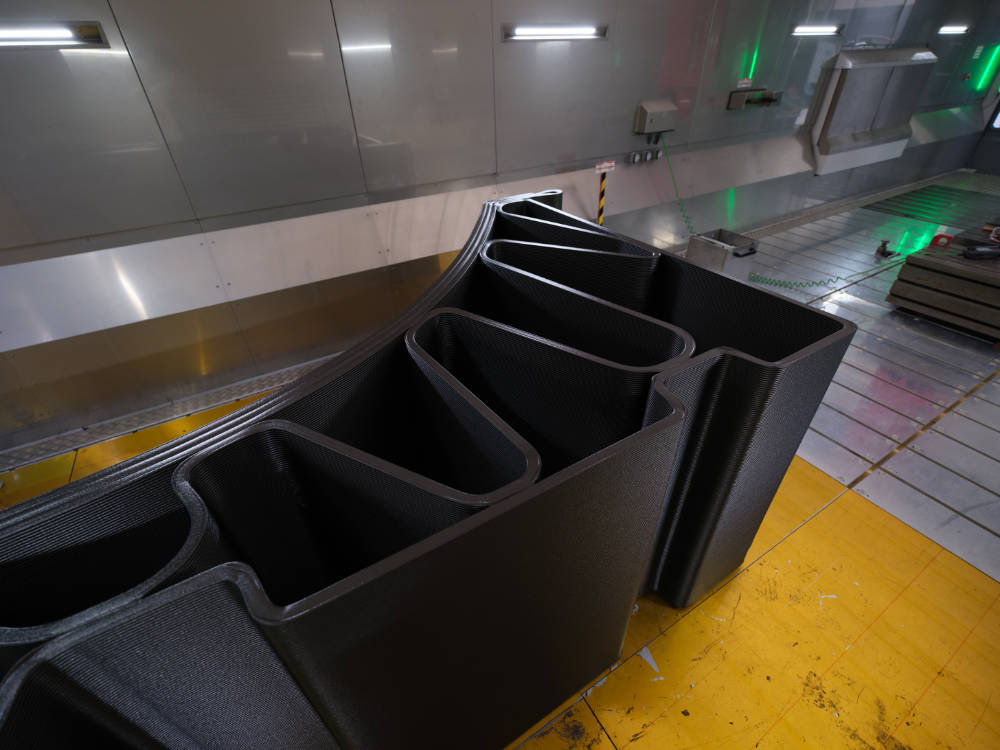
According to Andrea Sanzani, Genesi was conceived from the outset as a pure industrial production system, not a prototype-driven 3D printer. Designed for Large Scale Additive Manufacturing using reinforced thermoplastics, Genesi ranks among the world’s largest industrial additive platforms, with a deposition capability of up to 200 kg per hour. This massive extrusion capacity directly translates into faster build times and sharply reduced operating costs across labour, machine utilisation, and power consumption. What further strengthens the process is the larger extrusion bead itself, which enhances both mechanical layer compactness and aesthetic surface quality after milling, making the output suitable for demanding end-use applications.
One of Genesi’s most defining differentiators is its hybrid architecture, which seamlessly integrates additive manufacturing and high-speed CNC milling on the same machine platform. Unlike conventional workflows that require multiple handoffs between printing and machining centres, Genesi enables manufacturers to print large near-net-shape parts and immediately perform final finishing operations via high-speed milling—within a single, tightly controlled production environment.
This capability allows for manufacturers to directly produce “ready-to-use” industrial components, delivering significant gains in process time, dimensional accuracy, and surface quality. For industries such as mould & die, aerospace structures, naval applications, and energy systems, this hybridisation unlocks an entirely new class of large, high-performance components that were previously difficult or economically unviable to manufacture.
Perhaps the most significant industrial breakthrough within Genesi lies in its predictive AI-driven control architecture. Large-format thermoplastic extrusion has traditionally suffered from repeatability uncertainty—variations in thermal behaviour, layer fusion, and adhesion often compromise final part quality. Genesi overcomes this through a closed-loop system driven by machine learning, predictive control logic, and real-time thermal imaging. During printing, the machine continuously monitors layer temperature using thermal cameras and automatically adjusts extrusion speed, corner behaviour, adhesion temperature, and layer fusion parameters. If deviations are detected, the system autonomously adjusts the next layer’s parameters to maintain perfect adhesion and fusion continuity. Over time, the platform continuously improves its prediction accuracy through reinforcement learning, transforming Genesi into a self-learning production system rather than a static machine tool.

On the materials front, Genesi is optimised for high-performance composites and engineering polymers, including carbon-fibre and glass-fibre reinforced compounds such as ULTEM (PEI). These materials offer exceptional stiffness, low thermal expansion, and temperature resistance up to 150°C, making them ideal for high-temperature tooling, aerospace structural parts, autoclave-ready moulds, and advanced naval components. This material compatibility firmly positions Genesi as a core platform for industries operating under extreme thermal, mechanical, and dimensional performance requirements.
Looking ahead, Sanzani believes the most transformative impact of Genesi over the next three to five years will come from the full maturation of its AI-driven predictive manufacturing capabilities and the emergence of new industrial business models. By optimally controlling layer adhesion behaviour and thermal fusion, Genesi has demonstrated the ability to reduce material usage by up to 60 per cent in specific applications, directly improving part economics, lowering waste, and accelerating ROI. This shift will significantly accelerate the industrialisation of additive manufacturing, particularly in tooling and mould manufacturing, where high-performance moulds can now be produced rapidly using thermoplastics and immediately finished through hybrid milling. The aerospace and naval sectors are also poised for rapid adoption in areas such as eVTOL structures, drone fan housings, and eco-sustainable marine hulls.
Sustainability is another dimension where Genesi is expected to play a defining role. Additive manufacturing inherently reduces waste by using only the required material for structural performance. Beyond this, Breton is actively engaged in the research and development of recycled and bio-composite materials. This effort was recently recognised with the Innovazione Smau 2024 award for sustainable materials innovation. With machine learning built into the Genesi platform, new sustainable materials can be rapidly characterised in collaboration with customers, enabling faster industrial validation and adoption of environmentally responsible manufacturing solutions.
From a market standpoint, India holds deep strategic significance for Breton. The company’s engagement with the Indian ecosystem spans more than 25 years, beginning with early installations at institutions such as NAL and CMTI. For a long time, although Breton’s high-end technologies were greatly admired, adoption remained limited to specialised, niche applications. However, over the past four to five years, this landscape has changed decisively—especially with India’s rapid expansion in aerospace, defence, and advanced manufacturing, supported by rising domestic aviation demand, defence offset programmes, and indigenous platform development. This evolution has led to a sharp increase in serious industrial enquiries, many of which have successfully converted into firm orders.
Breton also sees a strong opportunity emerging from global manufacturers setting up production facilities in India, many of whom are already Breton customers elsewhere. At the same time, the rise of ambitious Indian startups and new-age OEMs in aerospace, composites, drones, and advanced structures is opening new opportunities for deep technology partnerships. Sanzani emphasises that Breton sees itself not merely as a supplier of machines, but as a long-term technology partner to its customers, working alongside them as they scale up their manufacturing ambitions.
Together, these developments signal a clear shift: large-format additive manufacturing is no longer a futuristic concept; it is rapidly becoming an industrial production reality. With Genesi, Breton is combining scale, composite performance, AI-driven predictability, and hybrid machining into a single industrial platform. As India deepens its footprint across aerospace, defence, infrastructure, energy, and sustainable manufacturing, technologies such as Genesi are poised to play a decisive role in shaping how the country designs, builds, and industrialises its next-generation high-performance components.








