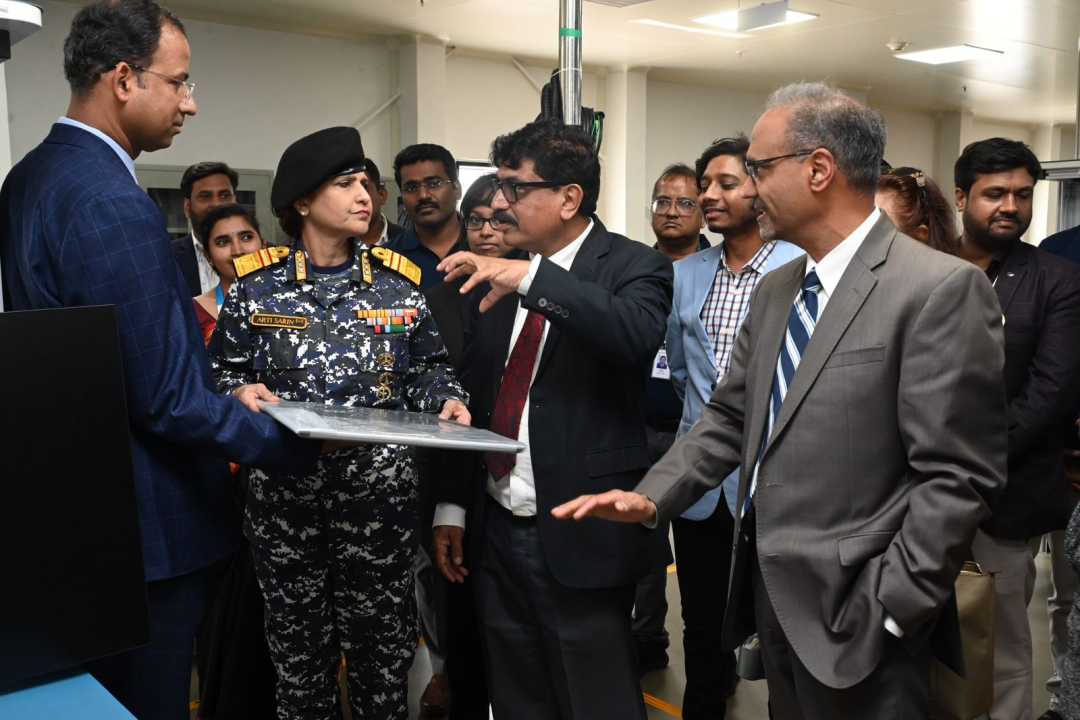
India’s medical technology manufacturing ecosystem received a major boost with the inauguration of Varex Imaging Corporation’s advanced production facility at the Andhra Pradesh MedTech Zone (AMTZ) on December 13. The launch marks a significant step toward domestic manufacturing of critical diagnostic imaging technologies and was held on the final day of the World Health Innovation Forum 2025, organised by AMTZ.
The facility was formally inaugurated by Surgeon Vice Admiral Arti Sarin, AVSM, VSM, Director General of Armed Forces Medical Services, along with Rajiv Nath, Managing Director of Hindustan Syringes & Medical Devices Ltd. and Forum Coordinator at the Association of Indian Medical Device Industry (AiMeD).
Located within the AMTZ campus, the new plant will manufacture flat panel detectors and other advanced imaging components, including Cesium Iodide (CsI) coating technology—introduced in India for the first time. This capability signals a shift in global diagnostic imaging supply chains, positioning India as a credible destination for high-value, precision manufacturing that has traditionally relied on imports.
Varex Imaging develops and produces the essential components that power diagnostic imaging systems worldwide. Its portfolio includes X-ray tubes and sources, digital flat-panel and photon-counting detectors, image processing software, and high-voltage accessories. These components are fundamental to medical systems such as X-ray equipment, CT scanners, and fluoroscopy units, directly affecting image clarity, diagnostic accuracy, radiation efficiency, and operational reliability.
Addressing the audience at the inauguration, Dr Jitendra Sharma, Founder CEO and Managing Director of AMTZ, said the entry of Varex into AMTZ reflects India’s growing credibility in complex, precision-driven medical technology manufacturing. He noted that the company is manufacturing core imaging components rather than undertaking assembly operations, a development that significantly strengthens India’s self-reliance objectives and positions the country on the global map of advanced diagnostic manufacturing.
Dr Sharma added that AMTZ was established to attract deep-technology companies capable of anchoring complete industrial ecosystems. According to him, when global leaders choose India for core manufacturing, it leads to skill development, supplier ecosystem growth, job creation, and long-term technological independence.
Formed as a spin-off from Varian Medical Systems in 2017, Varex Imaging has built a strong international presence across North America, Europe, and Asia. The company supplies critical imaging components to leading original equipment manufacturers and serves a wide range of applications beyond healthcare, including dental and veterinary imaging, security screening at ports and airports, and industrial non-destructive testing.
Sunny Sanyal, Chief Executive Officer and President of Varex Imaging Corporation, said India plays a central role in the company’s long-term growth and innovation plans. He highlighted that the investment at AMTZ reflects confidence in India’s manufacturing capabilities, regulatory environment, and skilled workforce, while enabling faster, more resilient supply chains for both domestic and global customers.
Vivek Phalle, Managing Director and Country Head for India at Varex Imaging, said the facility reinforces the company’s commitment to the “Make in India for the World” vision. He acknowledged AMTZ’s supportive ecosystem in enabling global-quality manufacturing of flat panel detectors from India. Under his leadership, the India operations are expected to support domestic OEMs, reduce dependence on imports, lower system costs, and expand access to advanced diagnostic imaging across healthcare facilities nationwide.
The commissioning of Varex Imaging’s facility at AMTZ aligns with India’s broader objective of becoming a global centre for medical device manufacturing, innovation, and exports—signalling a decisive transition from technology importation to the production of high-value medical components that support healthcare systems worldwide.