

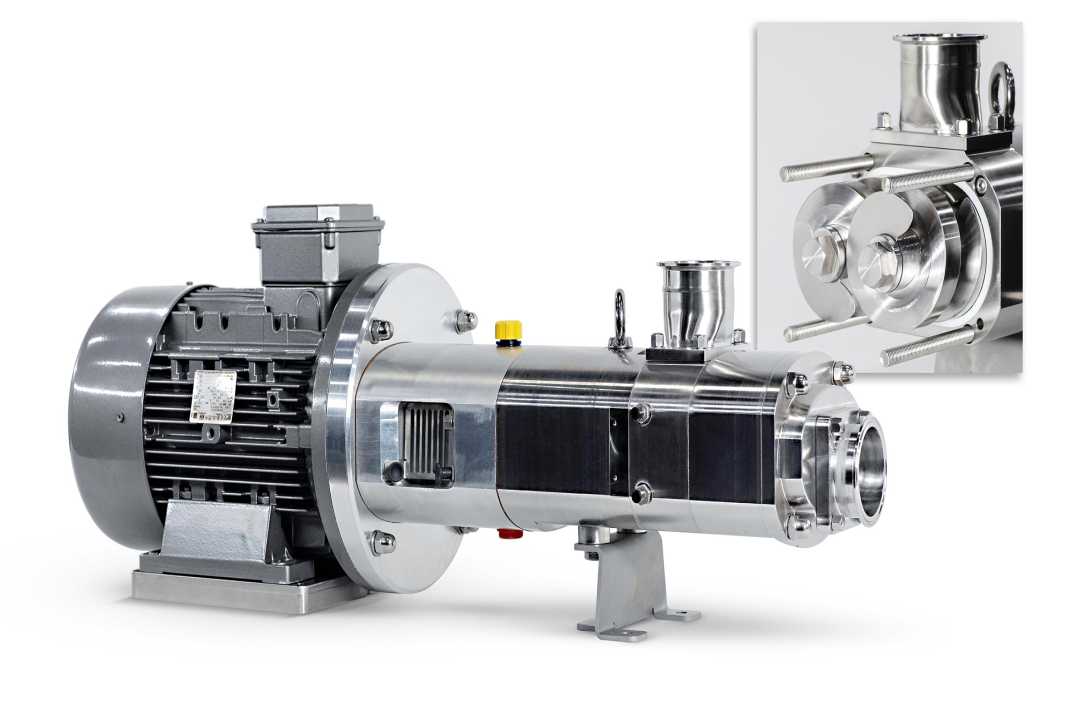
Unibloc® Hygienic Technologies (UHT), a manufacturer of hygienic pumps and flow control equipment, has introduced a new line of patent-pending twin screw pumps designed to improve serviceability, sanitation and speed of reassembly. The company said the new pump family is suited for applications across food and beverage, cosmetics, personal care, industrial processing and pharmaceutical manufacturing.
UHT stated that, like other twin screw pump systems, the new Unibloc Twin Screw pumps deliver steady, non-pulsating flow with minimal shear, helping preserve the structure of high-viscosity or shear-sensitive products. These include dairy-based products, emulsions, fruit purees, soups, creams, gels and serums. The pumps are also designed to deliver higher pressure than some alternative pump types, supporting longer pipe runs, vertical transfer and challenging viscous products. The company added that the pumps support effective clean-in-place (CIP) performance through high-speed operation.
UHT said its twin screw pumps offer features intended to reduce operating complexity and overall ownership cost. The pump design incorporates fewer parts, identical screw shafts, and a one-direction reassembly method, helping reduce cleaning time compared with conventional hygienic twin screw pumps. The company also highlighted an external timing adjustment function, which it says enables timing changes in around five minutes without opening the oil housing. UHT noted that many other designs require disassembly that can expose the surrounding area to contamination risk and oil spills.
UHT further stated that the pump includes a patent-pending oil reservoir structure intended to improve oil circulation, heat dissipation and bearing protection, helping extend service life and lower overheating risk. A front-loaded seal arrangement is also intended to simplify seal replacement and reduce seal failure risk. The modular design allows upgrades to other models within the range, while bi-directional pumping supports more complete line emptying to reduce waste and support stronger batch changeovers. The pump family is also positioned as dual-duty equipment, enabling low-speed processing and higher-speed operation for CIP in a single unit.
With the introduction of the twin screw range, UHT said it now offers all four primary hygienic pump technologies—lobe, gear, air-operated double diaphragm (AODD) and twin screw—allowing its engineers to recommend pump technology based on process requirements rather than product limitations.
Chris Stevens, CEO of UHT, said customers often have deep process expertise but may not specialize in fluid transfer dynamics, and the expanded portfolio allows the company to recommend the most appropriate pump type for each application without compromise. UHT stated that the new pumps can handle fluids up to 1,000,000 cP, with solid particles up to 45 mm.
The four-pump lineup offers flow rates from 200 to 1,200 gallons per minute (757 to 4,542 liters per minute), with more than 90% volumetric efficiency. The pumps operate up to 248°F (120°C) and pressures up to 360 psi (24.8 bar). The pumps meet 3-A sanitary requirements and support CIP routines, with operating speeds up to 3,600 RPM and reverse pumping capability to reduce product loss.
Unibloc® Hygienic Technologies is a leading provider of high-performance, precision-engineered pumping and fluid-handling solutions. Its portfolio includes positive displacement pumps, air-operated double-diaphragm pumps and drum pumps, along with valves, strainers, bubble traps, oil coolers and sight glasses, marketed under the Unibloc, Flotronic®, Hygenitec™ and Standard Pump brands. Designed for demanding process environments, Unibloc’s solutions emphasize safety, efficiency and ease of maintenance, helping customers lower lifetime operating costs while delivering reliable performance and long service life in even the most challenging applications.








