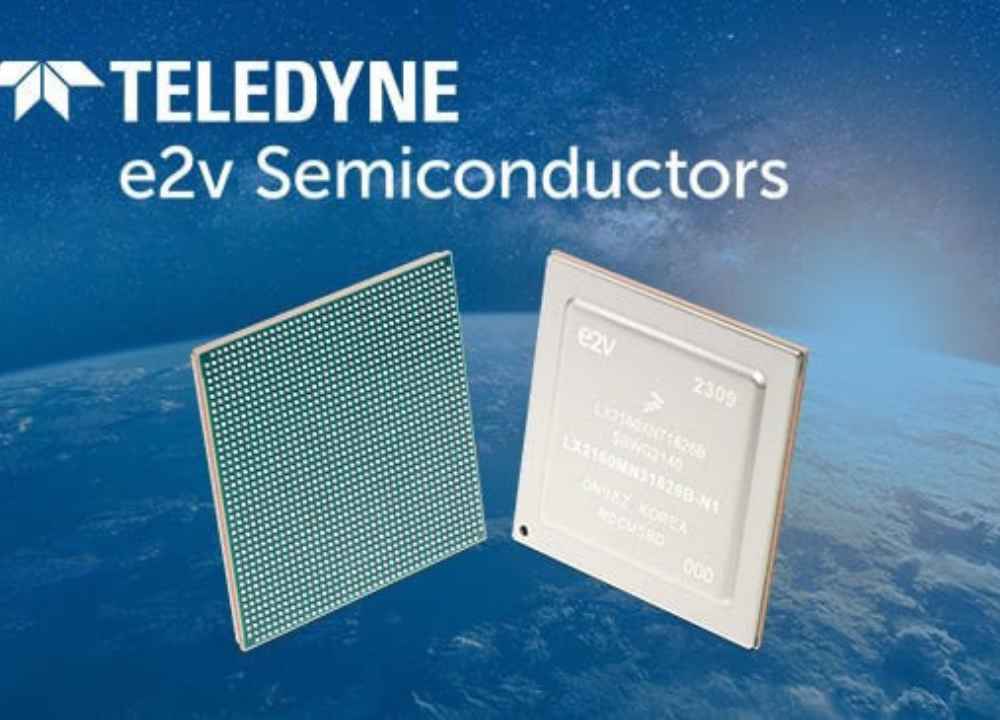
Teledyne e2v Semiconductors has announced that flight models of its LX2160-Space processor will be available by the end of 2026. Designed for spacecraft applications, the processor enables onboard mission-data processing, supports artificial intelligence workloads and facilitates autonomous decision-making.
Based on a 16-core Arm® Cortex®-A72 architecture operating at speeds of up to 2.2 GHz, LX2160-Space combines computing and networking capabilities to address demanding space applications. The processor is designed to support data routing in space, bringing together computing capacity, memory bandwidth and high-speed interfaces to manage increasingly complex onboard data flows. Its applications include Earth observation, image processing, communications and spacecraft avionics.
The processor integrates 16 64-bit Arm Cortex-A72 cores and an error-correcting code (ECC)-protected memory architecture, delivering approximately 200,000 DMIPS. It features two DDR4 memory interfaces operating at speeds of up to 3.2 GT/s. LX2160-Space enables system designers to consolidate processing, networking and security functions within a single device. Its high-speed data-handling capabilities include up to 100 Gigabit Ethernet, multiple PCIe Gen3 controllers, packet-processing acceleration, a 100 Gbps data compression engine and a 50 Gbps security accelerator. These integrated features can simplify system architecture while providing the processing capacity required to handle growing volumes of data directly onboard spacecraft.
The processor is offered through multiple qualification flows to meet different mission requirements, including NASA Levels 1, 2 and 3, ECSS Class 3 and Teledyne e2v’s X1 New Space grade. Radiation-characterisation targets include 100 krad (Si) total ionising dose performance and characterisation beyond 60 MeV·cm²/mg for single-event effects. Extensive testing has been completed on the processor cores, cache architecture and peripheral functions. The launch extends Teledyne e2v’s portfolio of space-processing solutions, drawing on the company’s experience in qualifying high-reliability digital processing products for aerospace, defence and space applications.
“With LX2160-Space, spacecraft designers can process images onboard, support autonomous operation and handle high-speed data, while choosing qualification options that fit their mission needs. They can also benefit from the full ecosystem around the LX2160,” said Frédéric Devrière, Marketing Product Manager, Teledyne e2v Semiconductors.
Visitors to Space Tech Expo Europe, scheduled to take place in Bremen, Germany, from November 17 to 19, 2026, can see a demonstration at the Teledyne e2v booth in Hall 4, Booth B09. The demonstration will show how an AI-optimised inference engine enables LX2160-Space to run multiple AI image-processing algorithms concurrently.
Teledyne e2v delivers advanced solutions for healthcare, life sciences, space, transportation, defence and industrial markets. Its portfolio includes high-reliability semiconductors such as data converters, microprocessors and radiation-tolerant memories, as well as specialised manufacturing and test services. Part of the Teledyne Imaging Group and Teledyne Technologies Incorporated (NYSE: TDY), Teledyne e2v works with customers to develop tailored technologies that enhance system performance.
Teledyne Technologies Incorporated (NYSE: TDY) is a provider of digital imaging products and software, instrumentation, aerospace and defence electronics, and engineered systems. Its operations are primarily located in the United States, Canada, the United Kingdom, and Western and Northern Europe.