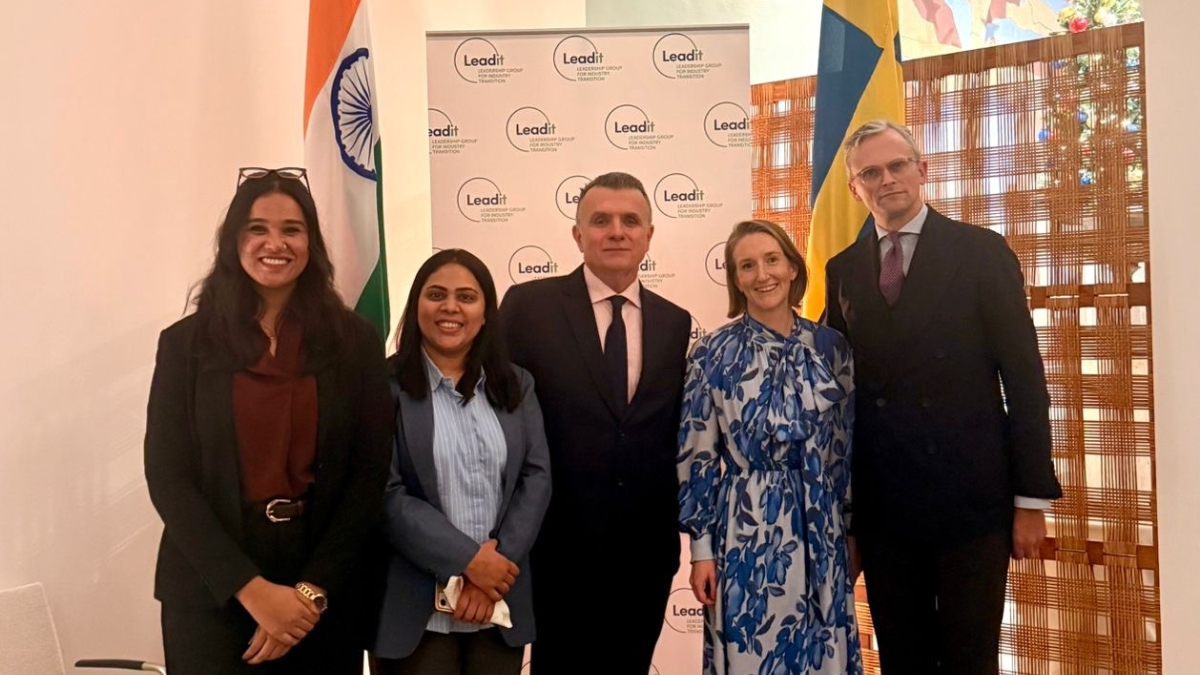
Tata Steel has secured support under the Indo–Sweden Industry Transition Partnership (ITP) for two major initiatives aimed at advancing low-carbon technologies in the steel and cement sectors. The ITP programme—powered by LeadIT, India’s Department of Science and Technology, and the Swedish Energy Agency—focuses on accelerating breakthroughs that can drive deep emission cuts across energy-intensive industries.
Through this collaboration, Tata Steel will spearhead two research projects alongside leading universities and technology partners from both countries. The partnership highlights the growing alignment between India and Sweden in fostering scientific innovation and jointly developing solutions that can reshape industrial processes for a greener future.
Subodh Pandey, Vice President – Technology, R&D, NMB and Graphene at Tata Steel, noted that the company’s approach has always centred on co-creation: “Our goal is to develop transformative technologies in partnership with global experts. By working closely with our counterparts in India and Sweden, we can fast-track solutions that offer real potential for large-scale emission reduction. These projects show the way forward—science-based, collaborative and built for impact.”
The first initiative, MiCOBlast, aims to develop a microwave plasma-based method for converting blast furnace off-gases into useful products. In association with IIT Hyderabad and Swedish firm Green14, the project seeks to reimagine how carbon-rich gases are processed in ironmaking. By moving this technology closer to pre-pilot deployment, the effort could help cut emissions from conventional steel production.
The second project, Steel Slag Reborn, targets improved resource utilisation across the steel and cement chains. Partnering with IIT ISM Dhanbad, J K Cement and Sweden’s Cemvision, the initiative will work on extracting high-value metallics from steel slag and transforming the remaining material into low-carbon cement additives. This approach reduces industrial waste while lowering the carbon footprint of one of the world’s most emission-heavy industries.
The projects were unveiled at COP30 in Brazil, held from November 15–17, 2025, aligning them with global climate priorities. The formal project launch took place at the Swedish Embassy in New Delhi on December 8, 2025, marking the beginning of a strengthened bilateral effort driven by shared research and technological expertise.
The Indo–Sweden collaboration goes beyond joint studies—it reaffirms a common vision to develop next-generation climate-positive industrial solutions. For Tata Steel, the partnership underscores its ongoing commitment to innovation-driven decarbonisation and the belief that global cooperation is essential to building a cleaner industrial future.
Tata Steel is one of the world’s leading steel producers, with a total crude steel production capacity of 35 million tonnes per annum. The company operates across five continents, with a diverse global presence in both production and commercial activities. For FY2025, Tata Steel reported consolidated revenues of approximately $26 billion, underscoring its position as a top-tier player in the global steel industry.
The company has long been recognized for its commitment to sustainability, with ambitious goals to achieve Net Zero emissions by 2045. It is also undergoing a digital transformation, with plants in Jamshedpur, Kalinganagar, and IJmuiden receiving recognition from the World Economic Forum as Global Lighthouse facilities. These plants exemplify Tata Steel’s leadership in advanced digital manufacturing practices and its ongoing efforts to drive innovation and efficiency across its operations.
Tata Steel’s commitment to responsible steel production is reflected in its achievements, including the first ResponsibleSteel™ certification for its Jamshedpur plant, with over 90% of its steel production in India now coming from certified sites. The company has also received numerous accolades, such as the Prime Minister’s Trophy for the best-performing integrated steel plant in 2016-17 and the 2024 Steel Sustainability Champion award from worldsteel, underscoring its leadership in both sustainability and performance within the global steel sector.