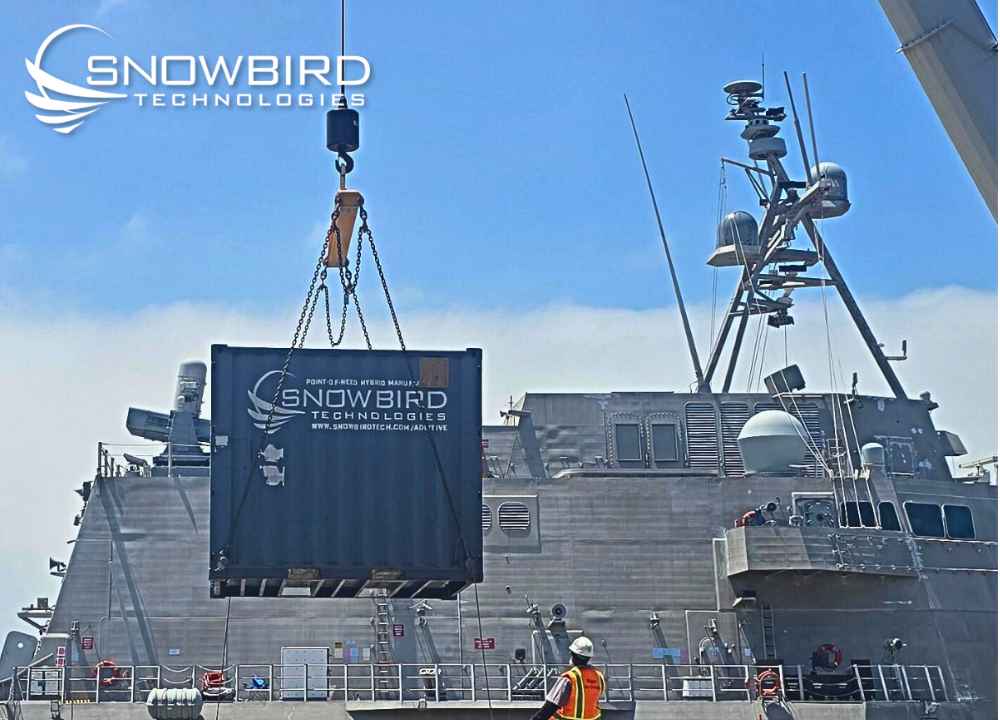
Snowbird Technologies, a US-based manufacturer of mission-critical equipment and deployable manufacturing systems, has reported successful operational results from its participation in the Naval Postgraduate School (NPS) Consortium for Advanced Manufacturing Research & Education (CAMRE)’s Littoral and Expeditionary Advanced Manufacturing and Repair Experiment at RIMPAC 2026. The company’s SAMM Tech deployable hybrid manufacturing platform demonstrated on-demand metal additive manufacturing aboard the USS Essex and at Schofield Barracks in Hawaii.
Conducted under the NPS CAMRE and FLEETWERX initiatives, the deployment showcased the system’s ability to manufacture replacement components close to the point of need. SAMM Tech used the Meltio Engine Blue wire-laser metal additive manufacturing solution, with nitrogen as the process gas. Following shipboard operations, manufacturing continued at Leader’s Field, Schofield Barracks, using nitrogen supplied by an on-site generator.
During the exercise, the platform produced seven different components, including oxygen tank brackets, drain caps, load test clamp components, turnbuckles, a 4-inch pipe flange and an air pressure radio six-pack. Snowbird’s analysis found that four of the seven components offered cost advantages over original equipment manufacturer (OEM) procurement, with reported savings of up to 351%.
Twelve oxygen tank brackets were manufactured in an estimated 75 hours at a material and gas cost of approximately US$2,492, compared with estimated procurement costs of US$9,624 from PHNSY and US$10,224 for the USS Essex. The load test clamp outer component was produced in around three hours for US$101, against procurement costs of US$420 and US$455, respectively. The air pressure radio six-pack was manufactured in approximately five hours for US$154, compared with procurement costs of US$624 and US$654, delivering reported savings of 325%. The exercise also demonstrated the operational value of avoiding procurement delays. Snowbird’s analysis indicates that approximately 692 hours of procurement time were avoided for one part order through on-site production.
“RIMPAC provided an important opportunity to demonstrate expeditionary manufacturing in an operational environment,” said Karl Wojtkun of Snowbird Technologies. He added that the results validated the ability to produce components in austere environments while highlighting the potential to reduce procurement costs and supply delays. Mr Wojtkun said the broader opportunity lies in connecting digital part files with manufacturing, machining, inspection and sustainment capabilities, enabling forces to respond to component requirements wherever they arise.
The RIMPAC deployment provides operational data supporting Snowbird’s continued development of SAMM Tech as a deployable sustainment solution for defence and other mission-critical applications. By bringing manufacturing closer to end users, the platform is designed to reduce dependence on centralised production facilities and conventional supply chains.
Based in Jacksonville, Florida, Snowbird Technologies provides advanced manufacturing, environmental control and atmospheric water generation solutions to defence, government and commercial customers worldwide. The company specialises in ruggedised systems designed to operate in extreme and austere environments. FLEETWERX is a Partnership Intermediary Agreement connecting the Naval Postgraduate School with industry, academia and government to introduce new solutions into operational military environments. It works directly with end users to test, refine and accelerate the adoption of emerging technologies. The Consortium for Advanced Manufacturing Research and Education (CAMRE) at the Naval Postgraduate School focuses on advancing manufacturing capabilities that support military operations, including the production, repair and delivery of components in the field.