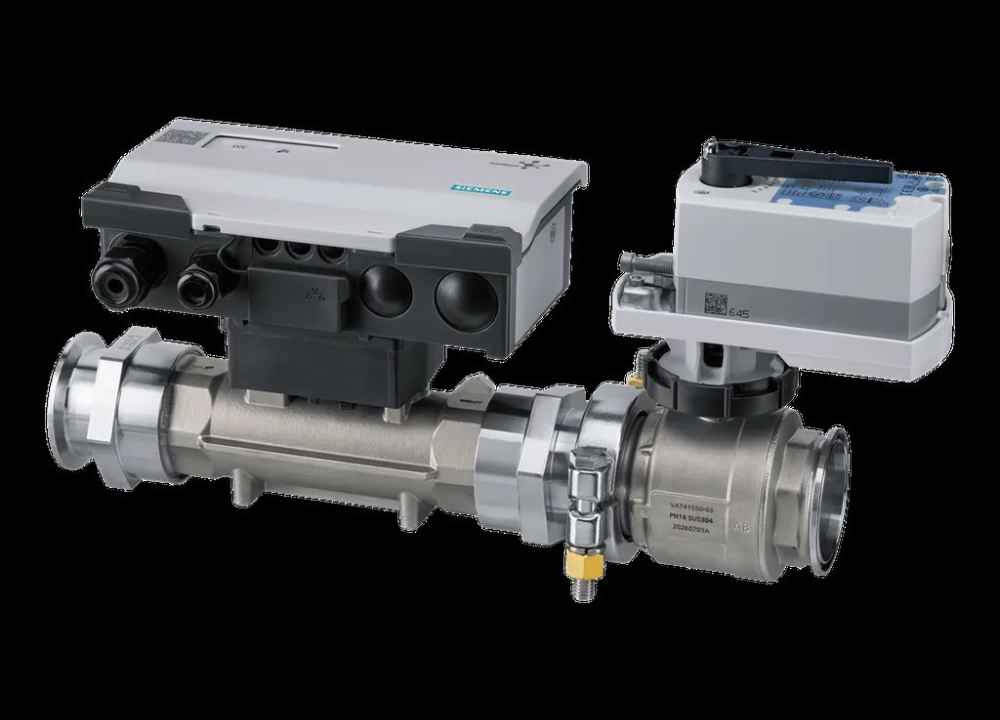
Siemens is expanding its liquid cooling portfolio with a new stainless steel version of its Intelligent Valve, designed for direct-to-chip rack loop cooling applications in AI data centres and high-performance computing environments. The launch comes amid rising demand for advanced cooling solutions, with the global liquid cooling market projected to grow at a compound annual growth rate (CAGR) of 22.65% between 2026 and 2031, according to a Mordor Intelligence market report.
The new stainless steel design addresses increasingly stringent requirements for wetted materials specified by leading chip manufacturers and hyperscale data centre operators. It provides an alternative to brass and other materials, supporting advanced cooling environments where coolant purity and media compatibility are critical considerations.
The valve builds on Siemens’ existing portfolio and forms part of the company’s broader approach to developing future-ready thermal infrastructure. By combining hydronic components with scalable automation and digital simulation, Siemens aims to help data centre operators enhance cooling reliability, energy performance and cost efficiency. The approach also enables partners to design, test and deliver integrated liquid cooling solutions more quickly.
“AI is fundamentally changing the thermal requirements of data centres, with increasing compute density making liquid cooling a critical part of the infrastructure. Our role is to help customers manage this transition reliably and at scale. By combining proven hydronic technology with sensing, control and intelligence, this new valve supports cooling infrastructure that can adapt as computing requirements evolve,” said Nawfal Slimati, EVP Buildings Products at Siemens.
Installed within the hydronic cooling circuit, the Intelligent Valve continuously measures parameters such as flow, temperature and system performance while actively controlling hydronic conditions. At rack level, it maintains stable differential pressure to ensure consistent coolant flow and help protect critical IT equipment.
The valve also reduces the risk of pressure peaks that could lead to leakage or damage to cold plates during commissioning, operation and maintenance. It automatically adapts to changes in the cooling system when servers or entire racks are added, removed or replaced.
Its integrated local control loops can operate independently of the coolant distribution unit controller. Automatic presetting and open communication interfaces support faster commissioning and flexible integration with wider automation and monitoring systems. These capabilities help operators respond to changing cooling requirements, improve visibility into system performance and move towards more automated, self-adapting data centre infrastructure. The valve is compatible with water, water-ethylene glycol and water-propylene glycol cooling media, supporting a range of liquid cooling applications.
Siemens AG, headquartered in Berlin and Munich, is a global technology leader with operations spanning industry, infrastructure, mobility, and healthcare. The company develops technologies that bridge the physical and digital worlds, helping customers improve productivity, efficiency, and sustainability. Siemens supports manufacturers in building smarter factories, enables cities to enhance infrastructure and livability, and advances sustainable transportation systems. As a pioneer in industrial artificial intelligence, Siemens combines deep industry expertise with advanced AI capabilities, including generative AI, to deliver practical and scalable solutions across a wide range of sectors.