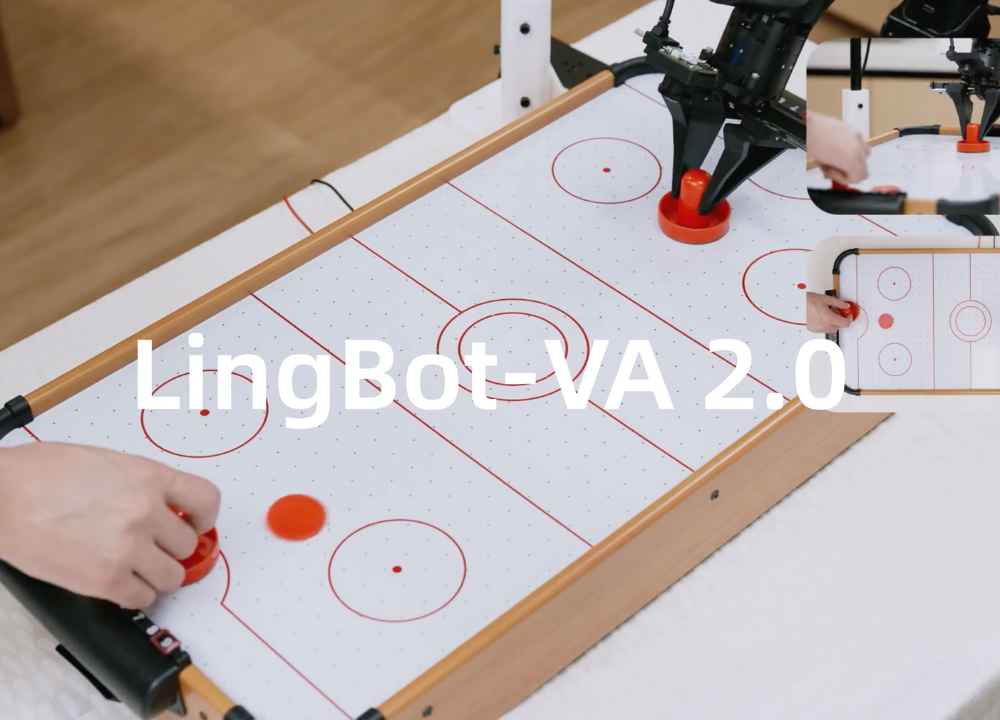
Robbyant, the embodied AI company within Ant Group, has released LingBot-Touch, an open-source tactile foundation model designed to give robots improved touch perception during fine manipulation tasks. Pre-trained on nearly 5,000 hours of real-world tactile data, the model supports magnetic tactile, visual tactile and piezoresistive sensing technologies.
LingBot-Touch converts signals from different sensor types into a common tactile representation, allowing robotic hands and action models to share tactile information. The system is designed to help robots perform tasks requiring precise contact and handling, including turning pages, opening bottle caps and identifying Mahjong tiles.
Tactile sensors use different technologies and produce different signals, even when measuring the same physical contact. As a result, models trained for one sensor or hand may not work effectively with another. This can require developers to collect new data and retrain systems whenever hardware changes, increasing development time and integration costs.
LingBot-Touch addresses this issue through separate encoding pathways for different sensing technologies. It processes varied sensor signals and maps contact points from different layouts into a shared fingertip coordinate system. A common model then learns contact location, force distribution and changes in contact over time, generating unified tactile tokens.
The architecture also allows data collected from people wearing tactile gloves and from teleoperated robotic hands to be used together during training. Different action models can draw on the same tactile features, while the system can be extended to accommodate new sensor technologies.
Robbyant evaluated LingBot-Touch through 26 real-world tests using two dexterous robotic hands, Sharpa Wave and XHand. Four action models—LingBot-VLA, π0.5, Diffusion Policy and T-Rex—recorded average task success-rate improvements of approximately 14 to 26 percentage points when using tactile input.
In a test involving T-Rex controlling Sharpa Wave to unscrew a bottle cap, the success rate was 56.25% without tactile input and 62.5% when raw sensor signals were supplied directly to the policy. With LingBot-Touch’s tactile representation, the success rate increased to 90%.
The team also tested cross-hardware use on XHand. Its magnetic tactile sensor was not included in the model’s pre-training data. Instead, the magnetic tactile experience came from data collected using human gloves. The model parameters remained unchanged, while the action model was trained using XHand demonstration data. Robbyant offers two model sizes. All 26 real-world tests used LingBot-Touch-Tiny, which has approximately 5.3 million parameters. When integrated with LingBot-VLA, π0.5 and T-Rex, it adds approximately 0.13% to 0.16% to the overall model size.
Robbyant is an embodied intelligence company within Ant Group. It develops software, hardware technologies and foundational models for embodied AI, while exploring next-generation intelligent devices. Its work focuses on robotic companions and care systems for applications including elderly care, medical assistance and household tasks.