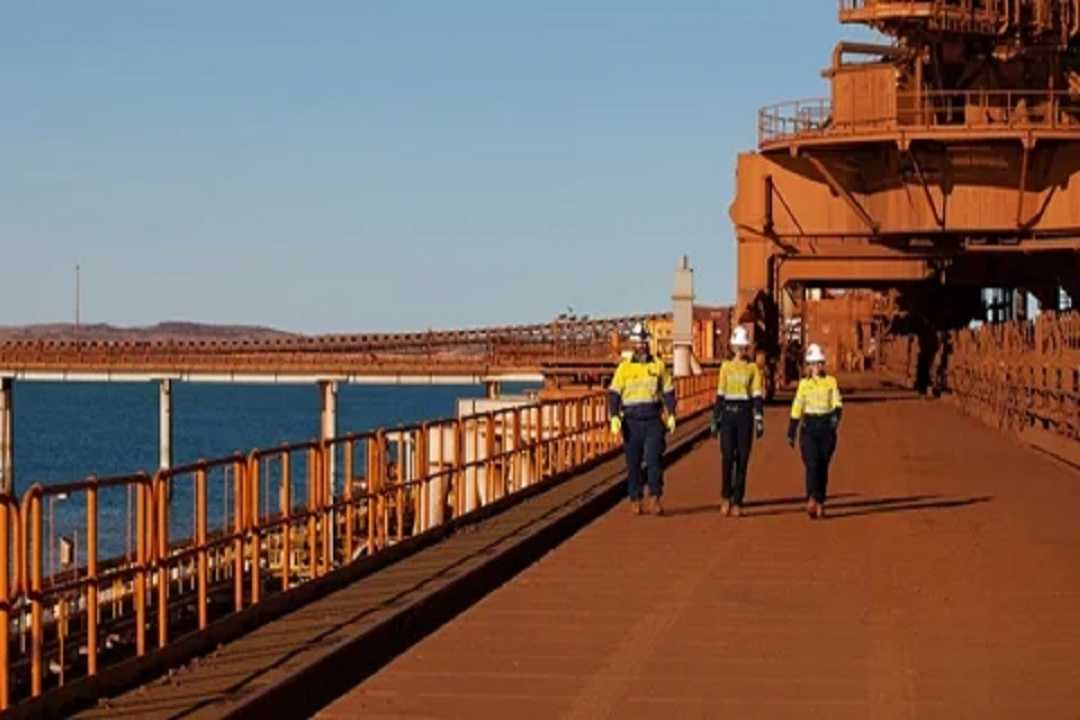
Rio Tinto has entered a Joint Development Agreement with Australian clean-technology company Calix to support the build-out of Calix’s Zero Emissions Steel Technology (Zesty™) demonstration plant in Western Australia. The facility is designed to show how Pilbara iron ore can be processed for lower-emissions steel production.
If approved, the demonstration plant will be located in Kwinana, south of Perth — the same site previously chosen for Rio Tinto’s planned BioIron™ research facility and pilot plant. The company has decided that the current BioIron furnace design needs further refinement to lower technical risks and improve performance. Research on BioIron continues in partnership with the University of Nottingham and Metso, as Rio Tinto remains committed to its long-term potential.
Rio Tinto plans to contribute more than A$35 million — a mix of financial investment and in-kind support — to help Calix develop the Zesty Green Iron Demonstration Plant, which is also backed by the Australian Renewable Energy Agency (ARENA). The Zesty process uses electric heating and hydrogen to reduce iron ore, making it suitable for lower-grade ores and producing iron with fewer emissions.
Matthew Holcz, Chief Executive of Rio Tinto Iron Ore, said “The world cannot reach its climate goals without low-emissions steel. We’re exploring every credible pathway to use Pilbara ores in cleaner steel-making technologies as they emerge. Our collaboration with Calix will help advance the Zesty process, while we continue developing BioIron with our partners. Together, these efforts support our broader emissions-reduction strategy and the long-term future of Australia’s iron ore industry.”
Western Australian Premier Roger Cook added “Producing green iron here at home is central to our ambition to build a renewable-energy powerhouse and expand local industry. Alongside our new ‘if not, why not’ requirement for green steel in major government projects, the Zesty Demonstration Plant will help diversify the state’s economy and strengthen Western Australia’s role in this growing sector. This agreement between Calix and Rio Tinto marks an important step for the state.”
The Kwinana site offers access to existing infrastructure including utilities, ports, and nearby industrial facilities. It is located close to the NeoSmelt1 project — supported by ARENA — which could potentially process Zesty-produced Direct Reduced Iron (DRI). Rio Tinto is among five companies involved in the NeoSmelt development. Calix has also been awarded a conditional A$44.9 million ARENA grant for the Zesty Demonstration Plant.
Phil Hodgson, CEO of Calix, said “This agreement is a major milestone for Zesty. It brings financial support as well as access to deep industry expertise, technical capability, and market reach. Rio Tinto’s involvement validates Zesty’s potential to help decarbonise a sector responsible for around 8% of global CO₂ emissions and strengthen Australia’s most valuable export industry. We look forward to advancing this project with Rio Tinto, ARENA, and other partners.”
Under the Joint Development Agreement, Rio Tinto will help bring the Zesty project to a Final Investment Decision (FID) through engineering assistance, technical input, and advocacy. If the project proceeds, the company will provide up to 10,000 tonnes of Pilbara iron ore for commissioning and early testing. Rio Tinto will also support market introductions for potential downstream users of Zesty-produced iron. The partnership grants Rio Tinto a non-exclusive global licence to use and sub-licence the Zesty technology and act as a global marketing agent for it.
Calix Limited is an Australian technology company focused on reducing industrial emissions. Its Zesty process uses electric heating and hydrogen to produce low-emission iron and, ultimately, greener steel. The technology aims to lower production costs by minimising hydrogen use, eliminating pelletisation, enabling flexible electric heating from renewable energy, and accommodating fine and lower-grade ores. Pilot-scale work with HILT CRC and industry partners has shown Zesty can produce green iron from multiple ore types.
The demonstration plant is designed to produce up to 30,000 tonnes per year of hydrogen-based DRI or hot briquetted iron (HBI). It is intended to operate as an open-access facility, providing toll processing for a variety of Australian ores while supporting the development of a domestic green-iron industry. Detailed engineering is underway, with a final investment decision expected in 2026.
BioIron was developed by Rio Tinto’s steel-decarbonisation team after more than ten years of research. The process uses raw agricultural residues — such as wheat straw, sugarcane bagasse, rice stalks, and canola straw — as the reducing agent instead of coal. BioIron requires roughly one-third the electricity of other hydrogen-based steelmaking routes that depend on renewable hydrogen.