

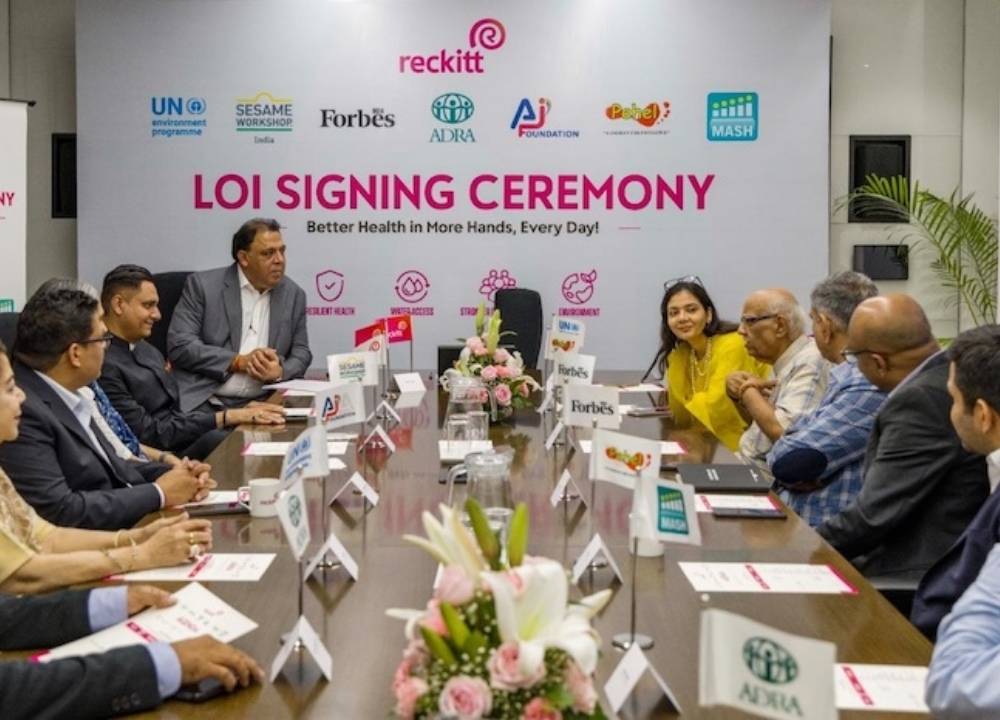
Reckitt has announced a strategic collaboration with seven leading organisations to strengthen health, hygiene, sanitation and adolescent wellbeing initiatives across India. As part of its purpose of “Better Health in More Hands, Every Day,” the company has signed Letters of Intent (LoIs) with partners from the development, education, environmental, media and social sectors to drive large-scale community engagement and behaviour change over the next three years.
The partnerships, covering the period from 2026 to 2029, are aimed at expanding the reach and impact of Reckitt’s flagship social programmes while supporting healthier and more sustainable communities. The initiative will focus on preventive healthcare, hygiene education, sanitation, environmental awareness, climate resilience and life skills for children and young people.
Through these collaborations, Reckitt will further strengthen programmes including Dettol Banega Swasth India, the Dettol School Hygiene Education Programme, Durex The Birds and Bees Talk (TBBT), the Harpic World Toilet College, and the Harpic Safe Sanitation Programme.The company said the initiative reflects a shift towards greater youth participation by encouraging children and young people to become active contributors to positive social change rather than simply being recipients of awareness programmes. The collaborations aim to provide practical knowledge, digital learning tools and community-based engagement to encourage healthier lifestyles and responsible environmental practices.
Commenting on the initiative, Gaurav Jain, Executive Vice President – South Asia, Reckitt, said meaningful partnerships are essential to delivering lasting impact in a country as diverse as India. He noted that the company remains committed to ensuring that no community is left behind as it works towards improving health outcomes. According to him, the new collaborations will help strengthen hygiene awareness, promote adolescent wellbeing, improve sanitation and encourage environmental responsibility while empowering young people to lead healthier lives.
Among the key partners, UNEP India will work with Reckitt to promote environmental awareness and climate literacy, while Sesame Workshop India will support the development of educational tools focused on hygiene, science and sustainability for children. Together, the programmes are expected to reach millions of students through age-appropriate learning resources and environmental education.
Jagran Pehel will support digital learning initiatives by introducing technology-enabled hygiene education through gamification, innovative classroom models and artificial intelligence-based learning tools to improve health education in schools. To strengthen adolescent health and life skills education, ADRA India and the Amar Jyoti Foundation will work with Reckitt to expand the reach of The Birds and Bees Talk (TBBT) programme across schools in Delhi, Odisha and several North-Eastern states. The initiative aims to equip young people with age-appropriate knowledge on health, wellbeing and responsible decision-making.
At the same time, the MASH Project Foundation and Forbes India (Network18) will support campaigns promoting gender equality, inclusion and youth leadership through national awareness initiatives, research studies and public engagement platforms.Collectively, the partnerships are expected to strengthen school-based health education, improve sanitation awareness, encourage sustainable practices and accelerate community-led behaviour change across the country.
The initiative also supports key national priorities, including Viksit Bharat 2047, the Swachh Bharat Mission, the Jal Jeevan Mission, the National Education Policy 2020, and the United Nations Sustainable Development Goals (SDGs). Through these collaborations, Reckitt aims to create scalable, locally relevant programmes that improve public health while empowering communities to build a healthier and more sustainable future.








