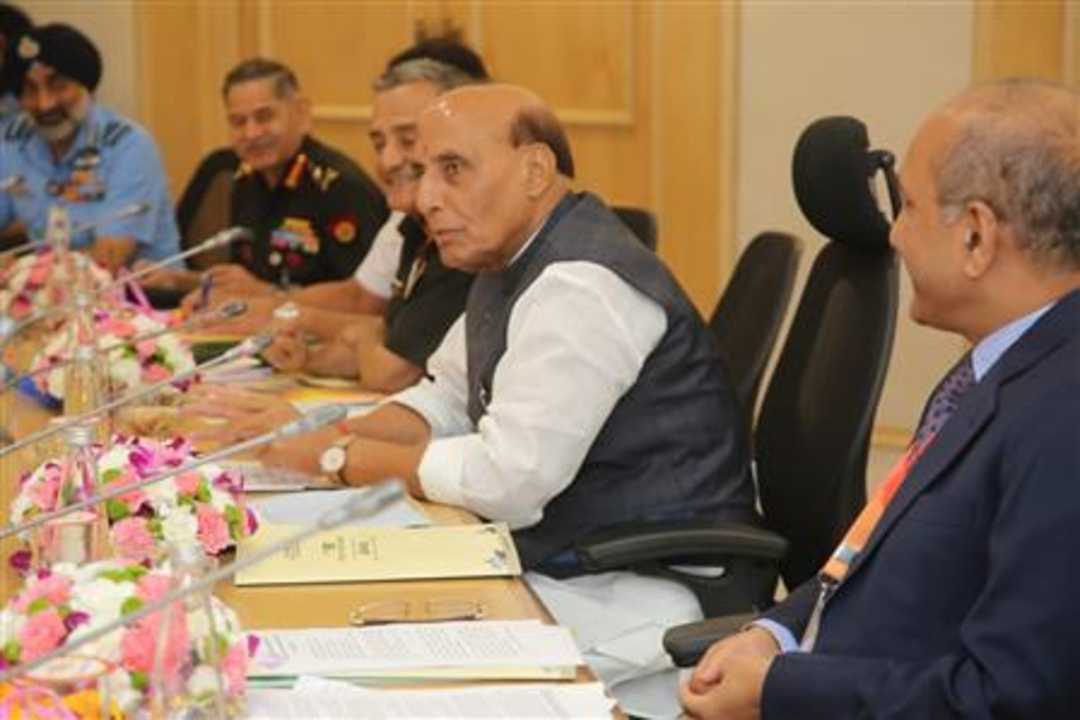
At the National Conference on ‘Opportunities in Defence Manufacturing’, held at Vigyan Bhawan, Union Defence Minister Rajnath Singh underscored that national security and defence preparedness are responsibilities that go beyond individual institutions. Addressing an audience comprising senior government officials, industry leaders, and representatives from states and union territories, the Defence Minister called for unified efforts across the nation to build a strong and self-reliant defence manufacturing base.
He appealed to States and Union Territories to actively contribute to shaping India into a globally competitive hub for defence production, underlining the importance of shared commitment and strategic collaboration between the Centre and the States. Highlighting India’s growing capability in the defence sector, Shri Singh noted that self-sufficiency in defence is not merely an economic or industrial milestone but a strategic imperative tied to national sovereignty. “When all segments of governance and society work in coordination—as seen during Operation Sindoor—it proves that no challenge is insurmountable,” he said.
The Minister shared key data points illustrating the expansion of India’s defence manufacturing ecosystem. He noted that domestic defence production has risen from ₹46,000 crore in 2014 to over ₹1.5 lakh crore in 2025—its highest level to date. Of this, approximately ₹33,000 crore was contributed by the private sector, signalling its growing role in national defence initiatives.
India’s defence exports also saw a significant jump, increasing from under ₹1,000 crore in 2014 to ₹23,500 crore in 2025. Shri Singh described this transformation as a reflection of India’s growing credibility as a supplier of reliable defence systems globally.
As part of the government’s strategic roadmap for self-reliance in defence, Defence Minister Shri Singh outlined ambitious targets for the year 2029. These include achieving domestic defence manufacturing valued at ₹3 lakh crore and reaching defence exports of ₹50,000 crore. He emphasized that these figures are not merely economic indicators, but a symbol of national confidence—reflecting a future where India’s defence needs are met by homegrown solutions designed and built by Indian talent.
During the conference, the Defence Minister released a Compendium of State Policies on Defence and Aerospace Manufacturing, which brings together defence-related frameworks from all 28 States and 8 Union Territories. The publication serves as a guide for aligning state-level initiatives with national objectives and provides detailed insights into local incentives, infrastructure support, and policy implementation. Shri Singh encouraged all states to examine the compendium closely, adopt proven strategies, and play an active role in boosting defence manufacturing across the country.
In a bid to further streamline the defence production ecosystem, Shri Singh highlighted several ongoing reforms aimed at improving the business environment. These include the introduction of self-certification for quality assurance, the launch of a Centralised Defence Testing Portal, and the expansion of the Defence Testing Infrastructure Scheme (DTIS) to build certified testing centres. Updates to key policies such as the Defence Acquisition Procedure (DAP) 2020, Defence Procurement Manual (DPM) 2025, and offset regulations are also being implemented to attract investment and strengthen industry participation.
The Minister also emphasized the critical role of advanced technology in modern defence capabilities. He called for greater intellectual investment in fields such as Artificial Intelligence, Robotics, Quantum Computing, and Space and Cyber Technologies. This, he said, must be paired with India’s existing manufacturing strengths to develop next-generation systems. In support of this, digital tools like SRIJAN-DEEP—an industry capability directory—and the Defence Exim Portal have been introduced to simplify processes, boost collaboration, and reduce delays for stakeholders.
Supporting smaller enterprises and startups in the sector remains a key focus. Shri Singh announced that the Ministry is working on improved bill processing systems and automated cash flow management tools to help MSMEs and startups access timely funds. These measures are designed to ease operational challenges, strengthen supply chains, and ensure that innovative smaller players can thrive in the defence ecosystem.
Lastly, the Minister highlighted several inclusive reforms that extend beyond manufacturing. These include the Nari Shakti initiative to increase women’s participation in the Armed Forces, the allocation of 25% of the defence R&D budget to industry and academia, and the establishment of 100 new Sainik Schools under a public-private model. He also called for improved coordination with States on defence land use and launched an online platform to facilitate project approvals. Publications such as the iDEX Coffee Table Book and updates to digital platforms reflect the government’s broader commitment to knowledge-sharing, innovation, and transparent governance in the sector.
Organised by the Department of Defence Production (DDP), Ministry of Defence, the conference was aimed at engaging all States and UTs on emerging opportunities in defence manufacturing. It included the participation of top defence leadership including Chief of Defence Staff General Anil Chauhan, the Chiefs of the Army, Navy, and Air Force, senior officials from the Ministry of Defence, and representatives from central and state administrations.