

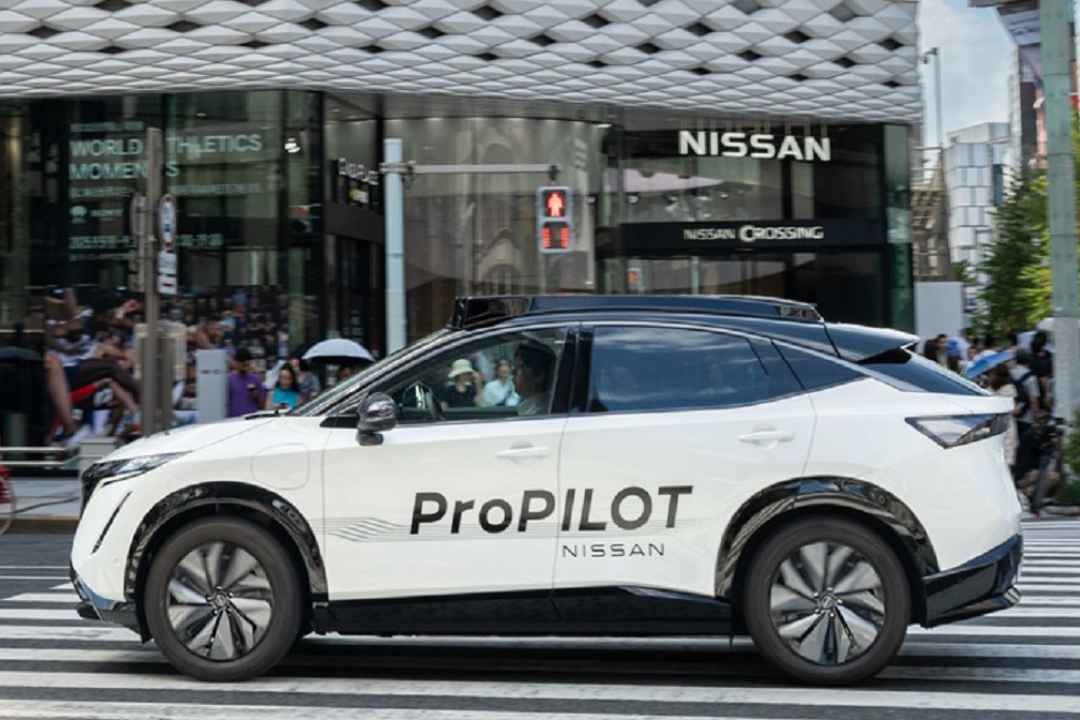
Nissan has begun live demonstrations of its next-generation ProPILOT advanced driver-assist technology, slated for release in Japan during fiscal year 2027. Using a fleet of all-electric Nissan Ariya-based prototypes, the company is testing the system’s ability to navigate the busy and unpredictable streets of central Tokyo with precision and confidence.
The updated ProPILOT system integrates cutting-edge “Wayve AI Driver” software developed by UK-based Wayve, along with Nissan’s own “Ground Truth Perception” platform powered by next-generation LiDAR. Together, these technologies aim to redefine what’s possible in automated driving support systems.
The test vehicles feature a comprehensive hardware setup that includes 11 cameras, 5 radar sensors, and a roof-mounted advanced LiDAR unit, ensuring precise perception and reliable data collection for safe and accurate operation.These sensors work in unison to provide a detailed, real-time understanding of the vehicle’s surroundings—essential for navigating complex urban environments.
Wayve’s AI software goes beyond traditional driver-assist systems by using embodied AI, a type of artificial intelligence that learns from experience and understands the broader context of its environment. This allows the vehicle to anticipate traffic patterns, interpret human behavior, and make decisions that mimic those of a skilled driver.
Unlike systems that react to isolated objects or events, Wayve’s AI learns to interpret the entire scene, adapting its behavior to changes on the road much like an experienced motorist would. This allows for smoother, safer navigation through unpredictable conditions—whether it’s merging traffic, sudden pedestrian movement, or complex intersections.
A key part of Nissan’s safety strategy is the use of high-performance LiDAR, which is capable of detecting obstacles and vehicles at long distances, even in low-light conditions. This is central to Nissan’s Ground Truth Perception technology, designed to deliver accurate, real-time awareness of the vehicle’s environment.
By combining multiple sensor inputs with LiDAR’s range and accuracy, the system can support safer driving at higher speeds and during nighttime operations—extending the usefulness of driver-assistance features beyond typical daylight and highway conditions.
Nissan’s driver-assistance systems have evolved steadily, from initial single-lane highway support (ProPILOT) to the more advanced ProPILOT 2.0, which offers hands-off driving under certain conditions. This new iteration takes another leap forward by handling complex city driving with increased intelligence and reliability.
Eiichi Akashi, Nissan’s Chief Technology Officer, stated, “While our ProPILOT 2.0 has been well received, the next-generation system introduces features that feel more intuitive and responsive—much like having a skilled driver at the wheel. It’s designed to provide a higher level of safety and reassurance, not just for drivers but for everyone sharing the road.”
The development of this next-generation ProPILOT is aligned with Nissan’s broader goals to improve mobility by making it cleaner, safer, and more efficient. By combining AI, advanced sensors, and real-world testing, Nissan aims to lead the shift toward intelligent, autonomous driving technologies. Production versions of the new ProPILOT system are expected to be introduced on select models in the Japanese market starting in FY27.









