

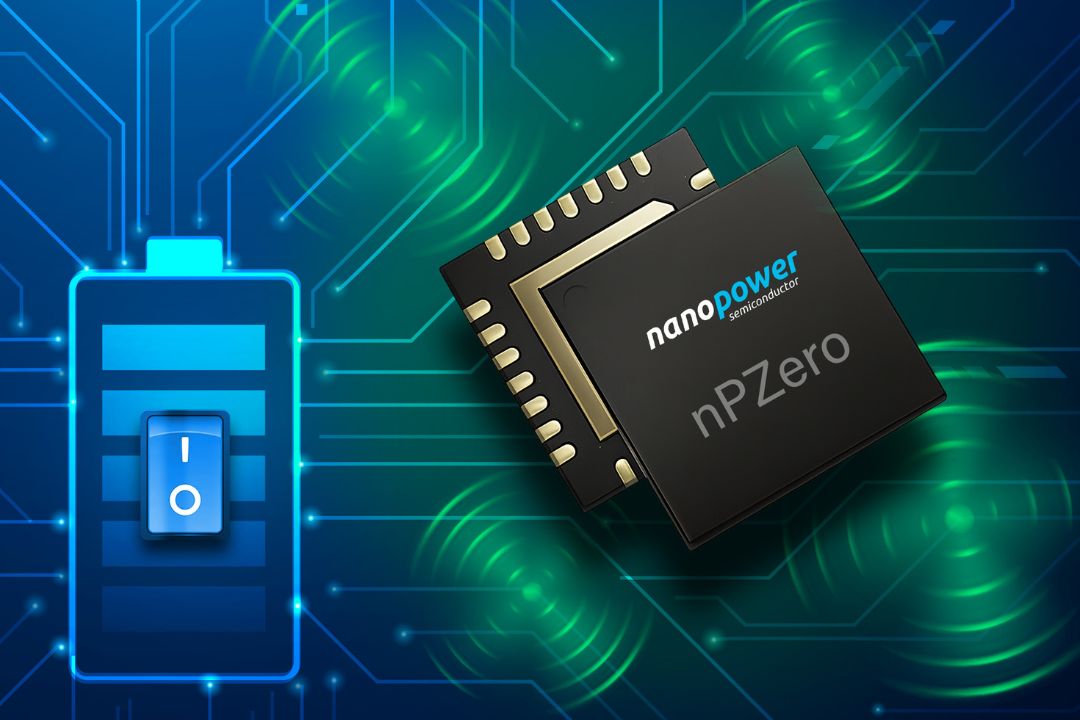
Nanopower Semiconductor, a European fabless semiconductor company, has announced that its nPZero power-saving integrated circuit (PSIC) has entered volume production. The device is designed to significantly reduce energy consumption in battery-powered and energy-harvesting Internet of Things (IoT) products, enabling original equipment manufacturers to transition from evaluation to large-scale deployment.
The nPZero IC has been developed to address one of the most persistent challenges in IoT system design—power efficiency. The component can reduce energy consumption in battery-powered applications by up to 90 percent by managing sensor monitoring tasks while allowing the primary microcontroller to remain in deep sleep mode for extended periods.
Nanopower Semiconductor will present demonstrations of the technology at Embedded World in Nuremberg, where the company is exhibiting at Hall 4, Booth 4-460. The demonstrations highlight how the nPZero IC can support both battery-powered and energy-harvesting devices, helping embedded engineers extend operational lifetimes and reduce maintenance requirements.
In conventional IoT architectures, the host microcontroller is frequently awakened to poll sensors and check system conditions. Even when no changes occur, these wake cycles consume energy and shorten battery life. The nPZero IC changes this system behaviour by taking over monitoring tasks while the microcontroller remains powered down.
During operation, the IC manages sensor interaction independently. It can power up and configure connected sensors, collect data, and monitor predefined conditions. If a user-defined event or threshold is detected, the IC wakes the host processor and transfers control back to it for further processing or communication.
The chip can interface with up to four sensors or peripheral devices, enabling continuous monitoring without constant processor activity. This design allows IoT devices to remain responsive to environmental changes while operating within tight energy budgets.
The technology is particularly suited for applications where devices must operate unattended for long periods. Typical use cases include smart building monitoring systems, smart city infrastructure, agricultural monitoring platforms, and tracking or data logging equipment deployed in remote locations.
Nanopower has also developed supporting tools to simplify integration into embedded systems. The nPZero Configurator software provides a graphical interface that allows developers to define system parameters and automatically generate application programming interface code for implementation. This approach reduces development complexity and shortens the time required to evaluate the technology.
The nPZero IC was originally developed following the invention of Nanopower’s ultra-low-power technology in 2017. The company has since refined the design to support scalable deployment across high-volume IoT markets.
Samples and development kits are currently available, enabling engineering teams to evaluate the technology before full-scale integration into new product designs. Nanopower Semiconductor is headquartered in Norway with operations in Kristiansand and Porto, Portugal.









