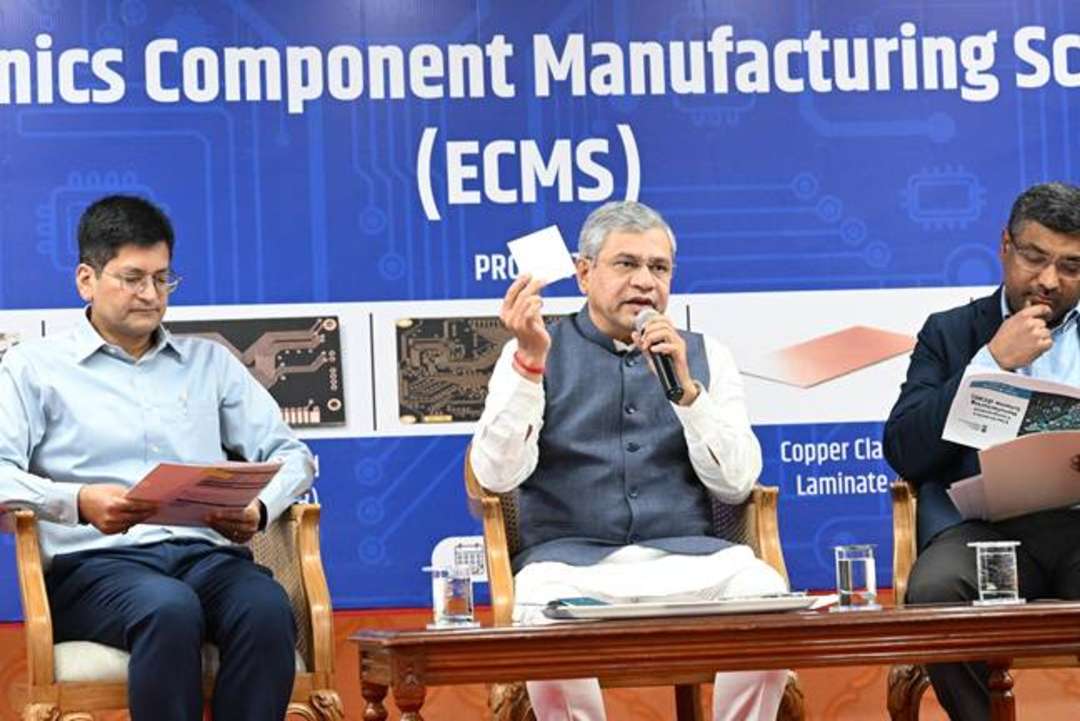
The Government of India has approved the first set of seven projects under the Electronics Manufacturing Components Scheme (EMCS), with a total investment exceeding ₹5,532 crore. The announcement was made by Union Minister for Electronics and Information Technology, Ashwini Vaishnaw, marking a major milestone in India’s transition from assembling electronic products to producing the core components and materials that power them.
Under this initiative, India will now locally manufacture Multi-Layer Printed Circuit Boards (PCBs), High-Density Interconnect (HDI) PCBs, Camera Modules, Copper Clad Laminates, and Polypropylene Films — components critical to electronic device production. The EMCS has seen exceptional participation from both Indian and international manufacturers. A total of 249 proposals have been received, representing a potential investment of ₹1.15 lakh crore, projected production worth ₹10.34 lakh crore, and the creation of over 1.42 lakh new jobs — the highest-ever investment intent in India’s electronics manufacturing sector.
The first tranche approved today, covering seven projects, will generate components valued at ₹36,559 crore and create more than 5,100 direct employment opportunities. The approved projects will be located in Tamil Nadu (5 units), Andhra Pradesh (1 unit), and Madhya Pradesh (1 unit) — reinforcing balanced regional industrial growth and extending high-tech manufacturing beyond major metropolitan hubs.
Minister Vaishnaw highlighted that production from these facilities will meet 20% of India’s domestic demand for PCBs and 15% of the requirement for camera module sub-assemblies. The domestic output of Copper Clad Laminates (CCL) will now fully satisfy national demand, with an additional 60% of production capacity dedicated to exports.
The newly approved projects cover a wide spectrum of critical components essential to the electronics manufacturing ecosystem. Among these are High-Density Interconnect (HDI) and Multi-Layer Printed Circuit Boards (PCBs), which form the backbone of virtually all electronic devices. These circuit boards are integral to the functioning of smartphones, laptops, industrial automation systems, and modern automobiles, providing the electrical pathways that connect and control various components.
Another major area of focus is the production of Camera Modules, which are compact, integrated optical units enabling image and video capture in a range of devices. Their applications extend far beyond smartphones, encompassing drones, medical instruments, robotics, and automotive systems. Local production of these modules will help reduce import dependency and enhance India’s capability in advanced imaging technologies.
In addition, the initiative includes establishing facilities for Copper Clad Laminates (CCL) — a key raw material used in the manufacture of PCBs. This marks the first time India will produce CCL domestically, representing a significant step toward self-reliance in electronic materials. By developing this critical input locally, India will strengthen its supply chain resilience and lower costs for downstream manufacturers.
The projects also feature the production of Polypropylene Films, which play a crucial role in the creation of capacitors — components widely used across consumer electronics, telecommunications, automotive systems, and industrial machinery. The local manufacturing of these films will not only reduce import reliance but also boost competitiveness in the global market, supporting India’s ambition to become a hub for end-to-end electronics production.
The EMCS will significantly reduce India’s dependence on imported electronic components, lower manufacturing costs, and enhance competitiveness in global supply chains. The scheme is expected to generate high-skilled employment across manufacturing and research domains while establishing secure and trusted supply chains for critical sectors such as defence, telecommunications, electric vehicles, and renewable energy.
With the launch of these projects, India takes another step toward becoming a “Product Nation” — capable of designing, manufacturing, and exporting complete electronic systems. The scheme complements other national initiatives such as the Production Linked Incentive (PLI) and the India Semiconductor Mission (ISM), building an integrated ecosystem that spans the entire value chain — from devices to chips, components to materials, and manufacturing to innovation.