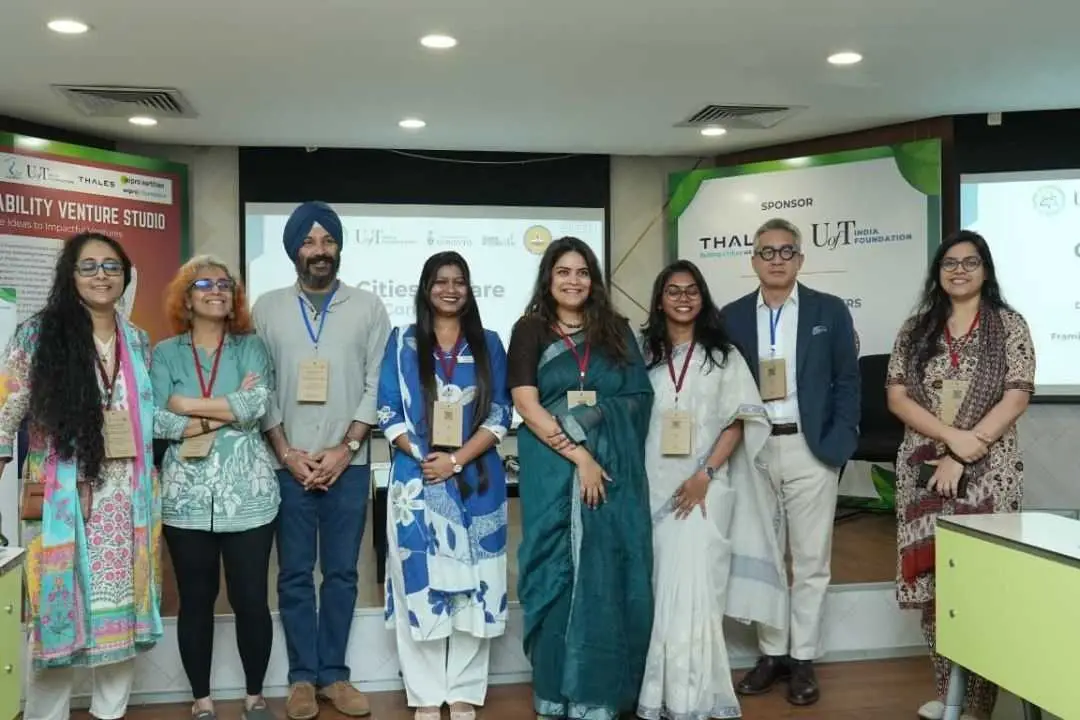
The University of Toronto India Foundation (UTIF), in partnership with IIT Madras’ School of Sustainability and the University of Toronto’s School of Cities, inaugurated the Cities of Care Conference at the IIT Madras Research Park today. The conference brings together leading universities, research organisations, policymakers and practitioners from across the world to strengthen climate action and reimagine sustainable urban growth for Indian cities.
The event comes as a new country report titled Sustainable India 2025, released by global sustainability platform REVOLVE, calls for India to move beyond climate targets and focus on real on-ground execution—particularly in energy transition, waste management and urban resilience—to stay on track for its 2030 commitments and 2070 net-zero goal.
According to the report, India’s energy transition has reached a critical stage. While renewable energy capacity has expanded at pace, the next phase requires deeper progress in industrial decarbonisation, stronger energy efficiency measures, and rapid expansion of decentralised clean energy. It also cautions that pressure on businesses to “go green” may remain superficial unless backed by workable compliance systems, affordable financing, and stronger monitoring.
The Cities of Care Conference has brought together more than 90 researchers, policymakers, practitioners and funders, focusing on urban climate challenges through the Water–Food–Waste systems approach. The programme includes plenary sessions, three thematic research tracks, 15 research presentations, and a cross-sector panel that connects Indian and global perspectives on urban complexity and climate-linked systems.
During the conference, UTIF—working with REVOLVE—also released the Sustainable India 2025 report, which presents a wide-ranging view of climate and sustainability progress across India’s cities, states and sectors. Emphasising the importance of collaboration, Prof Indumathi M Nambi, Professor, Department of Civil Engineering & School of Sustainability, IIT Madras, said platforms like this are essential for bridging the gap between research and real-world impact. She highlighted the need to connect academia, business and government to identify challenges and support applied research, while also encouraging investors to consider impact outcomes alongside financial returns.
REVOLVE’s Sustainable India 2025 report compiles sustainability developments from across India, capturing how climate efforts are evolving at national, state and city levels. The report includes feature stories, expert interviews, photo essays and key facts, offering insights into the initiatives, solutions and stakeholders shaping India’s climate response.
It also reflects the wider influence of India’s eight national climate missions, spanning climate resilience, clean energy transition, ecosystems, water security, sustainable mobility and inclusive development. By combining storytelling with evidence-based insights, the report is intended as a practical reference for policymakers, researchers and institutions working on climate-resilient urban development.
The report carries a foreword titled “No City Stands Alone: Reimagining Collaborative Urbanism” by Gauravi Lobo, Country Head, UTIF, underscoring the need for both cross-sector and cross-border partnerships to address complex urban climate challenges. The conference features speakers from major Indian and international institutions, including Prof Joseph Wong, Vice President (International), University of Toronto; Dr Supriya Sahu, IAS, Secretary, Department of Environment and Climate Change, Government of Tamil Nadu; Prof Isha Ray, Energy and Resource Group, UC Berkeley; Takayuki Hagiwara, FAO Representative in India; and Veena Srinivasan, Executive Director, WELL Labs Mission.
Discussions are centred on translating research into policy-ready insights, strengthening coordination between academia and government, and developing integrated solutions to urban challenges through the Water–Food–Waste Nexus lens.
Beyond dialogue and knowledge exchange, Cities of Care is intended to guide future research collaborations, policy planning and practical implementation. Insights emerging from the sessions are expected to support ongoing academic work and institutional partnerships focused on building more climate-resilient cities in India. The conference continues with thematic sessions, poster presentations and collaborative discussions aimed at identifying clear, actionable pathways for a sustainable and resilient urban future.